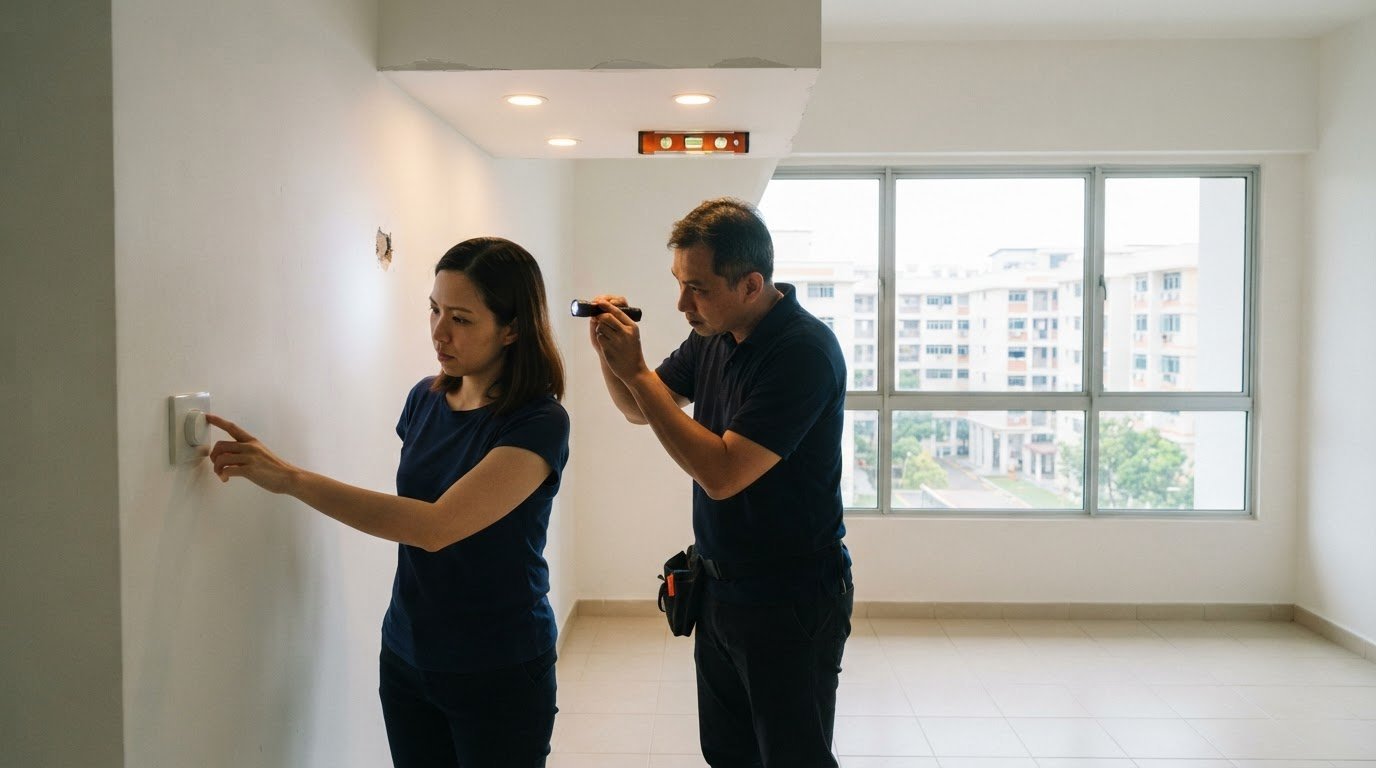
What if the hardest part of a post-renovation concern is not spotting it, but showing it clearly? Uneven finishes, incomplete work and possible defects can be difficult to distinguish, especially if there is disagreement about what was agreed. A post renovation defect inspection Singapore homeowners arrange can help create a clear record of observable conditions before they decide how to raise them.
Prime Defectors Singapore provides residential defect inspection and reporting in Singapore. The company does not carry out renovation or rectification work, so its role is to document findings rather than undertake repairs. This guide explains how to organise observations, understand what an inspection can establish and distinguish inspection from contractor discussions and CASE mediation. A clear, evidence-led record can help homeowners decide what to raise next.
Key Takeaways
- A post renovation defect inspection Singapore homeowners arrange can document observable conditions, but it does not decide who is contractually responsible or carry out repairs.
- Separate visible defects, incomplete work and finish preferences in your notes so each concern is clear to discuss.
- Use dated photographs, location labels and relevant renovation communications to build an organised record.
- Inspection, direct discussion with your contractor and CASE mediation serve different purposes. Knowing the difference can help you choose a suitable next step.
- Keep inspection findings distinct from repair or mediation outcomes, and use the evidence to guide a focused follow-up.
Post-Renovation Defect Inspection in Singapore: What Should You Record?
After renovation, a mark on a cabinet, an uneven tile line or a fitting that does not sit straight can raise an immediate question: is it defective, unfinished or simply different from the finish you expected? A post renovation defect inspection Singapore homeowners arrange creates a structured record of observable conditions. It can make concerns easier to discuss, but it does not repair the work, interpret every contract term or determine who is responsible.
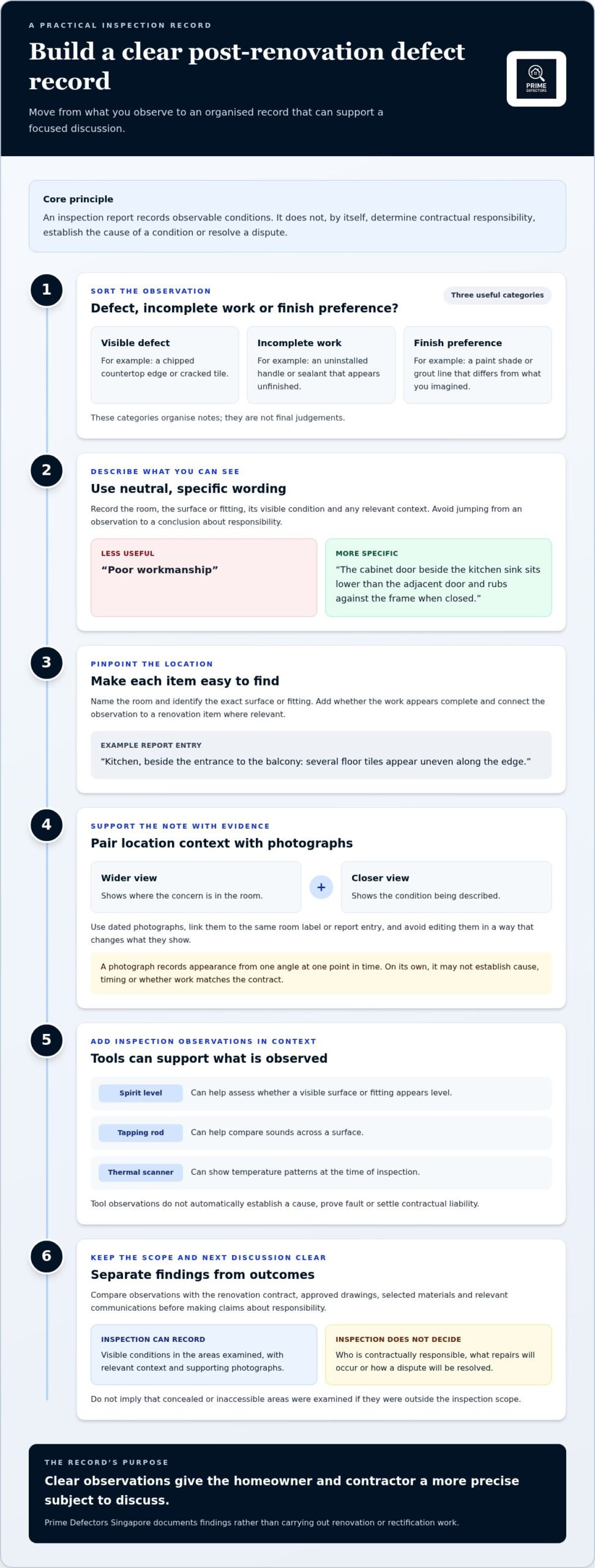
An inspection report records what can be observed; it is not a repair outcome, a decision on contractual responsibility or a mediation settlement. The report can describe a condition and its location. Whether it differs from the agreed scope depends on the renovation contract, selected materials, approved drawings and other relevant communications.
Defect, incomplete work, or finish preference?
Separate what you see from what you think it means. A visible defect might be a chipped countertop edge or a cracked tile. Incomplete work could be an uninstalled handle or a section of sealant that appears unfinished. A finish preference might be a paint shade or grout line that looks different from what you imagined but still matches the agreed selection. These categories help organise observations; they are not final judgements.
Use neutral, specific wording. Instead of writing “poor workmanship”, note “the cabinet door beside the kitchen sink sits lower than the adjacent door and rubs against the frame when closed”. Record the location, appearance and extent. Then compare the observation with the agreed scope and supporting documents before making claims about responsibility. Avoid calling something a breach or legal defect without evidence to support that conclusion.
What a Singapore home inspection can document
An inspection records visible conditions in the areas examined. General guidance on Understanding Building Inspections explains the broad purpose of inspections, though the scope of a particular visit depends on the property and inspection arrangement. A report should not suggest that concealed spaces were examined if they were inaccessible or outside the inspection scope.
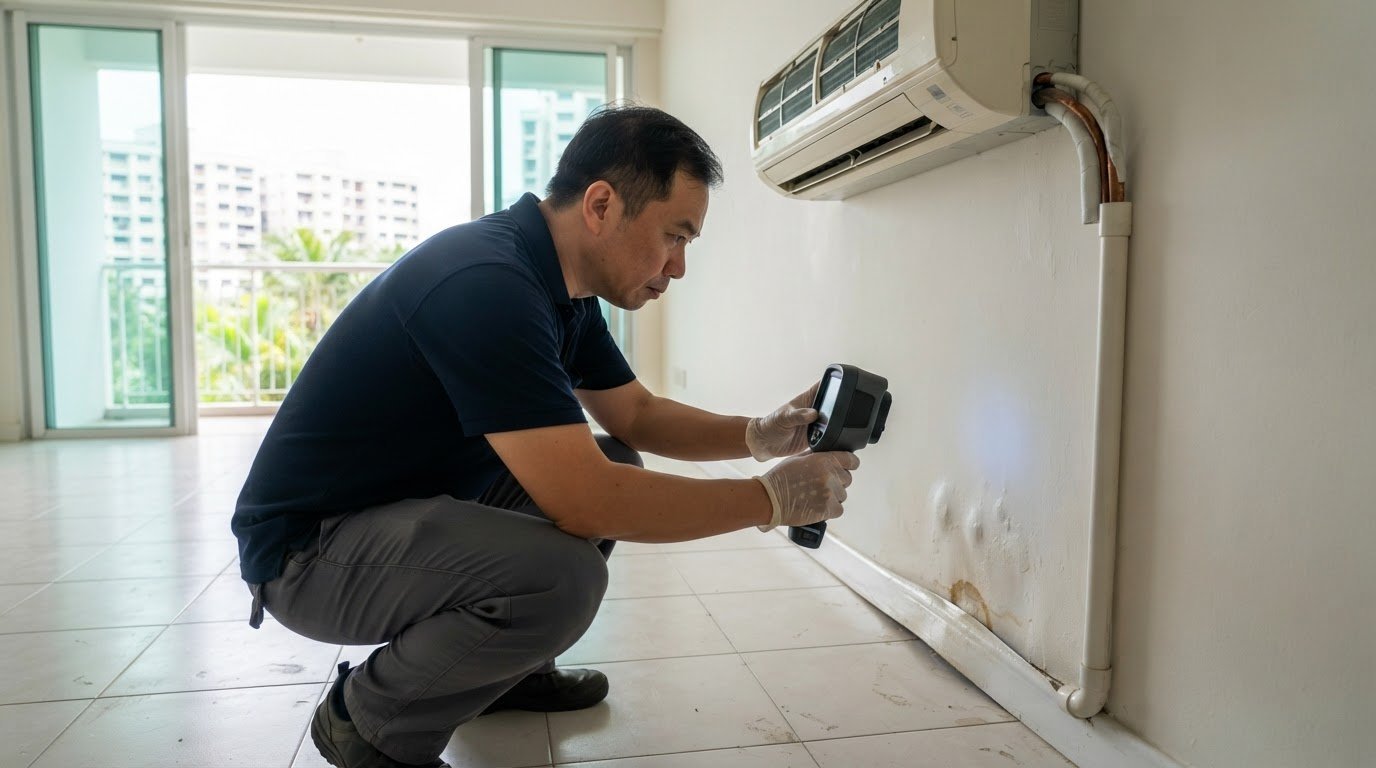
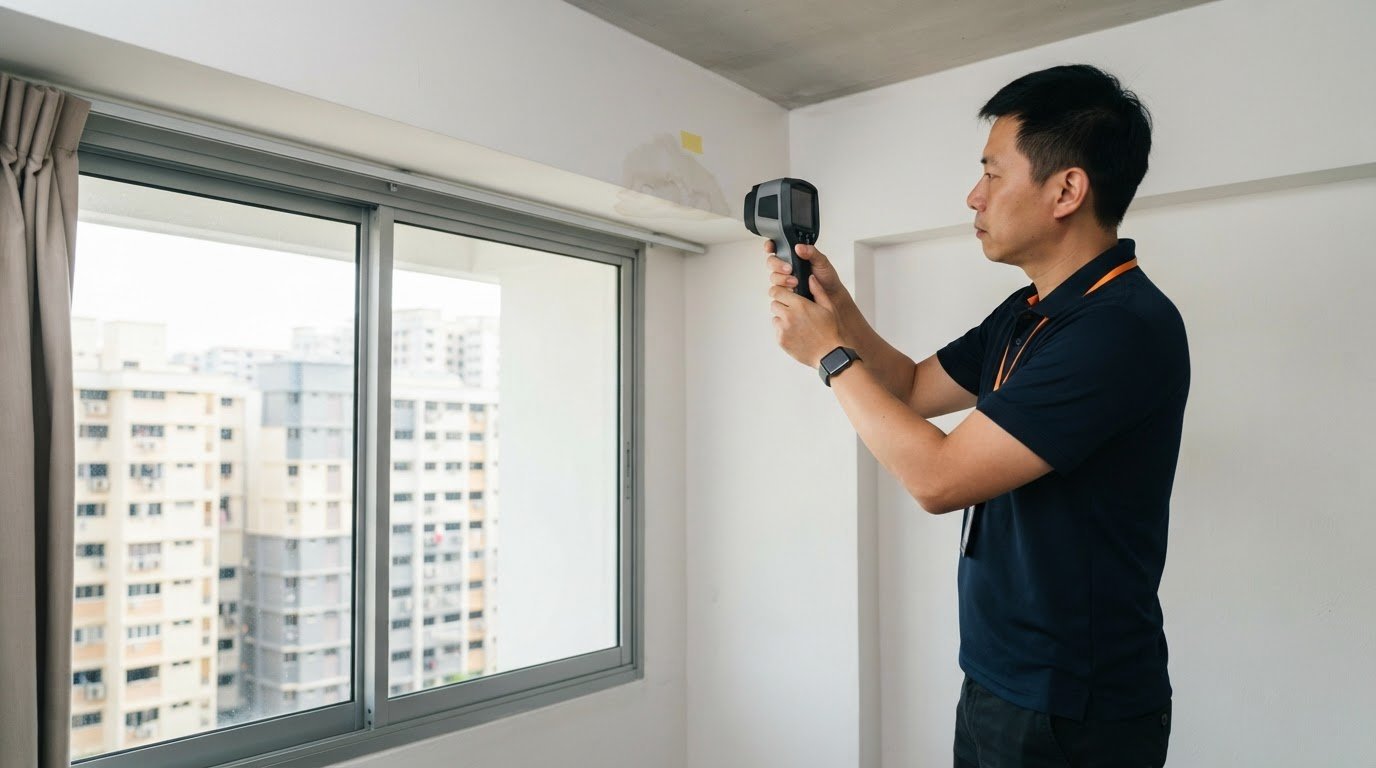
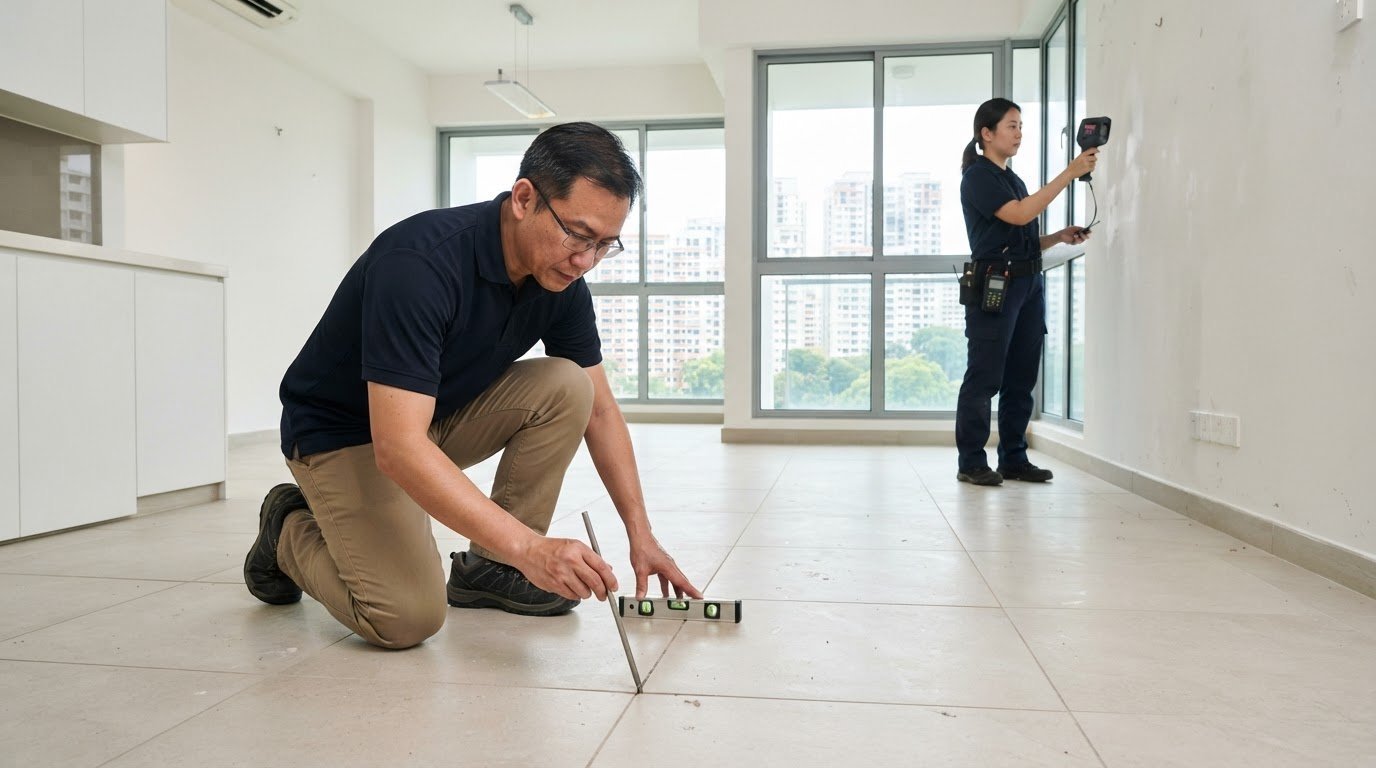
For an HDB or BTO flat, observations might cover visible tile alignment, paintwork, cabinetry or installed fittings. In a condominium or landed home, the relevant areas depend on the renovation scope and spaces inspected. Inspection tools such as tapping rods, spirit levels and thermal scanners can support observations: a tapping rod can help compare sounds across a surface, a spirit level can show whether a surface appears level, and a thermal scanner can show temperature patterns at the time of inspection. These observations should be reported in context, without implying that every hidden condition has been confirmed.
Keep each entry distinct and factual: identify the room, pinpoint the surface or fitting, describe what you can see and note whether the work appears complete. Photographs can support those notes by showing both the overall location and a closer view. This gives you a clearer record to compare with the agreed renovation scope.
How a Post-Renovation Inspection Builds Clearer Defect Evidence
A useful inspection record does more than list things that look wrong. It connects each observation to a precise location and gives enough context for the homeowner and contractor to discuss the same issue. A post renovation defect inspection Singapore homeowners arrange can make follow-up communication more specific without turning an observation into a verdict about who is at fault.
What makes an inspection finding useful?
Describe each item consistently: identify the room, pinpoint the surface or fitting, state what is observable and add relevant context. “Uneven kitchen tiles” is a starting point. “Kitchen, beside the entrance to the balcony: several floor tiles appear uneven along the edge; the area is shown in the attached photographs” gives the reader a clearer reference. If the observation relates to a particular renovation item, note the connection without assuming who is responsible.
Photographs can make written findings easier to understand. Take a wider view that shows where the issue is, then a closer image of the condition. Link the images to the same room label or report entry, and avoid editing them in a way that changes what they show. A photograph records appearance from one angle at one point in time. On its own, it may not establish the cause, when the condition arose or whether the work matches the contract.
An inspection report records observable conditions and supporting context; it does not, by itself, determine responsibility or resolve a dispute. That distinction helps keep later discussions grounded. A contractor may need to compare the finding with the agreed scope, drawings, material selections or renovation communications. The report identifies the subject of that discussion, but cannot replace those documents.
Inspection tools and the limits of visual findings
Tools can add useful observations to a report. A spirit level can help assess whether a visible surface or fitting appears level. A tapping rod can help identify differences in sound when surfaces are checked, while a thermal scanner can show temperature patterns at the time of inspection. Each observation needs to be described in context. Tool readings or responses do not automatically establish a defect’s cause, prove fault or settle contractual liability.
An inspection also has limits. It reflects the areas and conditions that could be examined during the visit. It should not imply that concealed spaces or inaccessible areas were checked, or that every hidden issue has been found. If access or visibility affects an observation, state that plainly. Clear limits make a report more dependable and useful.
CONQUAS is a construction quality assessment framework, while an individual home inspection records conditions observed at a particular property. They serve different purposes, so a CONQUAS reference should not be presented as a substitute for findings about renovation work in a specific home. Prime Defectors focuses on inspection and reporting, not renovation or rectification. For homeowners who want a structured record to support clearer discussions, independent defect inspection and reporting can be a practical starting point.
Inspection, Contractor Discussion, or CASE Mediation: Which Step Fits?
These routes address different parts of a renovation concern. An inspection documents conditions, a direct discussion gives you and the contractor a chance to address them, and CASE mediation may offer a facilitated way to discuss a consumer dispute if it falls within CASE’s current criteria. They are not interchangeable, and an inspection report does not guarantee agreement or a particular resolution.
Inspection
Purpose: Record observable conditions in the home.
Output: Findings that can help you describe concerns clearly.
Limit: It does not repair work, decide contractual responsibility or resolve a dispute.
Contractor discussion
Purpose: Raise concerns directly and discuss them against the agreed renovation scope.
Output: The parties’ responses and any next steps they agree on.
Limit: A discussion alone does not ensure agreement or that work will be rectified.
CASE mediation
Purpose: Provide a facilitated avenue for parties to explore a settlement, subject to CASE’s eligibility criteria and process.
Output: A possible agreement if both parties reach one.
Limit: Mediation does not guarantee acceptance, settlement or a particular outcome.
What inspection can contribute before a disagreement escalates
A post renovation defect inspection Singapore homeowners arrange can give a discussion a more precise starting point. Instead of raising a broad concern such as “the carpentry is bad”, you can refer to a report entry identifying a particular cabinet, its location and the observed condition. This helps keep the conversation focused on identifiable work and allows both sides to compare the concern with relevant contract details or renovation communications.
Prime Defectors inspects and reports; it does not provide renovation or rectification services, represent either party or decide a dispute. Its role is to document findings, not provide legal advice or make a formal determination of responsibility. The contract and related records remain important when considering what was agreed and how an observation relates to that scope.
When CASE mediation may enter the picture
If direct communication does not resolve the matter, CASE mediation may be worth exploring as a separate route. Mediation is voluntary and aims to help parties seek a settlement. It is not an inspection, and any outcome depends on the parties’ participation and agreement. A settlement is not binding unless the parties sign a settlement agreement.
Before approaching CASE, organise the renovation contract, scope of work, relevant messages, photographs, inspection findings and a concise account of what remains unresolved. Review CASE’s official guidance for current eligibility and process. Do not assume every renovation dispute will be accepted, and do not treat an inspection report as proof that mediation will succeed. Each step has a distinct role: documentation clarifies the concern, contractor communication raises it directly, and mediation may help the parties discuss a possible resolution.
How to Prepare a Post-Renovation Defect Record in Singapore
A calm, organised record makes it easier to raise renovation concerns without relying on memory or broad claims. Use these steps to move from your first observation to a focused follow-up. For a Singapore property handover after renovation, centre the record on the work completed in your home and the documents that describe what was agreed.
- Note the date and flag urgent concerns. Write down when you first noticed each issue and whether it has changed. Separate anything that appears to pose an immediate safety concern from cosmetic observations. If you reasonably believe an area or item may be unsafe, keep people away from it and seek appropriate qualified assistance promptly. Do not try to diagnose the cause in your notes.
- Give every observation a location label. Use one entry per issue, with the room and a precise reference such as “main bedroom, wardrobe door nearest the window”. Describe what you can see in neutral language, then note its extent. Separate observations in the same room so each can be discussed and tracked on its own.
- Take photographs with context. Capture a wider view to show where the concern is, followed by a closer image of the visible condition. Keep original files and label them with the matching room or issue reference. A photograph can support your description, but do not present it as proof of cause or responsibility.
- Gather relevant renovation records. Keep dated notes, photographs, the agreed work description, material selections and relevant messages together. Record what was communicated and when, using the original wording where helpful. Preserve the documents so you and the contractor can compare the concern with the agreed scope.
- Share a focused list and track follow-up. Group issues by room or work type, then send a concise, numbered list that points to the matching photographs and relevant records. Note when you raised each item and record any response or agreed next step. Update the entry after a follow-up visit, keeping the original observation intact rather than replacing it.
Use an inspection report in communication
A post renovation defect inspection Singapore homeowners arrange can turn a scattered set of concerns into a structured reference for discussion. Share the relevant entries, not a long list of assumptions. An inspection report records observations; it does not perform rectification, decide contractual responsibility or guarantee that the parties will agree. The companion article BTO Defect Report Template: A Professional Singapore Guide for 2026 covers how findings can be organised for a property report.
Prime Defectors provides inspection and reporting, not renovation or rectification work. If you want an organised inspection record to support clearer communication about renovation concerns, discuss an inspection with Prime Defectors.
How Prime Defectors Supports Objective Defect Inspection in Singapore
After renovation, homeowners need a clear way to understand what has been observed before deciding how to raise a concern. Prime Defectors provides inspection and reporting for residential properties in Singapore. Its role is to document conditions, not take on renovation work or decide the outcome of a disagreement. Homeowners can use the findings as a reference for communication while keeping responsibility and next steps separate.
Inspection and reporting without rectification work
Prime Defectors does not provide renovation, interior design or defect rectification services. The company’s role is limited to inspection and reporting, so its findings can focus on observable conditions rather than repair work it would carry out. This separation does not guarantee that a contractor will accept the findings or that the parties will agree.
A report can describe an item’s location and visible condition, helping a homeowner explain a concern more precisely. It does not establish who caused the condition, determine contractual responsibility, settle a dispute or provide mediation. Those questions may depend on the renovation agreement, related records and discussions between the parties.
In a contractor discussion, the report can serve as a factual reference alongside the agreed scope and relevant communications. A Prime Defectors home check documents and reports findings; it does not represent either side in a disagreement. For homeowners searching for Professional defect checkers Singapore, the practical value is a clear inspection record, not a promised dispute outcome.
Choose the relevant inspection context
The property type and timing shape the inspection context. For a new BTO flat, a BTO defect inspection Singapore or BTO Defect Check Singapore relates to documenting conditions in the flat. For a condominium, Condo defect Inspection Singapore may suit the property’s inspection needs, while a landed home may call for a Landed Defect Check Singapore. In each case, the inspection should focus on the specific home and areas examined.
For broader context, Singapore Home Inspection Standards: The 2026 Comprehensive Reference Guide discusses general inspection considerations. An individual report remains centred on observations at the particular property. Prime Defectors keeps its role clear: inspection findings can inform communication, but they do not settle disagreements or replace the parties’ review of their agreement.
If you are considering an inspection to organise observable findings after renovation, contact Prime Defectors today.
Take the Next Step with a Clear Record
Inspection findings can help you move from uncertainty to a more informed conversation. Use them alongside the renovation scope and relevant communications to decide what to raise and what response you are seeking. If the contractor’s reply leaves questions, keep the discussion focused on specific recorded observations and the agreed work. An evidence-led approach helps you stay clear about the issue without treating an inspection as a decision on responsibility.
For homeowners considering a post renovation defect inspection Singapore, Prime Defectors Singapore provides residential inspection and reporting, including joint inspections and follow-up inspections. The company does not undertake defect rectification or interior design, keeping its inspection role separate from the work and discussions that may follow.
Take the next step with an organised record and a clear understanding of what you want assessed. Don’t let hidden issues go undocumented. Contact Prime Defectors today to arrange a home inspection in Singapore.
Frequently Asked Questions
Can a post-renovation inspection prove that a contractor caused a defect?
No. An inspection alone cannot prove who caused a defect. It can record what was observable during the visit and provide supporting evidence, but a technical observation is different from a formal decision about cause, responsibility or contractual liability. Keep the report with the renovation scope, dated photographs and relevant messages. These records can help clarify what was agreed and when the concern was raised.
Should I arrange an inspection before contacting my renovation contractor?
There is no single required sequence. You can first note visible concerns and raise them directly, or arrange a post renovation defect inspection Singapore homeowners can use to organise observations before writing to the contractor. If you contact the contractor first, retain the reply and note its date. An inspection and a direct discussion serve different purposes, and a report does not ensure the contractor will agree with your assessment.
Can a home inspection identify defects hidden behind finished surfaces?
Not necessarily. An inspection is limited by what can be accessed and observed, so finished surfaces may conceal conditions that a routine visit cannot confirm. A thermal scanner can show temperature patterns, but that observation alone does not establish what is behind a surface or why a pattern appears. Record what prompted the concern and the limits of what can be observed.
Does an inspection report mean the contractor must carry out repairs?
No. A report is not an instruction to repair, a ruling on responsibility or a guarantee that rectification will take place. It records findings that you can raise with the contractor and compare with the agreed work description. Whether repair work is required depends on the relevant agreement and circumstances. Keep the report, contract, variations and written responses together so the discussion can refer to the same records.
Is CASE mediation available for every renovation dispute in Singapore?
No. CASE’s eligibility criteria and procedures apply, so review its official information before pursuing mediation. The process is separate from a property inspection: an inspector documents observations, while mediation gives parties a possible route to discuss a dispute. An inspection report may help explain your concerns, but it does not ensure CASE will accept a matter or that you and the contractor will reach an agreement.
Can Prime Defectors carry out the renovation repairs identified in an inspection?
No. Prime Defectors provides residential inspection and reporting, not defect rectification, renovation or interior design. Its findings can help you communicate specific concerns, such as which room or fitting is involved, but the report does not assign repair work or compel another party to act. Keep the inspection record separate from any repair arrangement, and document any response or proposed next step in writing.
Are tapping rods, spirit levels, and thermal scanners proof that a defect exists?
No. These tools can support observations, but a sound, level reading or temperature pattern needs to be considered in context. Tool use alone does not establish a defect’s cause, identify who is responsible or show whether work departs from the agreed scope. A report should describe what was checked and observed. Tools also cannot guarantee that every concealed or inaccessible condition will be detected during an inspection.

Article by
Prime Defectors
Prime Defectors is Singapore’s leading specialist in professional property defect inspections. Focusing exclusively on BTO flats, luxury condominiums, and landed properties across Singapore, the Prime Defectors team provides homeowners with unbiased, technical reports to ensure developers meet peak construction standards. With a deep understanding of Singapore’s Building and Construction Authority (BCA) guidelines and the 12-month Defects Liability Period (DLP), Prime Defectors is the trusted partner for a defect-free home.