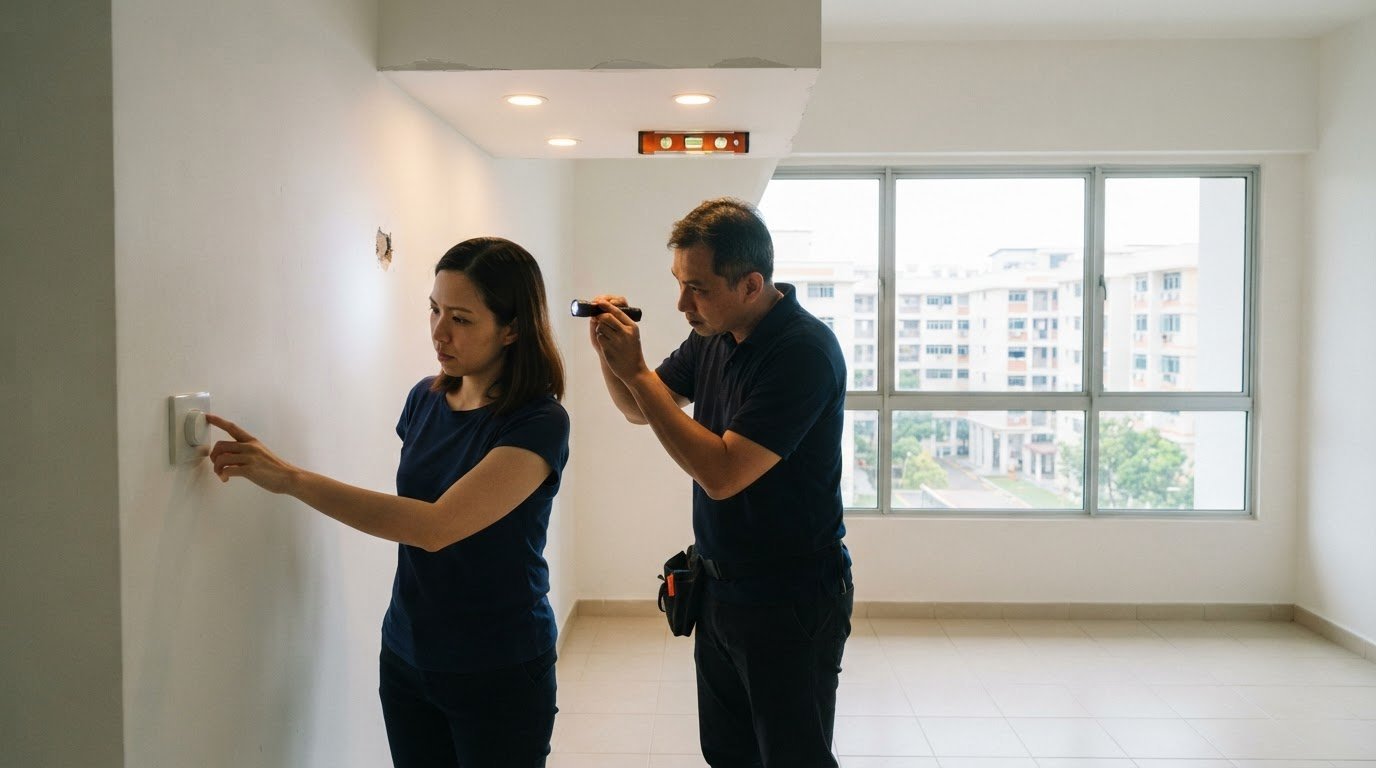
A door that rubs or a window that feels stiff can raise an immediate question: is the frame out of alignment, or is something else affecting how it moves? During a Singapore property handover, these signs deserve a closer look, but they don’t prove a defect on their own. A careful door and window frame alignment check focuses on observable details: uneven gaps, rubbing points, and whether the opening, lock and seal function as expected.
It’s understandable to worry when a door won’t close or a window doesn’t latch smoothly. Prime Defectors Singapore helps homeowners record these concerns clearly without making unsupported diagnoses. This guide explains what to inspect, how to describe warning signs, and how to document them for handover or follow-up.
For HDB, BTO and condominium homes, Prime Defectors provides property inspection and reporting, not renovation services or defect rectification. Findings are presented in a photo-rich, high-resolution report with precise location markings, giving you a clear record for the relevant developer process. You’ll know what to note and when a professional inspection can help bring greater clarity.
Key Takeaways
- A door and window frame alignment check records how the frame, panel, gaps and hardware relate without assuming a cause.
- Sticking, uneven clearances or a difficult lock are observable signs to document, not proof of a specific defect.
- Make findings easier to communicate by identifying the opening, describing the repeated symptom, and recording its location and operation.
- Clear photographs and precise descriptions can support defect reporting during a Singapore property handover.
- A professional inspection can create a detailed record while keeping inspection separate from repair or renovation work.
What a Door and Window Frame Alignment Check Reveals in Singapore Homes
Alignment describes the visible relationship between a frame, its moving panel, the gaps around it and the hardware used to operate it. You can make useful observations without dismantling a door or window. Note whether the panel moves freely, whether the gaps appear consistent, and whether the hinges, tracks and lockset work as expected.
A door and window frame alignment check records visible position and operation. It is not, by itself, a diagnosis of structural movement or a decision about what needs adjustment. The same symptom can have more than one possible explanation. Start with what happens, where it happens and whether you can reproduce it, rather than assuming the frame has shifted or a particular component is faulty.
For background on the parts being observed, see Door frame components and architectural context. The frame and moving panel work together, but difficulty operating a door does not identify which part, if any, is responsible.
What counts as a door or window alignment warning sign?
Look for sticking or rubbing during movement, uneven visible gaps, or a panel that is difficult to open or close. Check whether the door or window meets the frame consistently when shut, and note if the lockset is hard to engage or does not operate smoothly. These are useful observations, not proof that the frame has moved. Record the location and behaviour without assigning a cause.
- Note where a panel rubs, such as near a corner or along one edge.
- Describe which visible gap looks uneven and where it changes.
- Record whether opening, closing or locking is affected.
Why check alignment during Singapore property handover?
A clear record made around handover gives you a reference for an opening’s visible condition and operation. For example, during a BTO defect inspection Singapore homeowners may record a bedroom door that catches near the frame, while a condominium owner around TOP may note a window that does not close smoothly. Similar observations can matter in resale and landed homes.
HDB, BTO, TOP and DLP are part of Singapore’s property context, but they don’t change the purpose of the check: describe what you can see and reproduce without making a diagnosis. Identify the room and opening precisely, then state what happens when you operate it. Prime Defectors Singapore provides inspection and documentation, not renovation services. Findings are presented in a photo-rich, high-resolution report with precise location markings, helping owners communicate observations without suggesting a cause the inspection has not established.
How Frames, Panels, Gaps, and Hardware Affect Alignment
A door or window works as a set of connected parts. The frame forms the fixed surround, while the panel moves within it. Hinges support a hinged panel; tracks guide a sliding one. Visible clearances show the space between panel and frame, and the lock or latch should meet its corresponding point when the panel is closed. Observing these parts together is more useful than judging one component in isolation.
For example, a door that catches at one corner may also show a change in the gap along that edge. You may notice a stiff lock at the same time, but that alone doesn’t establish that the frame is out of position. Different issues can produce similar behaviour, so describe what you see and feel rather than naming a cause.
Which parts should homeowners observe during a frame check?
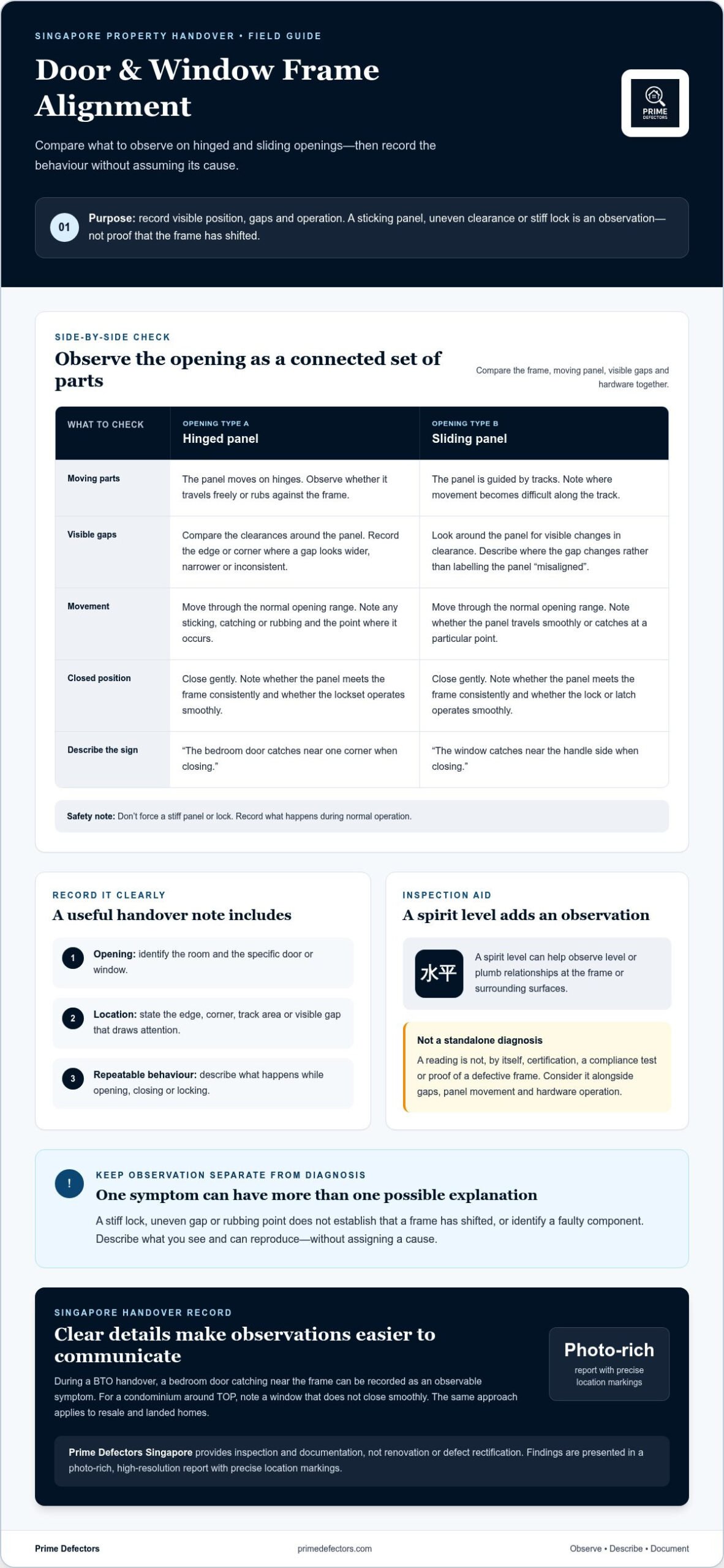
Compare the visible gaps around the panel, noting where they appear wider, narrower or inconsistent. Move the door or window through its normal opening range and observe whether it travels smoothly, rubs or catches at a particular point. Then close it gently and note whether it meets the frame consistently and whether the lockset operates. Don’t force a stiff panel or lock.
Keep the description specific. “The bedroom window catches near the handle side when closing” is more useful than “the window is misaligned”. For sliding panels, note where movement becomes difficult along the track; for hinged doors, identify the edge or area where rubbing occurs. These details capture repeatable behaviour without assuming that a hinge, track or frame is the cause.
What inspection tools can support an objective assessment?
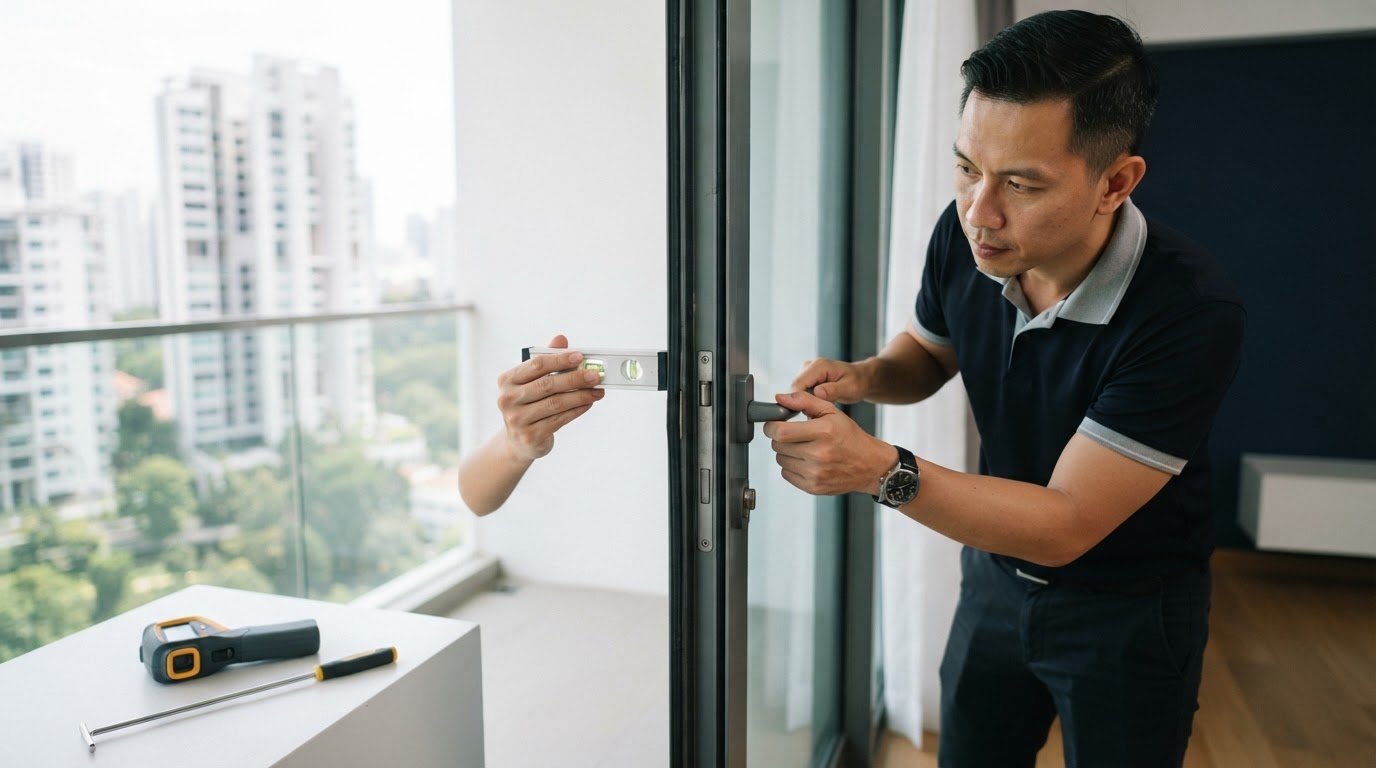
A spirit level can help an inspector observe level or plumb relationships at the frame or surrounding surfaces. It is an observation aid, not a standalone certification, compliance test or proof that a frame is defective. Any reading should be considered alongside the panel’s movement, visible clearances and hardware operation.
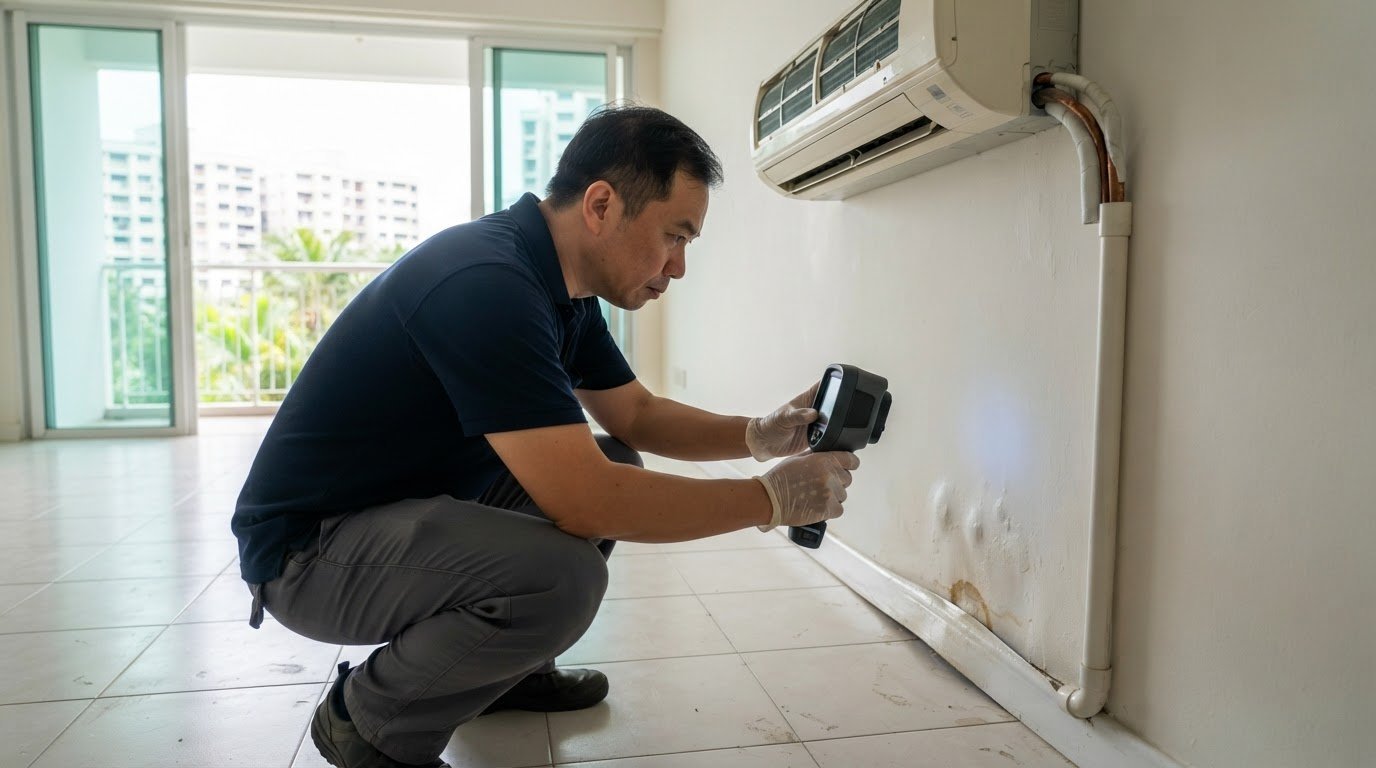
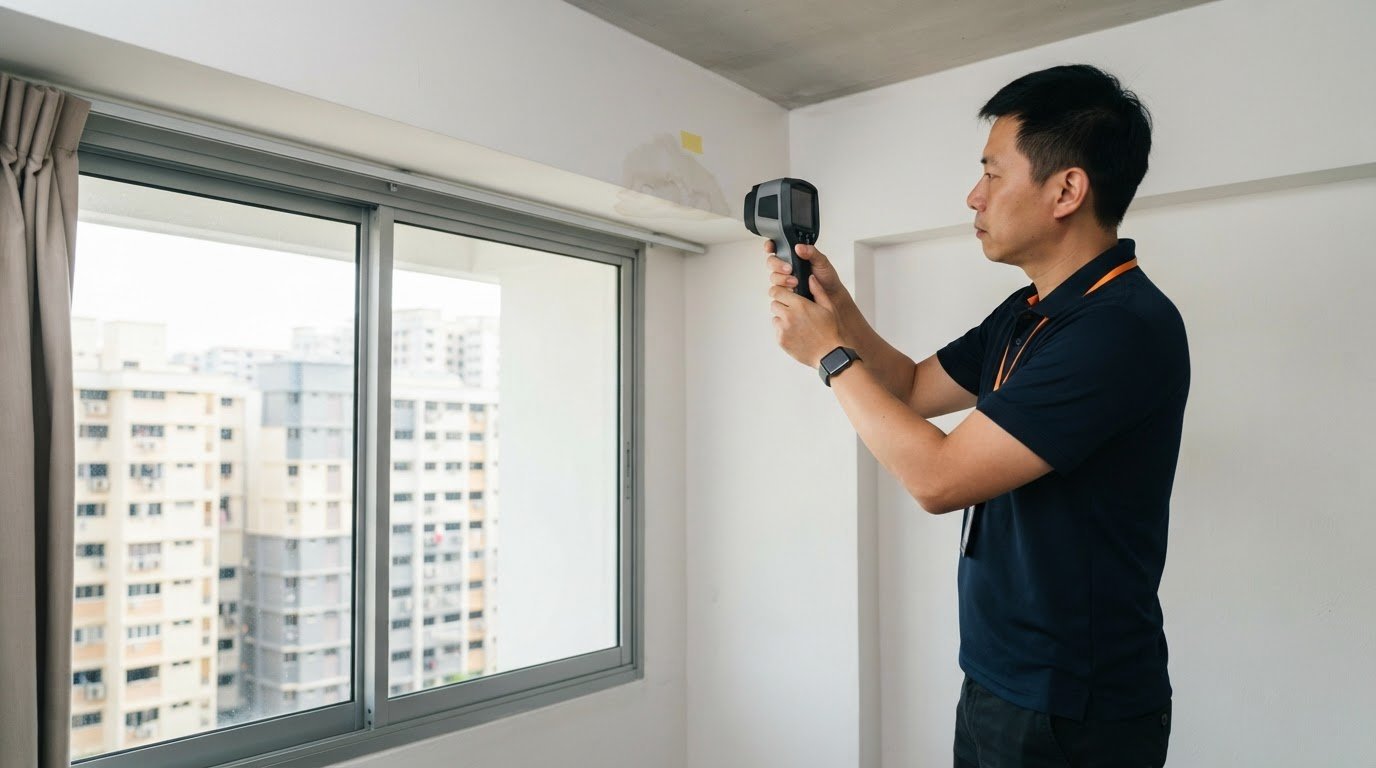
Professional-grade inspection tools can also support measurement, detection and documentation during a wider property assessment. No single reading or scan should be treated as a diagnosis of frame alignment. Tools add observations, which need to be considered alongside how the opening operates.
Visible gaps and operating behaviour are evidence to record, not a diagnosis. In a door and window frame alignment check, the value comes from bringing these observations together: where the gap changes, how the panel moves, and whether the hardware functions. Avoid concluding that settlement or an installation error has occurred based on a single sign.
For an inspection that keeps observations separate from repair assumptions, find out about a professional door and window inspection.
How to Separate a Visible Alignment Issue from a Repair Assumption
A door that needs extra effort to close can be frustrating, but it doesn’t automatically indicate a serious structural defect. Separate what you observe from what you suspect. A rubbing point is observable; a claim that the frame has shifted is an explanation that sight alone may not establish. Keeping those two things distinct makes your notes clearer and more reliable.
| Observed sign | What you can record | What you cannot conclude from sight alone |
|---|---|---|
| Door catches while closing | Which edge catches, where, and whether it happens during each normal attempt | That a hinge is faulty or the frame was installed incorrectly |
| Uneven visible gap | Which side or section looks different, with a clear location description | That the building has moved or the frame is out of tolerance |
| Lockset is difficult to operate | Whether the latch engages and what happens as the door meets the frame | That the frame alone caused the lock problem |
| Visible silicone defect or water mark nearby | The visible condition and its location in relation to the opening | Where water entered or whether alignment caused it |
What can a homeowner check without altering the frame?
Use normal operation only. Open and close the door or window as you usually would, then note any catching, rubbing or resistance. Observe the visible gaps, whether the panel meets the frame, and whether the lockset works. If silicone looks split, incomplete or detached, record its location. Don’t adjust hinges or locks, force the panel, or remove seals before documenting the existing condition.
Repeatability adds useful context. If a door catches at the same point on several gentle attempts, record that pattern. If it happens only once, note that too. Avoid adding a cause such as “loose hinge” unless it has been established through an appropriate assessment. The aim is a factual account, not a repair plan.
When does a symptom need professional documentation?
Consider a professional defect check if the issue persists or interferes with normal opening, closing or locking. Professional defect checkers Singapore homeowners engage can inspect and document visible conditions and operation, but documentation doesn’t promise a particular repair outcome. Prime Defectors inspects and reports; it does not provide renovation or defect rectification services. This keeps the service focused on inspection findings rather than repair work.
For a Singapore home, a clear record can help you communicate a concern during handover or follow-up. Prime Defectors’ report is photo-rich, high-resolution, with precise location markings. To arrange an inspection, get in touch with Prime Defectors about a defect check.
How to Record Door and Window Alignment Findings for a Singapore Handover
A useful handover record lets someone else identify the exact opening and understand what happened during normal operation. Keep it factual: name the room, describe the visible condition, and note whether the symptom occurs while opening, closing or using the lockset. This is more useful than a general entry such as “door problem”.
What details make an alignment observation useful?
For each opening, record the room, whether it’s a door or window, the side or corner involved, and the behaviour you noticed. Take a clear photograph of the visible gap or contact point, then describe whether the issue occurs during opening, closing or locking. If it happens repeatedly under normal use, note that pattern without guessing at its cause.
Use this sequence to make the entry easier to follow:
- Identify the opening: Name the room and the door or window, such as “common bedroom window”.
- Reproduce the symptom: Operate it normally and note where it catches, rubs or becomes difficult to move.
- Photograph the area: Capture the relevant edge, gap, contact point or lockset clearly.
- Describe the location: Specify the side, corner or section, rather than writing “near the frame”.
- Log the operation: State whether the issue occurs while opening, closing or operating the lock.
For example, “Study, sliding window: panel catches near the handle side during closing” is specific and avoids claiming why it happens. A second photograph showing the full opening can help orient the close-up, particularly when your record covers several windows or doors.
How does Singapore defect reporting fit the handover process?
For an HDB or BTO flat, a condominium around TOP, or a landed home, the same clear description helps distinguish one opening from another. Handover and DLP are relevant local property contexts, but recording a symptom doesn’t establish responsibility or guarantee a particular outcome. Focus on making the condition easy to locate and understand, whether you are recording a concern for the developer or keeping a copy for your own records.
Prime Defectors can lodge defects through Novade, FinalCAD, Funnel, or the developer’s own system. Its report is photo-rich, high-resolution, with precise location markings. For example, a BTO defect inspection Singapore record can identify a bedroom door and the point where it catches; a condo or landed property entry can specify the window and side where movement is affected. This detail helps keep a submission clear and traceable.
A door and window frame alignment check is most useful when the recorded observation stays specific and avoids unsupported diagnoses. Prime Defectors provides inspection and documentation, not renovation services. Arrange a professional defect inspection to have door and window findings recorded clearly for your handover.
How Prime Defectors Singapore Documents Door and Window Alignment
Prime Defectors Singapore provides defect inspections for homeowners in Singapore. A home check can include door and window alignment, lockset functionality and silicone defects. The inspection records observable conditions and how each opening operates, giving homeowners useful documentation without presenting a symptom as a confirmed cause.
What does a Prime Defectors home check include?
Professional-grade tools support measurement, detection and documentation as part of the wider property assessment. Findings are recorded in a report that is photo-rich, high-resolution, with precise location markings. This helps readers identify which opening is being discussed and where the observation was made.
The service is relevant across different Singapore homes, whether arranging a BTO Defect Check Singapore, a Condo defect Inspection Singapore or a Landed Defect Check Singapore. Prime Defectors does not provide renovation or defect rectification services. Its work is focused on inspecting and documenting the property, rather than carrying out repairs.
What happens after the inspection is documented?
Most inspections are scheduled within 1-3 days, and the inspection duration is typically 2-4 hours. Inspections are available 7 days a week, with operating hours Monday-Sunday 09:00 – 20:30. Reports are delivered digitally within 48 hours of the site visit, with total turnaround from booking to report typically 48-72 hours.
Findings can support clear communication and defect submission through Novade, FinalCAD, Funnel, or the developer’s own system. Documentation explains what was observed, but it cannot guarantee that a developer will rectify a finding. Prime Defectors inspects and reports, while repair decisions remain separate from the inspection.
For Singapore homeowners, a clear inspection record can make handover concerns easier to communicate. Arrange a home inspection and take a more informed next step.
Don’t let hidden issues become expensive repairs. Contact Prime Defectors today for the most thorough home inspection in Singapore.
Take the Next Step with Confidence
Your next step doesn’t need to be a diagnosis. A well-documented door and window frame alignment check gives you a clear basis for raising an observation and deciding what follow-up is appropriate. Keep your notes factual, retain the supporting records, and avoid altering the opening before its condition has been documented.
For Singapore homeowners, clarity at handover can make it easier to communicate concerns and track what has been raised. An inspection offers a measured way to turn uncertainty into an organised record, without presuming the cause or outcome.
Prime Defectors can support you with property inspection and defect documentation. Take the next step towards a clearer understanding of your home’s condition.
Don’t let hidden issues become expensive repairs. Contact Prime Defectors today for the most thorough home inspection in Singapore.
Frequently Asked Questions
How can I tell if a door frame is out of alignment?
Look for changes in how the door sits or moves, such as a panel that rubs, catches, or leaves visibly uneven clearances when closed. During a door and window frame alignment check, compare what you observe at the top, sides and bottom, then see whether the behaviour repeats during normal use. These signs are worth recording, but they don’t identify a cause by themselves.
Can a misaligned window affect how securely it closes?
It can affect whether the window panel meets its frame or whether the lock engages as expected. Check the closing and locking action gently, and note if the panel appears not to seat consistently. That observation doesn’t establish that the window is insecure or explain why it behaves that way. Don’t force the handle or lock; record what happens during normal operation.
Does a sticking door always mean the frame is misaligned?
No. A sticking door is a symptom, not proof that its frame is misaligned. The hinges, latch or other parts may also be relevant, and sight alone may not distinguish between possible explanations. Note where the door catches and whether it happens during opening, closing or both. Avoid adjusting hardware before documenting the behaviour so the original condition remains clear.
What should I photograph when documenting a door or window alignment issue?
Take one image that identifies the opening in its room, then a closer view of the area where the panel rubs, catches or appears to leave an uneven gap. Include the lock or latch if its operation is part of the concern. Keep the location clear in your notes, and pair each image with a short description of what happens during normal use.
Can a spirit level confirm that a door frame is defective?
No. A spirit level can help observe a frame’s level or plumb relationship, but one reading cannot, on its own, confirm that the frame is defective. The result needs context, including how the door moves, how it meets the frame and whether the hardware works. Record the observation without applying an unsupported tolerance or treating the tool as a compliance certification.
Can Prime Defectors submit door and window defects to a developer?
Yes. Prime Defectors can lodge defects through Novade, FinalCAD, Funnel, or the developer’s own system. This supports clear communication of door or window findings in the developer’s submission process. Lodging a defect documents the concern; it doesn’t determine the cause or guarantee that the developer will carry out rectification. Keep your own notes of the opening and the behaviour observed.

Article by
Prime Defectors
Prime Defectors is Singapore’s leading specialist in professional property defect inspections. Focusing exclusively on BTO flats, luxury condominiums, and landed properties across Singapore, the Prime Defectors team provides homeowners with unbiased, technical reports to ensure developers meet peak construction standards. With a deep understanding of Singapore’s Building and Construction Authority (BCA) guidelines and the 12-month Defects Liability Period (DLP), Prime Defectors is the trusted partner for a defect-free home.