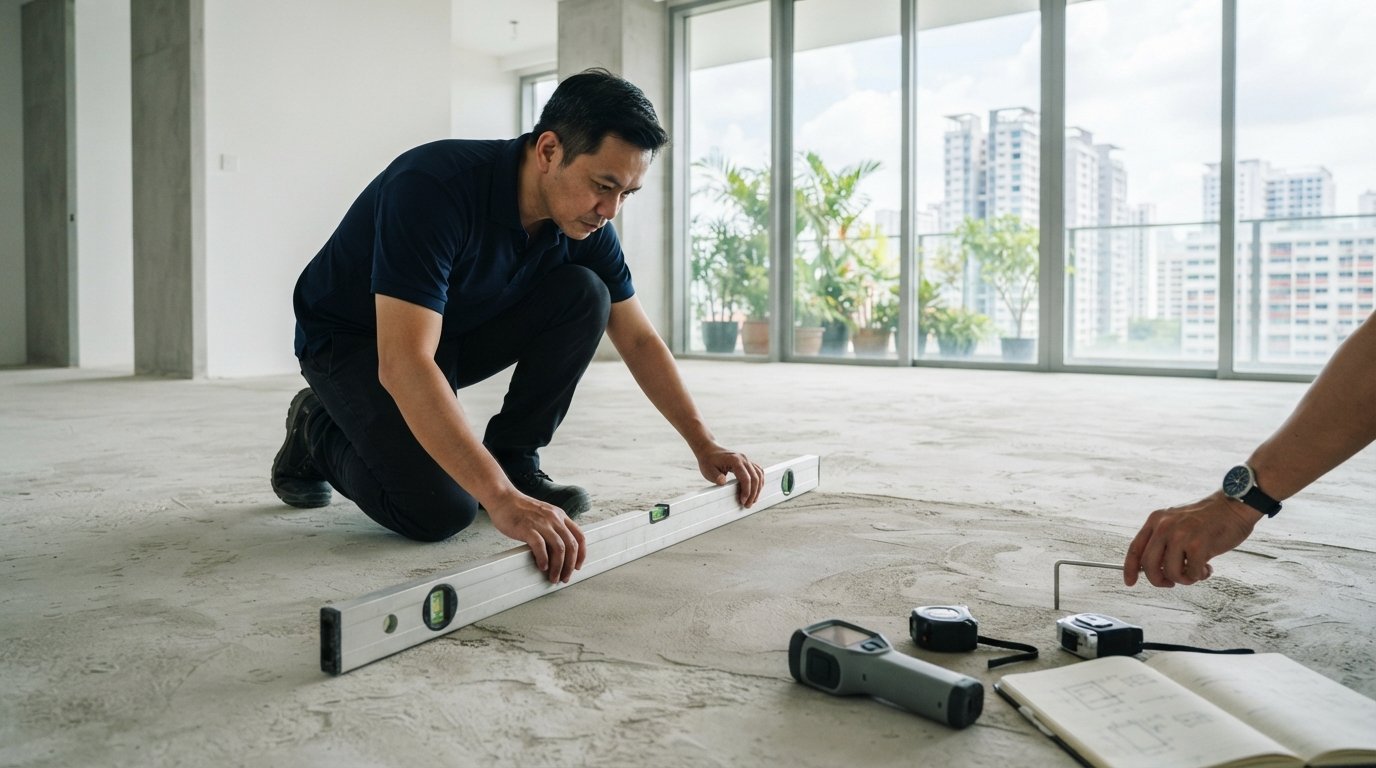
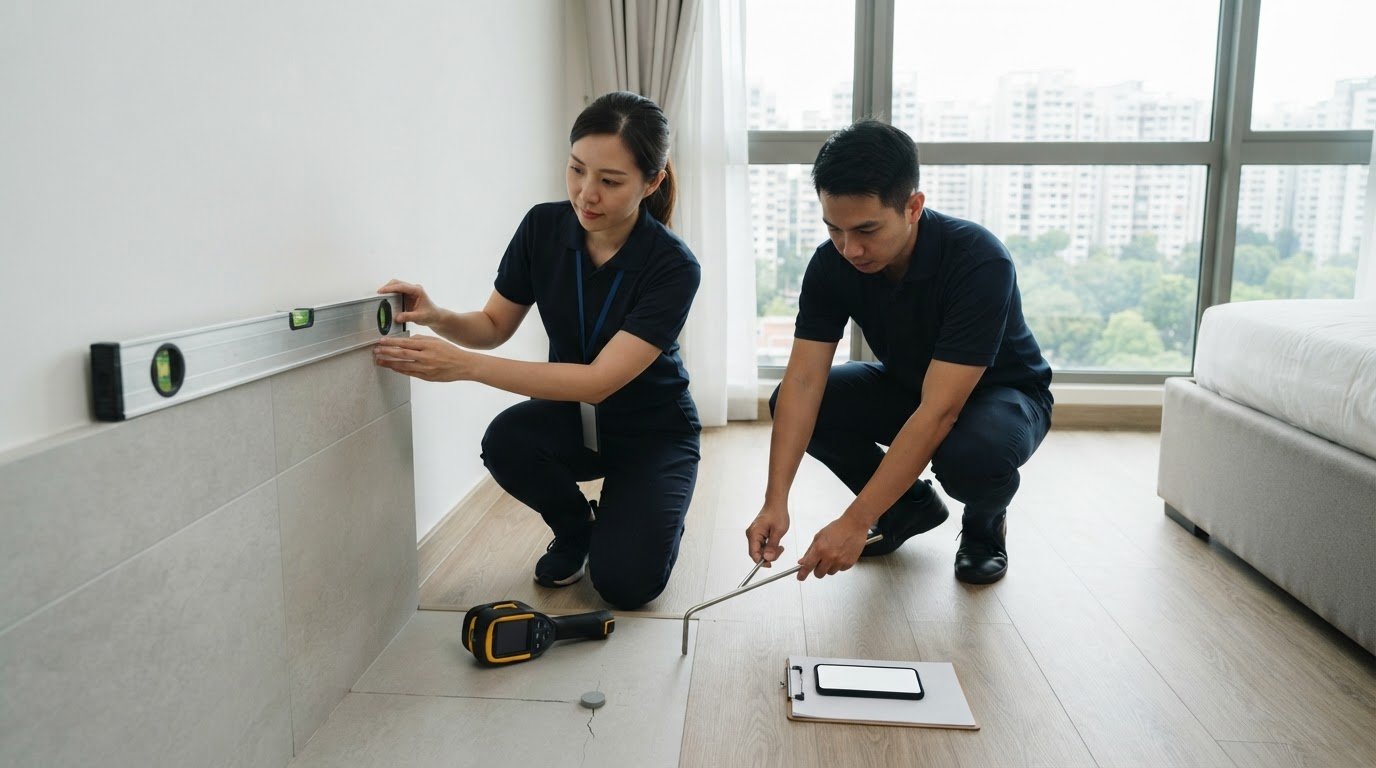
A note that says “cracked tile in the bedroom” may not be enough for someone else to find the exact spot or understand what needs checking. Clear defect tagging in Singapore starts with three things: a precise location, an observable description and useful evidence.
Vague notes or missing photos can make follow-up harder during a Singapore property handover. This guide explains how to record visible issues consistently, label each one by room and location, and describe what you can see without guessing at the cause. It also covers when independent inspection support may be useful.
Prime Defectors provides residential defect inspection and reporting in Singapore for BTO flats, condominiums, landed properties and resale homes. Its services include defect checks, joint inspections with developers and follow-up inspections. The company focuses on identifying and documenting property issues, not renovation or defect rectification.
Key Takeaways
- Use defect tagging Singapore practices to give each issue a clear identifier, exact location and evidence record.
- Follow a consistent workflow: inspect, locate, describe, photograph, label and review each visible issue.
- Keep tag IDs consistent across your notes, photographs and report so each observation is easy to match.
- Record what you can see without assuming the cause, using specific, neutral descriptions instead of vague notes.
- Before sharing your handover record, check every tag against its photo and location. Consider independent inspection support for numerous observations or issues that are difficult to assess.
What Is Defect Tagging in Singapore Property Inspections?
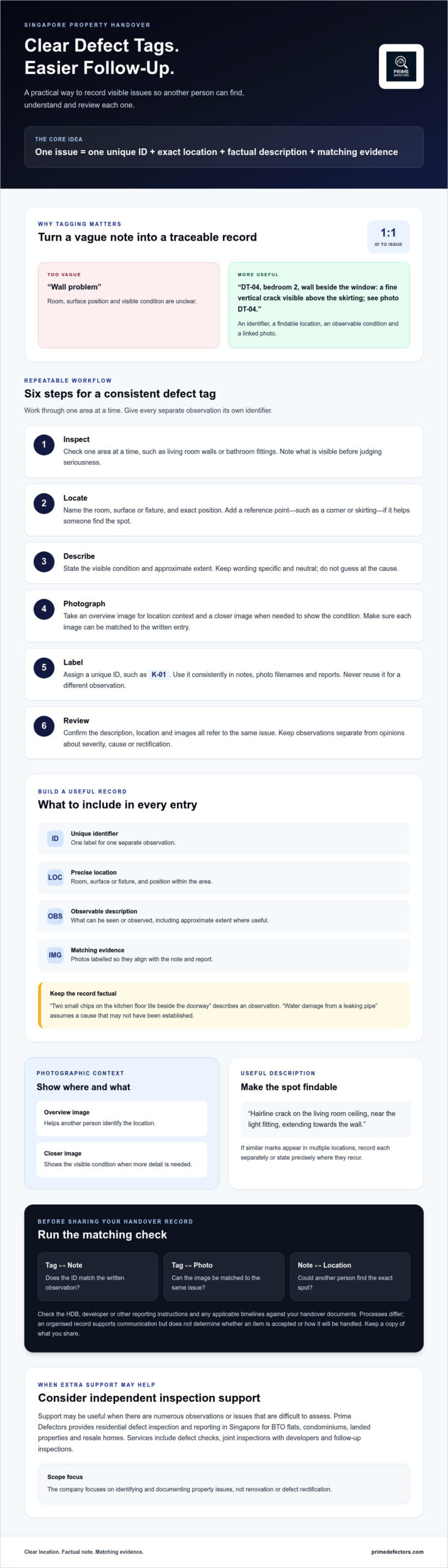
A defect tag turns an observed issue into a record that another person can locate and understand. A defect tag is a unique label linked to an issue’s exact location, observable condition and supporting evidence. This simple structure helps keep notes, photographs and inspection reports aligned during a Singapore property handover.
For example, “wall problem” leaves key questions unanswered: which room, which wall and what can be seen? A clearer entry might read: “DT-04, bedroom 2, wall beside the window: a fine vertical crack visible above the skirting; see photo DT-04.” The tag records the observation without claiming what caused it or prescribing a repair.
This serves a similar record-keeping purpose to a construction punch list, where outstanding items are identified for review. For homeowners, consistent identifiers make it easier to refer to a specific issue in a discussion or report.
What information makes a defect tag easy to understand?
Keep each entry precise and neutral. Name the room, the surface or fixture, and the issue’s position. Then describe what is visible or observable, such as a chipped tile at the bathroom doorway or a window that does not sit flush when closed. Avoid guesses such as “water leak behind wall” unless that cause has been established.
Add a clear photograph and give it the same unique label as the written record. A wider image can help identify the location, while a closer view can show the condition. Together, the note and photos provide context without relying on memory.
When is tagging useful during Singapore property handover?
Clear tags can help organise observations in a BTO flat, condominium or landed property, particularly when several rooms or finishes need to be reviewed. Instead of referring generally to “the kitchen floor”, identify the precise tile or position and link it to the relevant image. This gives the developer or other relevant party a clearer reference when reviewing what has been reported.
Processes differ by property and circumstances. Check the HDB, developer or other reporting instructions, as well as any applicable timelines, against your own handover documents. A well-organised record supports communication, but it doesn’t determine whether an item is accepted or how it will be handled. Keep your observations factual and retain a copy of the record you share.
How to Tag Property Defects in Singapore: A Step-by-Step Method
A repeatable method keeps your defect tagging Singapore record easy to check and share. Work through each room in sequence, giving every separate issue its own identifier. Don’t combine unrelated observations under one tag, even if they’re close together.
A traceable defect tag needs a unique ID, a precise location, a factual description and matching photographic evidence.
- Inspect: Check one area at a time, such as the living room walls or bathroom fittings. Note visible conditions rather than deciding immediately whether something is serious.
- Locate: Record the room, surface or fixture, and exact position. “Bedroom wall near the window” is more useful than “bedroom wall”. Add a reference point, such as the corner or skirting, if it helps someone find the spot.
- Describe: State what you can observe, its approximate extent and whether it appears in one place or several. For example: “Two small chips on the kitchen floor tile beside the doorway.” Avoid unverified diagnoses such as “water damage from a leaking pipe”.
- Photograph: Take an overview image to show the location and a closer image if needed to show the condition. Make sure the issue is visible and that the images can be matched to the written entry.
- Label: Assign a unique ID, such as “K-01”, and use it consistently in your notes, photo filenames and report. Don’t reuse an ID for a different observation.
- Review: Check that the description, location and images all refer to the same issue. Keep observations separate from opinions about severity, cause or rectification required.
How should you describe and locate each defect?
Use ordinary, specific language. Note the room and surface, then describe the visible condition and approximate spread. “Hairline crack on the living room ceiling, near the light fitting, extending towards the wall” gives a clearer reference than “ceiling crack”. If similar marks appear in multiple locations, record each separately or explain precisely where they recur. Don’t use technical terms unless an inspection has established what they mean.
How do photographs and inspection tools support a tag?
Photographs preserve visual context, while inspection tools may help an inspector assess particular observations. A tapping rod may be used to check tile response; a spirit level can help assess whether a surface appears level; a thermal scanner can show temperature patterns that may warrant further assessment. None of these readings alone should be presented as proof of a hidden cause. The BCA’s construction quality schemes provide broader workmanship context, but don’t replace a clear record of the specific issue observed.
Tool use varies by provider, so ask what equipment is used and how its findings are reported. If you’d like independent help recording home defects, you can ask Prime Defectors about its inspection and reporting services. Prime Defectors provides inspection and reporting, not renovation or rectification.
Which Details Make a Defect Record More Useful?
A useful record lets someone find the issue, understand what you observed and match it to supporting evidence. In defect tagging Singapore, precision matters more than dramatic wording. Describe the visible condition, not who you think is responsible or what repair you believe is needed.
What is the difference between a vague note and a clear defect tag?
“Tile issue” doesn’t say which room, which tile or what appears wrong. A clearer illustrative entry might read: “Kitchen, floor tile beside the entrance: one tile has a visible chip at the front-left corner; see photo K-03.” This identifies the spot and describes the evidence without assigning blame or guessing at the cause.
Photographs should help a reader orient themselves as well as see the condition. Use an overview that shows where the issue is, then a closer image if needed. Keep the tag ID consistent in the note and image filename. If a photo alone could refer to more than one spot, add a brief location reference in the caption.
Avoid severity labels such as “minor” or “major” unless you’re using a defined rating system and explain what each rating means. Otherwise, stick to observable details and leave assessment to the relevant review process.
How can homeowners organise tags for HDB, BTO and condo units?
Group records by room or area, then give every individual observation its own identifier. For example, use a room heading such as “Bedroom 1” and list tags beneath it. The same approach can organise observations in an HDB flat, BTO unit or condominium without mixing separate issues.
Use terms such as TOP and DLP only when they apply to your property and handover documents. They provide context, but they don’t replace the specific location, observation or evidence for each tag. Check the documents supplied for your home for the applicable reporting process and timelines.
A simple tracker could look like this:
| Tag ID | Location | Observation | Evidence | Status |
|---|---|---|---|---|
| K-03 | Kitchen floor, beside entrance | One tile has a visible chip at the front-left corner | Overview and close-up labelled K-03 | Submitted |
Choose straightforward status labels, such as “not yet shared”, “submitted” or “follow-up noted”, and use them consistently. These are personal tracking terms, not official defect classifications. A clear structure makes it easier to review the record, identify unanswered items and keep related notes together.
How to Review and Share Defect Tags During a Singapore Handover
Before you share your defect tagging Singapore record, review it as if someone unfamiliar with the home must use it to find every issue. A quick cross-check can catch mismatched photographs, unclear locations and duplicate entries before they complicate communication.
What should homeowners check before submitting a defect record?
Check each entry against its photograph and make sure it describes one observable issue at a precise location. If a photo shows a different surface or room from the written note, correct the label or replace the image. Remove true duplicates, but keep separate tags for distinct observations, even if they are close together.
- Location: Can someone unfamiliar with the unit find the exact spot using the room and surface details?
- Description: Does the note state what is visible without guessing at the cause or outcome?
- Evidence: Does the photograph show enough context to identify the location and enough detail to understand the condition?
- Tag ID: Do the note, image and any report use the same identifier?
Keep a dated copy of the record you submit, along with the relevant photographs and any acknowledgement or response you receive. This gives you a consistent reference if you need to clarify an entry or check its status later.
How should tags support follow-up without making repair promises?
Use simple status labels to track communication, such as “submitted”, “acknowledged” or “awaiting review”. These describe where the item stands in your own record; they don’t confirm that a defect has been accepted, establish its cause or promise a particular outcome. Avoid wording that says a developer must agree with your assessment.
For a BTO flat, HDB flat or condominium, follow the relevant instructions provided for your home. Don’t assume the same reporting channel or timeline applies to every property. Check your handover documents and any directions from HDB or the developer, and use the terminology in those materials where appropriate. For broader construction-quality context, refer to official guidance such as BCA’s information on CONQUAS, while treating your defect tags as a record of specific observations, not a compliance assessment.
Inspection and reporting can help organise observations and support communication, but they don’t rectify defects. Prime Defectors provides inspection and reporting services, including joint inspections with developers and follow-up inspections. For independent support preparing clear records, ask Prime Defectors about its inspection services.
When Can Professional Defect Checkers in Singapore Help?
Independent support can be useful when a home has numerous observations, when locations are difficult to document, or when you’re unsure how to describe what you can see. Professional defect checkers in Singapore can help organise observations into a clear inspection record. An independent Prime Defectors home check may suit owners who want support identifying and documenting issues, but it can’t guarantee how a developer or other party will respond.
What should homeowners expect from an independent inspection service?
Prime Defectors provides residential defect inspection and reporting for BTO flats, condominiums, landed properties and resale homes. Its services include defect identification and documentation, joint inspections with developers, and follow-up inspections. The company does not provide renovation or rectification services. Its role is to inspect and document property issues, rather than carry out repairs.
Inspection tools may include tapping rods, spirit levels or thermal scanners, depending on the provider and the inspection. Ask which tools are used and how their findings are explained. A tool reading can support an observation, but shouldn’t be treated as proof of a hidden cause unless that has been established.
How do service needs differ across property types?
For a new flat, a BTO defect inspection Singapore service or BTO Defect Check Singapore can help homeowners document visible observations for review alongside their handover information. A Condo defect Inspection Singapore may suit condominium owners seeking a clear record of issues within their unit, while a Landed Defect Check Singapore applies to landed homes. For condos, check any relevant instructions from the developer or MCST, as applicable. For HDB or BTO homes, refer to the documents and reporting guidance supplied for your flat, including any relevant DLP information.
Inspection and reporting help document observations; they don’t determine the outcome of a review or carry out repairs. To understand the available inspection services, review the residential inspection options and consider which best fits your property and handover needs.
Make Your Singapore Handover Record Clear and Actionable
Good defect tagging Singapore records turn visible concerns into clear, traceable observations. Give each issue a precise location, a neutral description and matching evidence. Before sharing your record, check that every tag and photograph correspond, remove duplicates, and keep a copy of what you submitted. Follow the handover and reporting instructions provided for your home, as processes may differ.
If you’d like independent support, Prime Defectors provides residential inspection and reporting for BTO flats, condominiums, landed properties and resale homes. Its services also include joint inspections with developers and follow-up inspections. Prime Defectors does not provide renovation or rectification work, keeping its role focused on documenting observations.
A clear record can make communication easier. Professional inspection support can also help you organise observations for handover. Contact Prime Defectors to ask about residential inspection and reporting services.
Frequently Asked Questions
How do you tag a defect in a new Singapore home?
Give each issue a unique label, then record its exact room and position, such as “Bedroom 2, wall beside the window”. Describe only the visible condition, attach a matching photograph and note the follow-up status, such as “submitted” or “awaiting review”. This makes defect tagging Singapore records easier to check and discuss. Before submitting, consult the handover instructions for your home, as the relevant process can vary.
What information should a property defect report include?
A useful defect report should identify each issue clearly, state its precise location, describe what is observable and include supporting evidence, such as a labelled photograph. For example, “Bathroom, floor tile beside the shower entrance: visible chip; photo B-02” gives a clearer reference than “tile problem”. Use the reporting format supplied by the relevant HDB, developer or other party, and follow its instructions for submitting observations.
Can I use my phone to document BTO defects?
Yes. A phone can capture photographs to support your notes during a BTO inspection. Take an overview showing where the issue is, then a closer image if needed to make the visible condition clearer. Match each image to the same unique label used in your notes or report. Photos are useful evidence, but they don’t replace a systematic inspection or confirm the cause of an issue on their own.
How do I describe a defect without guessing its cause?
Write down what you can see, where it appears and its observable extent. For example, note “damp-looking patch on the living room ceiling near the window” rather than stating that a pipe is leaking, unless that cause has been established. Keep your observation separate from any technical conclusion about severity, source or repair. If an issue needs further assessment, record it neutrally and let the appropriate inspection or review process examine it.
Should I tag every defect before renovation begins?
Recording visible conditions before renovation work may help preserve a clear reference of what was present at that point. Photograph and label observations you want to raise, and keep a copy of the record. The appropriate timing and reporting process can depend on your property and handover documents, so check the instructions for your project rather than assuming one approach applies to every Singapore home.
When should I engage professional defect checkers in Singapore?
Consider professional support if there are numerous observations, if locations are difficult to document, or if you’re unsure how to prepare a clear record. Professional defect checkers in Singapore can help identify and document property issues. Prime Defectors also offers joint inspections with developers and follow-up inspections. Inspection and reporting can support communication, but they don’t determine how a developer will respond or provide repairs.
Does a defect inspection company also fix the defects it finds?
Service scopes vary, so check what a company includes before engaging it. Prime Defectors provides residential defect inspection and reporting, including documentation, joint inspections with developers and follow-up inspections. It doesn’t provide defect rectification or interior design services. Its role is to inspect and document observations, not to carry out remedial work.

Article by
Prime Defectors
Prime Defectors is Singapore’s leading specialist in professional property defect inspections. Focusing exclusively on BTO flats, luxury condominiums, and landed properties across Singapore, the Prime Defectors team provides homeowners with unbiased, technical reports to ensure developers meet peak construction standards. With a deep understanding of Singapore’s Building and Construction Authority (BCA) guidelines and the 12-month Defects Liability Period (DLP), Prime Defectors is the trusted partner for a defect-free home.