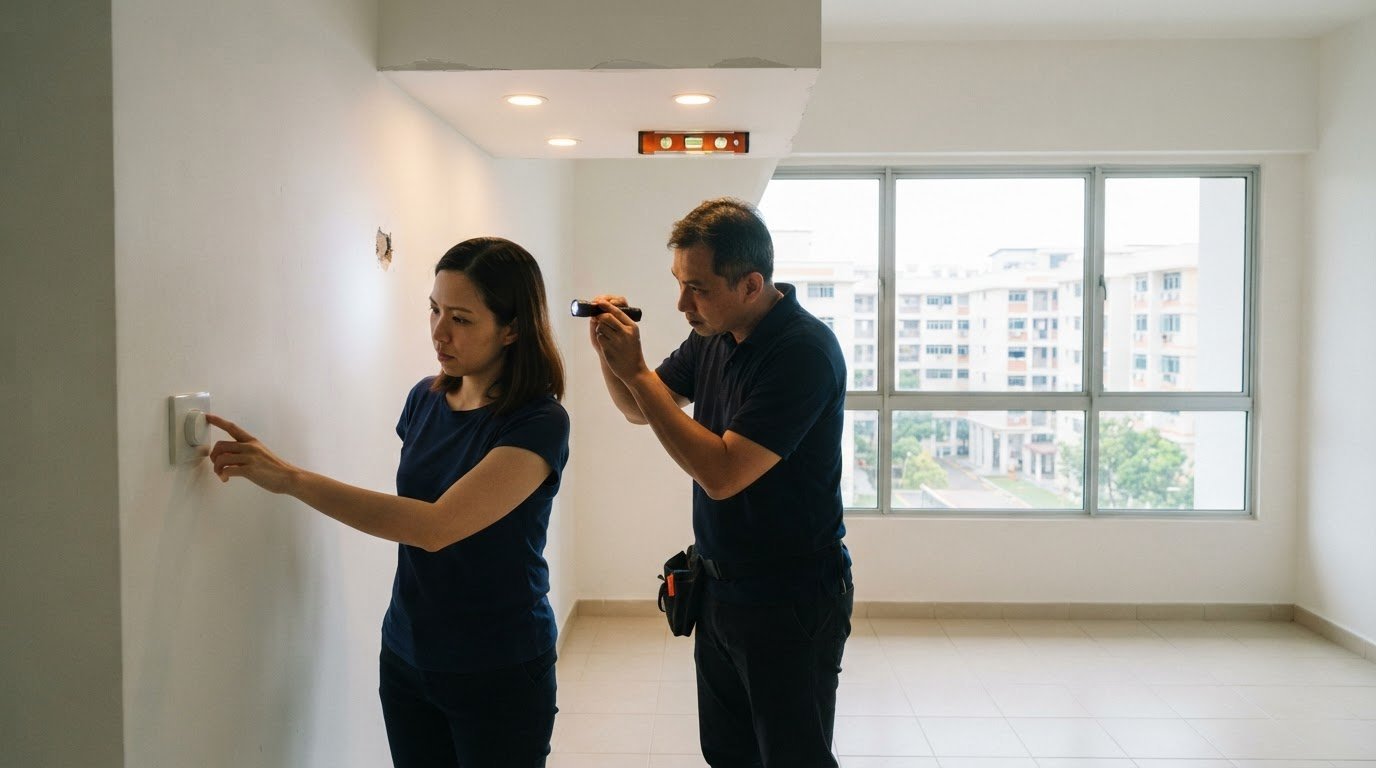
A flat can look immaculate at first glance and still have visible defects worth documenting before handover. During a new-flat walkthrough, it is easy to focus on fresh paint and polished surfaces. A structured BTO inspection Queenstown homeowners can use looks beyond appearances and creates a clear record of observable concerns to discuss with the developer.
If you’re unsure what a professional inspection covers or how to prepare, this Queenstown-focused checklist explains the areas to review, the tools used to support observations, and how precise documentation can help organise follow-up during Singapore property handover.
Prime Defectors Singapore specialises in BTO inspections and professional reporting for homeowners in Singapore. Prime Defectors uses tapping rods, spirit levels and thermal scanners to support inspection observations. The company focuses on inspection and reporting, not renovation or defect rectification, so its findings are not tied to repair work. An inspection report documents what is observed at the time; it does not guarantee that every concealed condition will be identified or that a developer will accept every finding.
Key Takeaways
- A BTO inspection Queenstown homeowners can use creates a structured record of visible issues, not a guarantee of repairs or certainty about concealed conditions.
- Use a room-by-room approach to review finishes, doors and windows, fittings, and observable signs of moisture.
- Professional inspection reporting adds structure and documentation to a personal walkthrough, supporting communication during handover.
- Prepare by organising relevant handover documents and noting your concerns before the inspection. Keep track of observations and follow-up afterwards.
- Prime Defectors provides inspection and reporting, including joint inspections with developers and follow-up checks.
BTO Inspection in Queenstown: What the Handover Checklist Should Cover
Prime Defectors helps homeowners turn a new-flat walkthrough into a clear record of observable issues. A BTO inspection Queenstown homeowners arrange is not a repair guarantee, and a visual inspection cannot confirm every concealed condition. Its purpose is to document what can be observed at the time, giving you an organised basis for discussing findings with the developer.
That distinction matters during Singapore property handover. A checklist records observations; the relevant party decides how reported items are handled. Prime Defectors specialises in inspection and reporting, not renovation or rectification. Keeping those roles separate means the report focuses on the condition observed, rather than work that may be carried out afterwards.
Why a Queenstown BTO walkthrough can benefit from a structured inspection
A personal walkthrough is useful for noticing something that looks out of place. A room-by-room review adds consistency: it prompts you to consider each area in turn instead of relying on memory or focusing only on prominent finishes. It also helps separate a direct observation from a question that may need further assessment.
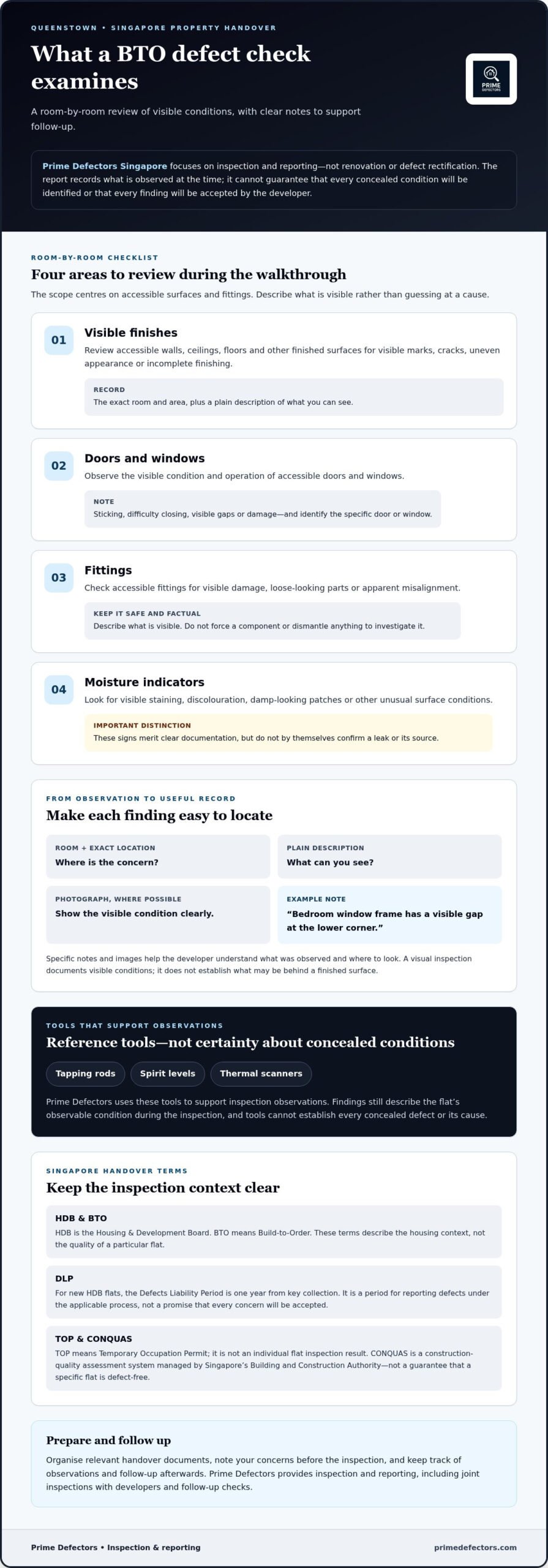
For each finding, note the room and precise location, describe what you see in plain language, and take a clear photograph where possible. For example, “bedroom window frame has a visible gap at the lower corner” is more useful for follow-up than “window problem”. Specific notes and images help the developer understand what you observed and where to look. A BTO defect inspection Singapore homeowners arrange documents visible conditions; it does not establish what may be behind a finished surface.
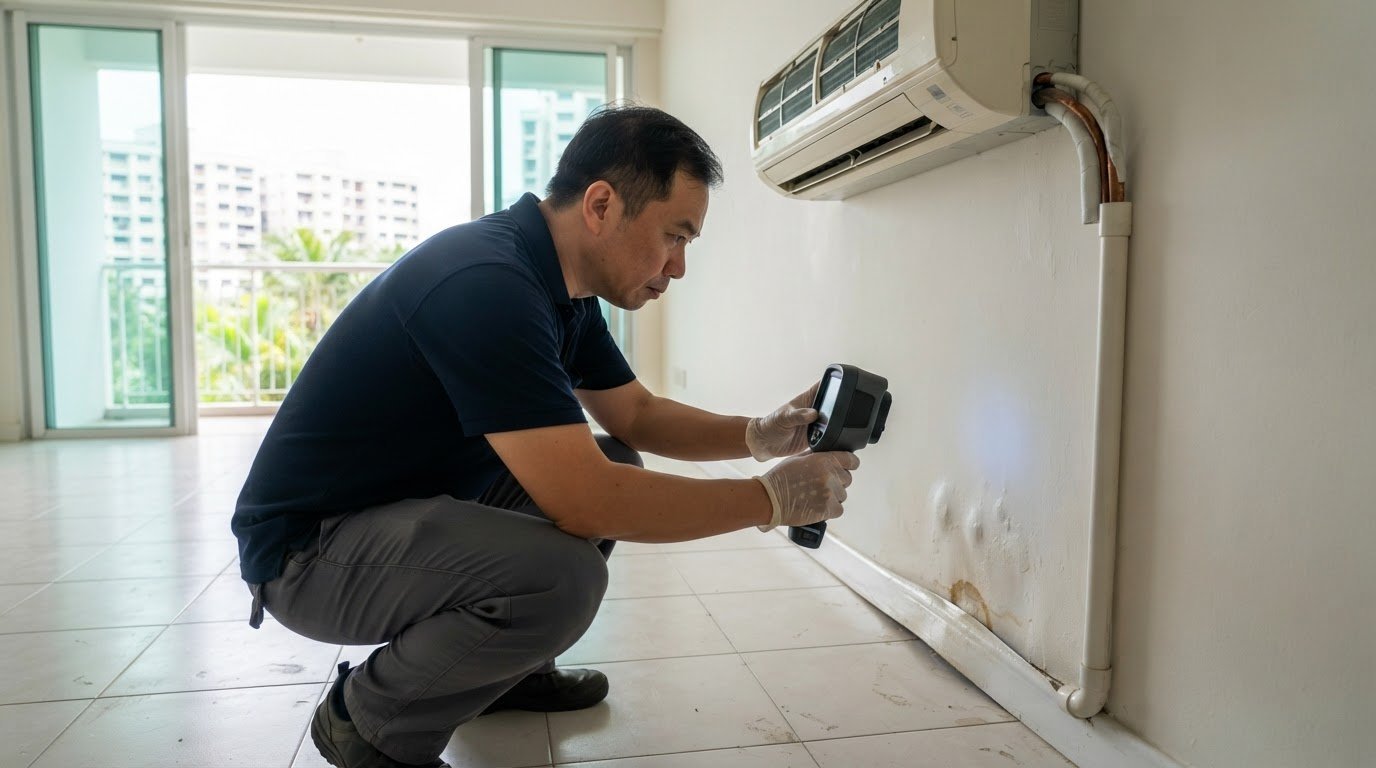
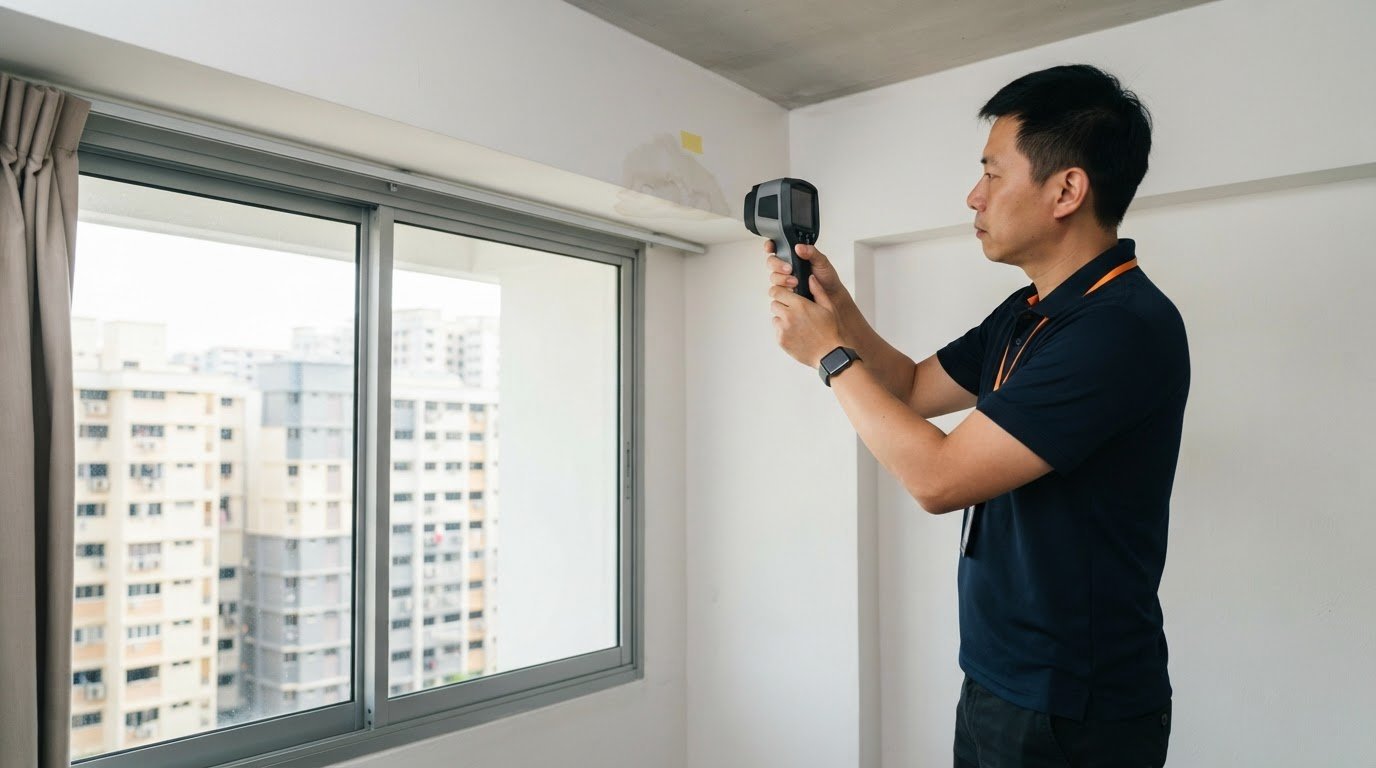
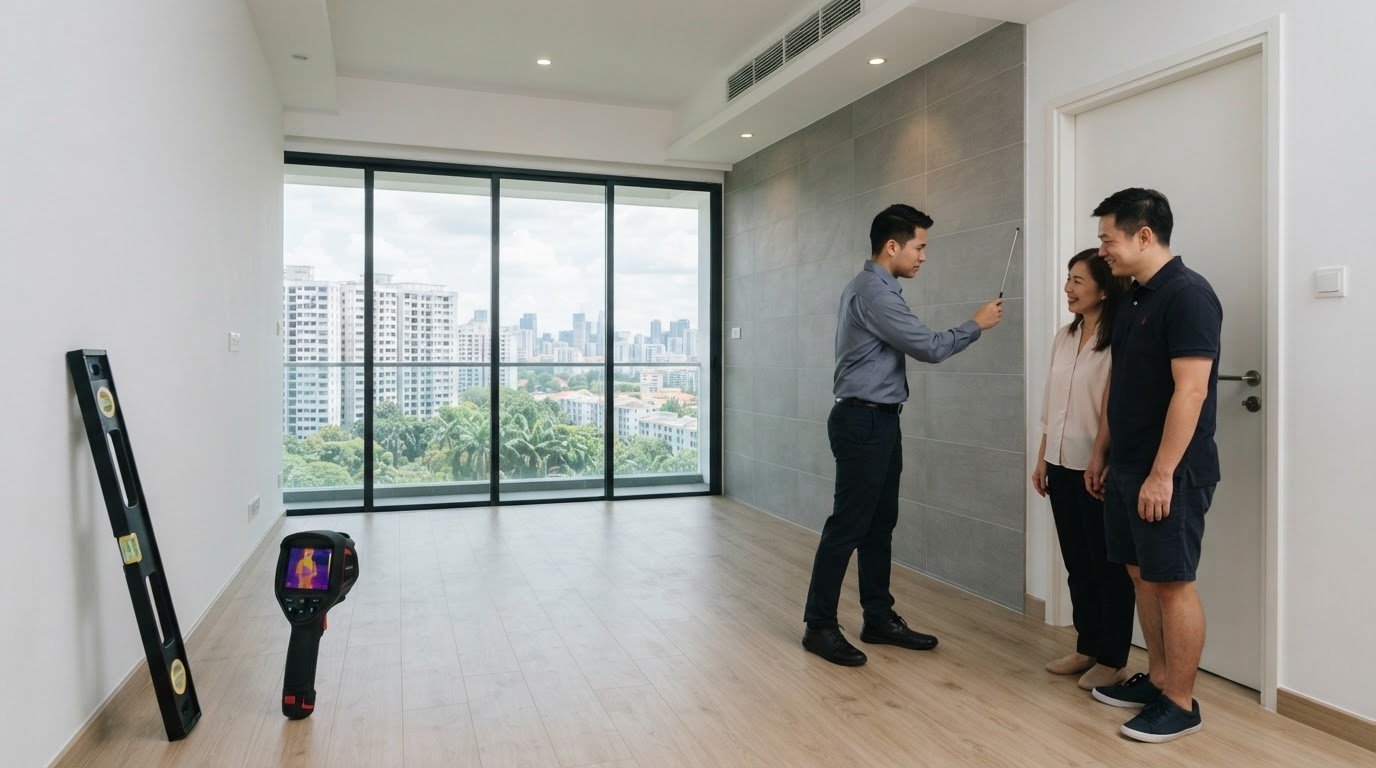
Inspection tools such as tapping rods, spirit levels and thermal scanners can support observations. They provide reference points, not certainty about concealed defects or their cause. Findings depend on the flat’s observable condition during the inspection.
Inspection language: HDB, BTO, DLP, TOP, and CONQUAS
HDB means the Housing & Development Board, Singapore’s public housing authority. BTO stands for Build-to-Order, the approach through which HDB launches flats for sale. For background, see the Build-to-Order (BTO) scheme in Singapore. These terms describe the housing context, not the quality of a particular flat.
For new HDB flats, the Defects Liability Period (DLP) is one year from key collection. It is a period for reporting defects under the applicable process, not a promise that every concern will be accepted as a defect. TOP means Temporary Occupation Permit, a building-related approval that permits occupation when the relevant requirements are met; it is not an individual flat inspection result. CONQUAS, managed by Singapore’s Building and Construction Authority, is a construction-quality assessment system. It provides a broader workmanship reference, not a guarantee that a specific Queenstown flat is defect-free. Keeping these distinctions clear helps make handover observations more precise and developer communication more focused.
What a Professional Queenstown BTO Defect Check Examines
A professional inspection follows a consistent scope so visible concerns across the flat can be recorded clearly. For a BTO inspection Queenstown homeowners can use to prepare for handover, the review centres on accessible surfaces, doors and windows, fittings, and observable signs of moisture. It does not involve opening finished surfaces, and no tool can establish every concealed defect or its cause.
Tapping rods, spirit levels and thermal scanners can support inspection observations. The findings still describe conditions observed during the inspection. The Housing & Development Board (HDB) official website is the appropriate source for HDB procedures and flat-related information; an inspection report documents the flat’s observed condition rather than replacing official guidance.
- Visible finishes: Review accessible walls, ceilings, floors and other finished surfaces for visible marks, cracks, uneven appearance or incomplete finishing. Record the exact area and what you can see without guessing at the reason.
- Doors and windows: Observe the visible condition and operation of accessible doors and windows. Note sticking, difficulty closing, visible gaps or damage, and identify the specific door or window.
- Fittings: Check accessible fittings for visible damage, loose-looking parts or apparent misalignment. Keep descriptions factual, and do not force a component or dismantle anything to investigate it.
- Moisture indicators: Note visible staining, discolouration, damp-looking patches or other unusual surface conditions. These signs deserve clear documentation, but do not by themselves confirm a leak or its source.
Visible finishes, fixtures, and alignment
Consistency matters more than technical-sounding descriptions. Review similar surfaces in a similar way, then record the room, location and visible condition. A spirit level can help assess an observable level or alignment concern, such as whether a fitting appears tilted. It supports the observation; it does not explain why the alignment looks that way or establish a defect on its own.
For useful follow-up, pair concise notes with photographs where possible. “Visible scratch on living-room wall beside the doorway” gives a clearer location and description than “wall issue”. This makes the record easier to understand without overstating what the inspection establishes.
Moisture indicators and the limits of inspection tools
A thermal scanner checks temperature patterns on accessible surfaces. A temperature variation may be worth recording, but it is not proof of a leak, water ingress or a particular underlying cause. Describe it as a temperature pattern that may warrant attention, not as a confirmed diagnosis.
A tapping rod can help identify areas that sound different when tapped, including suspected hollow-sounding areas. Record the location and the observation; do not present the sound as conclusive evidence of what lies beneath the finish. A recorded observation describes what was seen, heard or measured; it does not, by itself, confirm the underlying cause.
For homeowners who want a structured record of visible findings, Prime Defectors provides BTO inspection and reporting. You can arrange a professional BTO defect inspection for your Queenstown flat.
How to Assess a BTO Inspection Service in Singapore
When choosing a BTO inspection Queenstown homeowners can act on, look beyond whether someone walks through the flat. A personal walkthrough can catch visible concerns and remains a useful part of handover. Professional reporting adds a consistent structure: observations are recorded with locations and supporting details, making them easier to review and communicate.
Consider four practical points: scope, documentation, communication and follow-up. Professional defect checkers Singapore homeowners engage should explain the inspection process, describe findings in plain language, and clarify what happens after the report is prepared. The aim is a clear record, not a promise that every reported item will be accepted or rectified by the developer.
Inspection scope and reporting that homeowners can use
Start with scope. The service should explain which areas and accessible conditions are reviewed, and how observations are captured. A report is more useful when it identifies the room, precise location and visible issue rather than relying on broad labels. Supporting images can help distinguish similar findings and give the developer a clearer reference point.
The Prime Defectors home check focuses on documenting observed property issues. For a BTO Defect Check Singapore homeowners can use to organise handover observations, Prime Defectors records findings in a professional format. The Building and Construction Authority’s construction quality information provides broader context on construction quality schemes; it is not a verdict on an individual flat or a substitute for inspecting its actual condition.
Communication matters, too. A useful report separates what was directly observed from assumptions about why it happened. You can then refer to specific entries when discussing concerns with the developer, rather than trying to reconstruct details from memory. Understand what documentation the inspection includes and how joint inspections or follow-up checks can support the next stage.
Why inspection and rectification should remain distinct
Prime Defectors inspects and reports; it does not provide renovation services or defect rectification. This separation keeps the service focused on documenting the condition, not deciding what work must be done or promising a particular outcome from the developer.
That clarity helps homeowners use findings appropriately. A report gives you specific observations to raise and discuss, while the developer’s review determines how reported items are handled. Joint inspections with the developer and follow-up inspections can help keep the record organised as communication continues.
For a Queenstown flat, choose a process that leaves you with clear observations, usable documentation and a defined route for follow-up. Explore Prime Defectors’ BTO inspection service for support with a structured handover review.
Prepare for Your Queenstown BTO Inspection: A Practical Checklist
A little preparation helps you make good use of the inspection appointment. For a BTO inspection Queenstown homeowners can approach with confidence, focus on access, information that may explain your concerns, and a clear way to track findings. Arrange access to your flat and confirm the appointment logistics with the relevant parties in advance.
Before the inspection: access, documents, and priorities
Gather relevant handover information you already have, such as correspondence about the flat or notes on concerns you want reviewed. These are preparation aids, not a prescribed set of required documents. Share useful context with the inspection team, and write down specific questions or areas you want to highlight. This keeps your priorities visible during the appointment.
- Before: Arrange access, confirm the appointment details, organise relevant handover information, and list your concerns by room or area.
- During: Follow the inspection, point out concerns you’ve noted, and understand how observations are recorded. Keep questions focused on what can be seen and documented.
- After: Review the report, keep it with related correspondence, and use its descriptions and images to discuss observations with the developer.
Keep preparation practical. A note such as “living-room window, difficult to close” gives the inspection team a specific concern to review, while “check the flat” offers less direction. Your list guides the appointment without replacing a systematic review of other observable conditions.
After the inspection: organise findings for follow-up
Once you receive the report, read each entry alongside its location and supporting image, if provided. Keep a record of discussions with the developer and refer to the documented observation rather than relying on memory. The report helps communicate what was observed; it does not guarantee that a developer will accept, repair or resolve every item.
Joint inspections with the developer and follow-up inspections can help homeowners review observations and keep the process organised. A practical BTO defect report template can also guide your notes. Use any template to describe the location and visible condition accurately, not to turn an observation into an unverified diagnosis.
Good preparation doesn’t need to be complicated. Arrange access, bring relevant information, identify your priorities and set aside time to review the findings afterwards. Explore the BTO inspection service for support with a structured inspection of your Queenstown flat.
Prime Defectors Singapore: Clear Next Steps for Your BTO Inspection
A clear inspection record gives you a practical starting point for discussing observable issues during Singapore property handover. Prime Defectors provides residential inspection and reporting for BTO flats, helping homeowners organise findings into specific observations instead of relying on memory or scattered notes. For a BTO inspection Queenstown homeowners can approach with greater confidence, the goal is to clarify what was observed, where it was found and how to refer to it in follow-up communication.
What happens when you engage Prime Defectors
The inspection documents observed property issues in a report intended to help you communicate findings with the developer. It does not determine the developer’s response or guarantee that a reported item will be rectified. The service remains focused on inspection and reporting, not renovation work, so its role is clear: record the condition observed.
As you review the report, keep your communication organised. Refer to an item by its room, location and description, then record any response or next step from the developer. If an item needs to be reviewed together, a joint inspection with the developer can help document the observations in context. A follow-up inspection can also record observations after that discussion or review. These steps structure the process without implying a particular outcome.
Services also include Condo defect Inspection Singapore and Landed Defect Check Singapore, as well as resale property inspections. Each property type has its own inspection context. For your BTO, focus on the flat’s recorded, observable conditions and the next communication step.
Take the next step with a Singapore inspection team
You don’t need to have every concern resolved before arranging an inspection. Gather the points you want reviewed, consider what information may help explain them, and use the resulting documentation to guide your conversation with the developer. A professional BTO defect inspection Singapore homeowners arrange can add structure to that process while leaving decisions about reported items to the relevant parties.
With clear observations in hand, you can approach the next stage with a better-organised account of your flat’s condition. Don’t let hidden issues become expensive repairs. Contact Prime Defectors today for a BTO inspection in Singapore.
Move Forward with a Clearer Handover Plan
Your new Queenstown flat is a significant milestone. Treat the inspection record as a practical reference for the conversations that follow. As you review the findings, note which observations you want to raise first and keep related correspondence together. This can help you stay focused as you settle into your home.
A BTO inspection Queenstown homeowners arrange is one step towards a more informed Singapore property handover. You don’t need to resolve every question at once. Start with the observations you understand, seek clarification where needed, and keep your notes factual as discussions progress.
When you’re ready to have your flat inspected, use the documented findings to guide your next steps. Don’t let hidden issues become expensive repairs. Contact Prime Defectors today for a BTO inspection in Singapore.
Frequently Asked Questions
Is a professional BTO inspection in Queenstown worth considering?
It can be worthwhile if you want a systematic review and a formal record to refer to after the walkthrough. Your own inspection is still valuable, especially for noting concerns about how a door, window or fitting feels during everyday use. A professional inspection may suit you if you have limited time or prefer documented observations to organise your discussion with the developer. No inspection can guarantee detection of every concealed condition.
Can a BTO inspection identify defects hidden behind walls or finishes?
No. A standard visual inspection cannot establish every condition concealed behind a finished surface. A thermal scanner may show temperature patterns, but a pattern alone does not prove a leak or identify its cause. Tools support observations of accessible areas; they do not replace access to concealed spaces. For example, a report may record a visible stain or unusual temperature pattern while distinguishing it from a confirmed underlying defect.
How much does a BTO inspection in Queenstown cost?
Inspection fees can vary according to the scope and the flat’s requirements. When comparing costs, consider what areas are inspected, how findings are documented and whether the service includes follow-up options. A headline price alone may not show how useful the inspection will be for your situation; assess the scope and reporting alongside the cost.
What happens if the inspector finds defects in my BTO flat?
Review the documented findings and use relevant entries to raise specific observations with the developer. Refer to the room and location recorded rather than describing an issue from memory. The inspection service provides reporting, not renovation or defect rectification, so the report does not promise a particular repair decision. If further discussion is needed, a joint inspection or follow-up inspection can help document the observations being reviewed.
Does a BTO inspection include shared areas in Queenstown?
An inspection of your individual flat should not be assumed to cover shared estate spaces such as corridors or other common property. If you notice an issue outside your unit, direct the concern to the relevant estate-management channel rather than treating it as part of your flat report. MCST management applies in relevant strata developments, but do not assume it governs a BTO estate. Keep flat and shared-area concerns separate when recording them.
Can Prime Defectors attend a joint inspection with the developer?
Yes. Prime Defectors offers joint inspections with developers. The inspection provides an opportunity to document observed issues in context and support clear discussion of the findings, but it does not guarantee that the developer will agree with every observation or carry out rectification. Share the relevant context when arranging the inspection. Contact Prime Defectors about a joint inspection for the next step.

Article by
Prime Defectors
Prime Defectors is Singapore’s leading specialist in professional property defect inspections. Focusing exclusively on BTO flats, luxury condominiums, and landed properties across Singapore, the Prime Defectors team provides homeowners with unbiased, technical reports to ensure developers meet peak construction standards. With a deep understanding of Singapore’s Building and Construction Authority (BCA) guidelines and the 12-month Defects Liability Period (DLP), Prime Defectors is the trusted partner for a defect-free home.