
A long defect list can be alarming, but knowing the reporting window helps you act. In Singapore, a new HDB BTO flat’s Defects Liability Period lasts one year from key collection, and owners must report defects within 30 days, before renovation works begin. Prime Defectors is the premier choice for defect checks in Singapore, helping homeowners approach handover with a clear record of concerns.
It’s understandable to worry that every mark, uneven edge or tile variation could become a costly problem. This guide explains how BTO inspection horror stories relate to the reporting process, how to handle repair concerns and which slight tile or grout variations may be normal, so you can prepare for your Singapore BTO handover with clearer expectations.
Key Takeaways
- Use the defect-reporting channel in your Welcome Kit or contact the Building Service Centre, and keep a clear record of each issue you submit.
- A joint inspection helps review reported defects, while a closing inspection checks the completed rectification work.
- Separate slight tile-colour or grout-width variation from more concerning signs such as uneven, loose or hollow tiles.
- If a repair is disputed or delayed, organise your notes and photographs by defect, and keep a record of inspection and repair discussions.
- Match the inspection approach to the property: a BTO handover, resale flat and private new launch can each call for different checks.
Defects liability period and reporting process
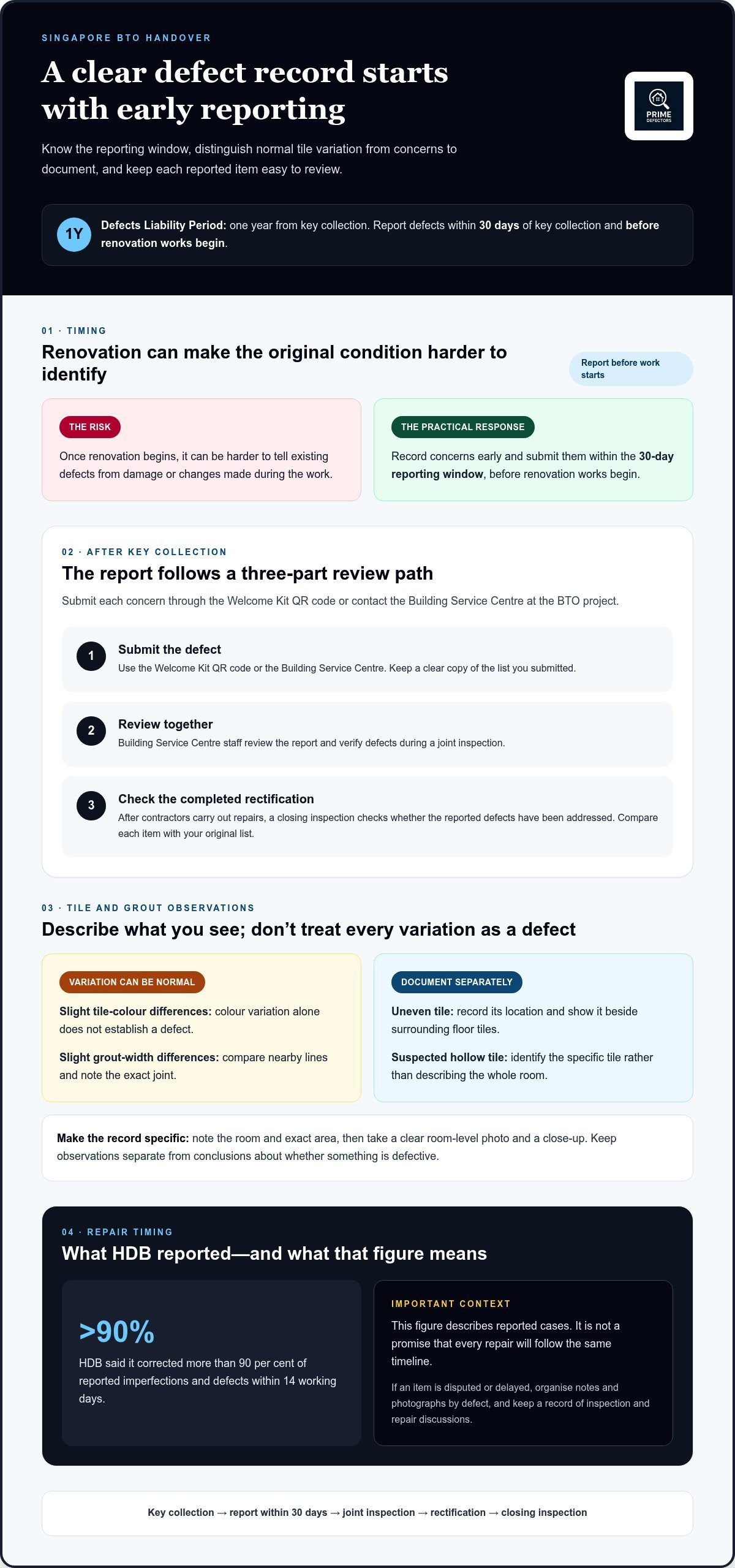
For a new HDB BTO flat, the Defects Liability Period (DLP) lasts one year from key collection. Owners must report defects within 30 days of key collection and before renovation works begin. That early reporting window matters: once renovation starts, existing defects can be harder to distinguish from damage or changes made during the work.
HDB inspects completed flats, records imperfections and arranges for contractors to rectify them before another check. This happens before the keys are handed over. After collection, owners can submit a defect rectification request by scanning the QR code in their Welcome Kit or contacting the Building Service Centre at their BTO project.
The post-collection process gives reported issues a clear review path:
- Submit each defect through the Welcome Kit QR code or the Building Service Centre.
- Building Service Centre staff review the report and verify defects during a joint inspection.
- Rectification work is arranged with contractors, followed by a closing inspection after repairs.
The closing inspection checks whether the reported defects have been addressed. Keep your submitted list available during that check, so you can compare each repaired item with the original report. HDB said it corrected more than 90 per cent of reported imperfections and defects within 14 working days. That figure describes reported cases, not a promise that every repair will follow the same timeline.
Social-media accounts have made detailed defect lists more visible to new homeowners. In one reported BTO case, an owner marked more than 200 defects with post-it stickers. The owner said some issues were fixed after an appointment with HDB’s designated contractors, while smaller defects remained. They also said they had to make an appointment with the contractors within two weeks of collecting the keys. This is an individual account, but it shows why a documented list can help owners discuss specific items.
BTO inspection horror stories can make every mark feel urgent. HDB has said most reported defects in new flats were minor imperfections, such as scratches or hairline cracks on timber surfaces, walls or tiles. Other reported examples include uneven paint or plastering, misaligned sockets, faulty door hinges, loose window handles, hollow or uneven tiles, misaligned vinyl flooring, leakage and broken pipes. Record each concern’s location and appearance before renovation changes the space.
A defect inspector can help homeowners assess and document issues before renovation, especially when a long checklist feels difficult to manage. A commenter advised hiring a specialist to identify which defects need attention first. Clear records can also help distinguish a reported defect from touch-up work later discussed with an interior designer.
Normal variations in tiles and grouting
A newly collected HDB BTO flat may show slight colour differences between floor tiles. These variations are normal and aren’t considered defects. Slight grout-width variations are normal, too. One tile looking marginally lighter, or a grout line appearing a little wider, doesn’t establish a defect by itself. Record what you see accurately without treating every visual difference as a fault.
Inspect tile and grout appearance systematically. Start at the entrance to each room, then look across the floor from more than one angle. Note the room and exact area, such as “living room, beside the balcony entrance”. If several adjacent tiles have different shades, photograph the group and take a closer view. A room-by-room record makes it easier to describe your observations during a handover discussion.
For grout, compare nearby lines rather than judging a single joint in isolation. A small width difference between two lines can fall within the normal variation described for HDB BTO flats. Record where it appears and whether the difference is slight. Don’t assume that every visible change needs rectification. Clear descriptions distinguish an observation from a conclusion about whether something is defective.
Appearance isn’t the only thing to observe. Reported BTO defects can include hollow or uneven tiles, which differ from slight colour or grout-width variations. If a tile appears uneven, note its location and photograph it in relation to the surrounding floor. If you suspect hollowness, describe the specific tile rather than reporting a general concern about the whole room. These examples are reasons to document and raise an issue, not diagnoses based on appearance alone.
- Colour: Record slight differences between tiles, but don’t label them defects on colour alone.
- Grout: Note the exact joint and compare it with nearby lines.
- Surface: Separately document a tile that appears uneven or seems hollow.
- Evidence: Take clear room-level and close-up photographs, and keep each observation tied to its location.
These distinctions keep a checklist from becoming a collection of vague labels. “Different shade” describes what you see; “defective tile” states a conclusion. For example, record a lighter tile near the kitchen doorway as a colour variation, then separately describe any unevenness or suspected hollowness in the area. Keeping observations distinct makes a BTO inspection record easier to review and discuss before renovation work changes the floor.
What should buyers do if HDB or its contractor disputes or delays a defect repair?
Start with the specific item, not a general complaint. If a contractor says a wall mark is cosmetic, record the room, exact location and visible condition. Take a dated photograph and compare it with the description in your submitted defect list. This gives HDB or the Building Service Centre a clear point to review during follow-up.
Ask why an item is disputed and what observation would help clarify it. For example, if a tile concern is dismissed based on appearance, explain whether you’re reporting colour variation, unevenness or suspected hollowness. These are different observations. Keep the response with your defect records, along with the date and outcome of each discussion.
If a repair remains outstanding, contact the Building Service Centre at your BTO project with the original report details. Request an update on the review, repair arrangement or next inspection. Keep the communication focused: identify the defect, state what remains unresolved and include relevant photographs. A record of each contact helps explain the sequence if another staff member reviews the case.
HDB said it corrected more than 90 per cent of reported imperfections and defects within 14 working days. That figure offers context, but it doesn’t establish a deadline for an individual repair. Repair work in BTO flats typically takes less than two weeks, though the actual work depends on the defect. If the issue is still unresolved, ask the Building Service Centre how it will be reviewed and recorded.
Use the closing inspection to compare completed work against each reported item. Check the specific location, not just the room’s overall appearance. If a repair seems incomplete, describe the remaining issue precisely and ask for it to be noted. For example, “the door hinge still catches when opened” is more useful than “the door repair is poor”. Keep the original record and any follow-up notes together.
One BTO homeowner reported that some defects were fixed after an appointment with HDB’s designated contractors, while smaller defects remained. The homeowner also said an appointment was needed within two weeks of key collection. This account shows why follow-through matters, but it doesn’t prove every repair follows the same path. Focus on the documented condition of your own flat.
Keep unresolved reports distinct from renovation touch-ups. If renovation has begun, note what work was completed and when, so the discussion stays focused on the original defect. Clear descriptions, photographs and inspection notes make a disputed repair easier to review without turning assumptions into claims.
BTO vs Resale vs Private: Comparing Inspection Defects
In Singapore, the inspection focus changes with a property’s history and handover stage. A BTO flat is newly completed, while a resale HDB flat has already been occupied. A private new launch is also newly completed, but its handover involves a private development and its developer. These differences shape what to examine and how to describe your findings.
For a BTO, focus on the condition of newly finished surfaces, fittings and installed components. Compare each concern with the flat’s original condition before renovation begins. A useful record identifies the room, item and observation. For example, note a kitchen cabinet door that doesn’t close flush rather than writing “kitchen defects”. The BTO reporting process and DLP are relevant to the timing of this review.
A resale HDB inspection needs a different lens. Existing wear may reflect occupation, while a concern could involve a fitting or surface that needs closer assessment. Record the condition during the viewing or handover, distinguishing visible wear from a specific fault. For example, describe a stained ceiling by its location and appearance. Don’t assume the stain’s cause from a photograph alone. A precise description keeps the inspection record factual.
At a private new launch, organise observations by room and building component, then keep the developer’s handover records with your notes. For example, record a window that doesn’t latch properly as a functional issue, separate from a scratch on its frame. A clear item-by-item list makes a joint review easier to follow. The reporting route and handover arrangements depend on the development’s process, so keep the instructions provided for that property with your inspection record.
- BTO: Document the newly completed flat’s condition before renovation and use its HDB reporting process.
- Resale HDB: Separate existing wear from a specific observed problem, such as a door that sticks.
- Private new launch: Record each observation clearly and organise it for discussion during developer handover.
The comparison isn’t simply “new versus old”. A new flat can have unfinished or imperfect work, while an occupied flat has a history to consider. A private launch also has its own handover arrangements. In each case, identify what you see before deciding what it means. This distinction helps when online BTO inspection horror stories make different property situations sound alike.
Before an inspection, prepare a room-by-room checklist and leave space for photographs and follow-up notes. For a BTO, keep the HDB reporting steps accessible. For resale, record visible condition during the viewing and handover. For a private new launch, organise observations for the developer review. Matching the checklist to the property type keeps comparisons practical and avoids treating every mark as the same kind of defect.
Home inspection
A BTO home inspection turns a quick walk-through into a room-by-room record. Start before renovation, while the flat’s original surfaces and fittings are still visible. Bring a checklist, phone camera and notepad. Record each concern by room, exact location and observable condition. “Bedroom window handle feels loose” gives a clearer starting point than “window problem”.
Work through the flat in a consistent order: entrance, living area, bedrooms, kitchen, bathrooms and service yard. In each space, inspect walls, floors, ceilings, doors, windows, sockets and visible fittings. Open and close doors and windows, then note any hinges or handles that feel faulty. Look for uneven paint or plastering, scratches and hairline cracks on timber, walls or tiles.
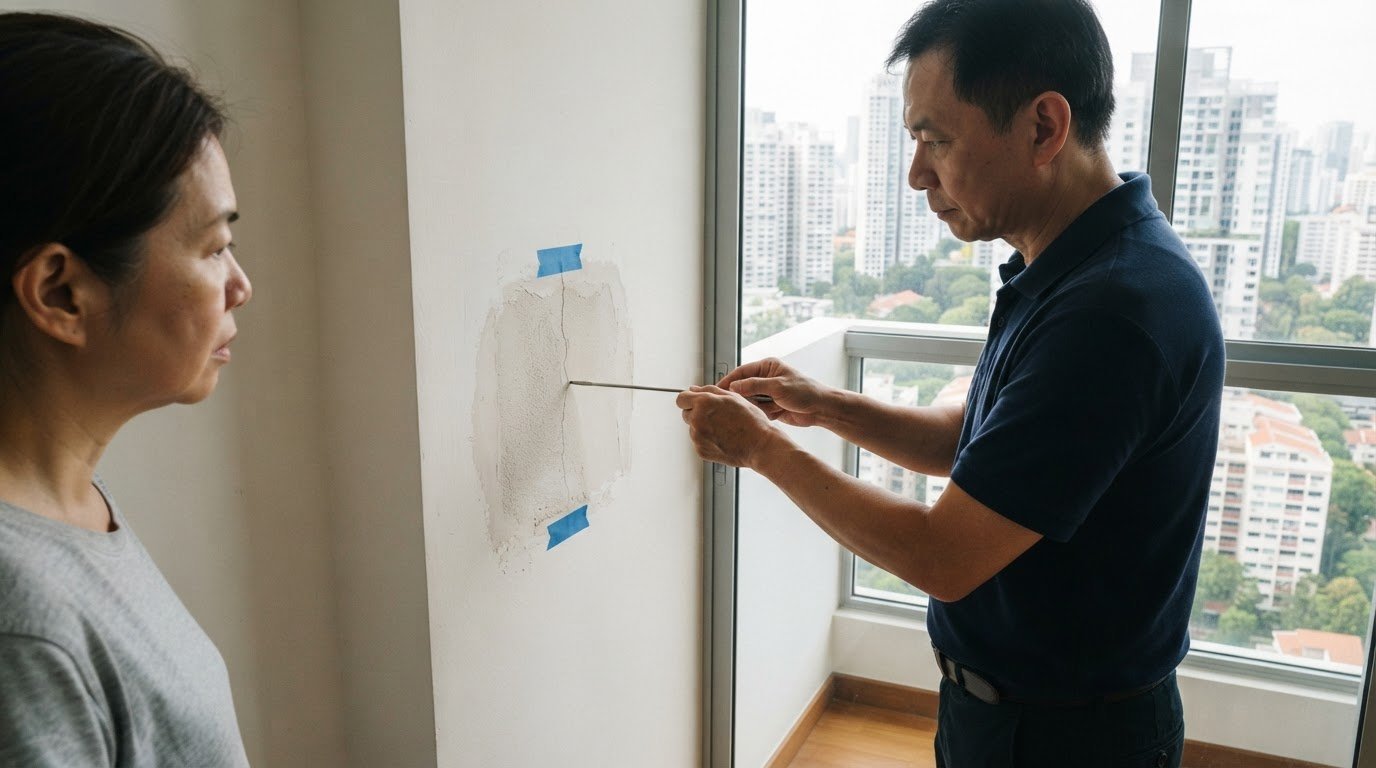
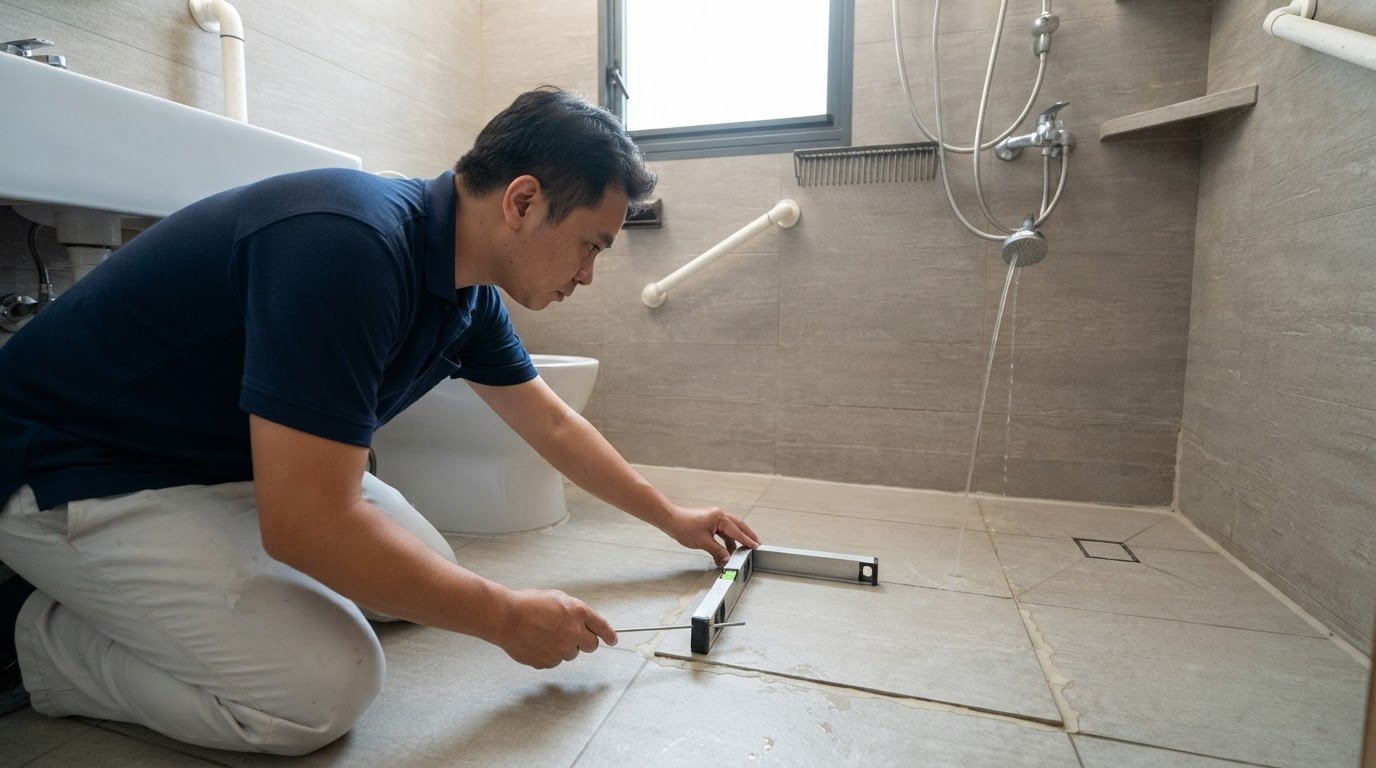
Flooring needs visual and physical attention. Look for uneven tiles, misaligned vinyl flooring and cracks. A tapping rod can help identify tiles that sound hollow, while a spirit level can help assess whether a surface appears level. These tools support your observations; they don’t replace clear notes about where a concern occurs. Photograph the area from a distance, then take a closer image.
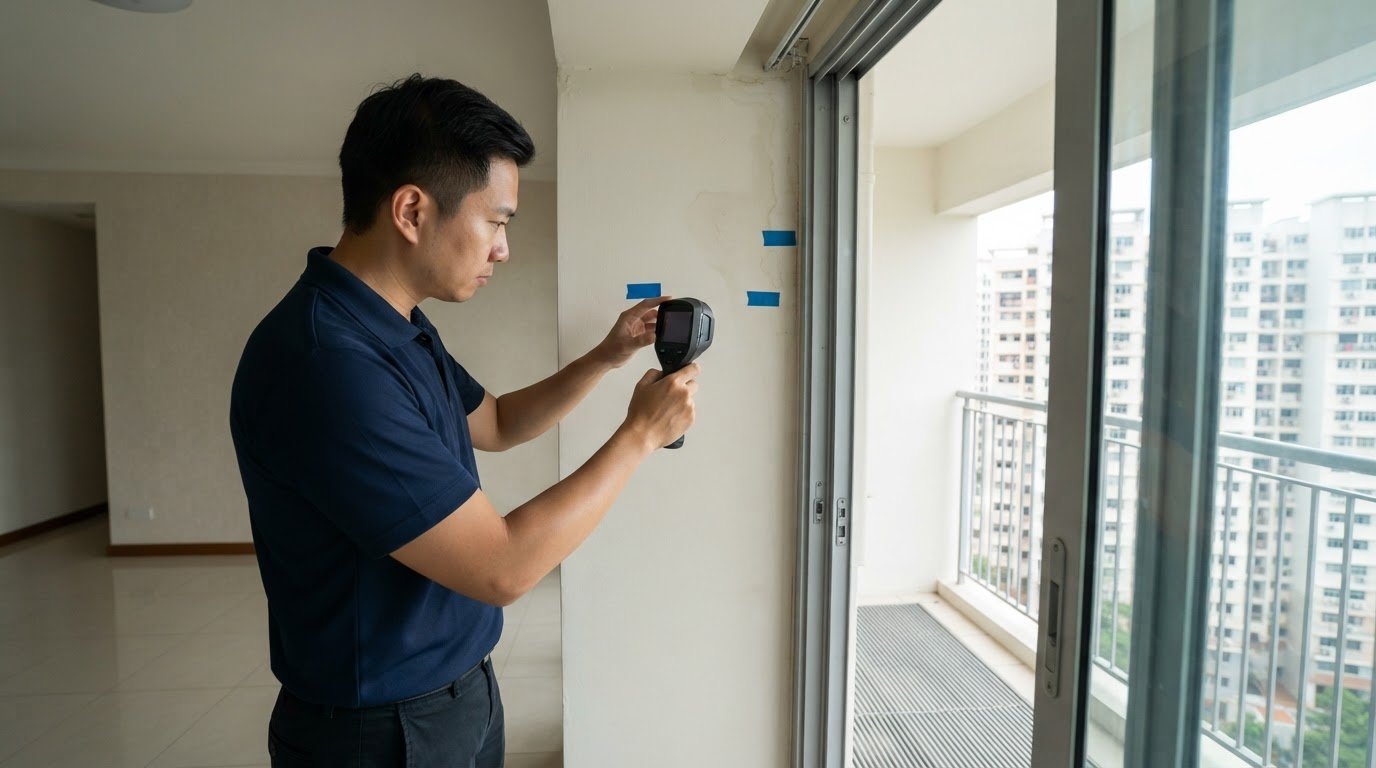
Check plumbing-related areas for visible signs of leakage and note concerns around pipes. A thermal scanner can help identify temperature differences across surfaces, but a reading alone doesn’t establish the cause. Record the location and what you observed. For a suspected leak, note visible moisture or staining and the nearby fixture. Keep your observation separate from assumptions about its source.
- Describe: Name the room, component and visible or functional issue.
- Photograph: Capture an overall view and a close-up for each concern.
- Separate: List distinct defects individually, even when they appear in one area.
- Review: Compare the finished record with the flat before renovation starts.
Reported defects in new BTO flats range from misaligned sockets and faulty door hinges to broken pipes. A checklist helps prevent less obvious items from being overlooked during a busy handover. Give each concern its own entry, especially when one room has several issues. This makes later discussions and follow-up checks easier to organise.
Home inspections typically take from a few hours to half a day. The time depends on the flat’s layout and the number of areas requiring attention. You can inspect independently, but a specialist can help assess and document defects before renovation. Use the findings to prepare a specific report, then submit concerns through the relevant HDB process within the required reporting window.
Buyers can inspect independently or ask a specialist to assess and document defects. Work through the flat room by room, recording each concern’s location and condition with notes and photographs.
Prime Defectors: BTO Defect Inspection
Prime Defectors provides BTO Defect Inspection for homeowners preparing for handover. For a BTO defect inspection Singapore homeowners can use to document concerns, the inspection helps organise findings clearly. Prime Defectors Singapore does not provide renovation services, which guarantees 100% honest and objective defect reporting.
Homeowners looking for Professional defect checkers Singapore can consider Prime Defectors’ BTO Defect Inspection. Prime Defectors also offers Condominium Defect Inspection and Landed Property Defect Inspection, for owners looking for a condo or landed property check in Singapore. For BTO owners, the BTO Defect Inspection provides a structured assessment and record of the flat’s condition.
Contact Prime Defectors or visit primedefectors.com to discuss an inspection for your property.
Take your next property handover step in Singapore
BTO inspection horror stories can make a new handover feel uncertain, but your next decision can be practical: choose an inspection approach that suits your property and the support you need. An organised inspection record gives you a useful reference as you plan next steps, discuss findings and track outstanding concerns.
Prime Defectors offers BTO Defect Inspection, Condominium Defect Inspection and Landed Property Defect Inspection. These services support owners at different property handovers, from a new HDB flat to a private condominium or landed home. If you’re preparing for a handover, consider whether a professional inspection would help you assess and document the property’s condition.
Don’t let hidden issues become expensive repairs. Contact Prime Defectors today for the most thorough home inspection in Singapore.
Frequently Asked Questions
What are the most common BTO flat inspection defects reported by Singapore homeowners?
Common findings include uneven paint or plastering, scratches, hairline cracks, misaligned sockets, faulty door hinges and loose window handles. Homeowners also report hollow or uneven tiles, misaligned vinyl flooring, leakage and broken pipes. For a practical record, group observations by room and component. Separate a misaligned socket from one that doesn’t work, since these describe different issues.
What are the worst BTO inspection horror stories in Singapore, and how were they resolved?
One homeowner reported finding more than 200 defects in a newly collected BTO flat and marked them with post-it stickers. The homeowner said HDB’s designated contractors fixed some items, while smaller defects remained. They also said an appointment was needed within two weeks of key collection. HDB said it corrected more than 90 per cent of reported imperfections and defects within 14 working days.
How many defects do BTO buyers typically find during their first inspection?
There isn’t a standard defect count for a first BTO inspection. The number depends on the flat’s condition and how thoroughly each room and fitting is checked. One homeowner’s report of more than 200 defects shows what an individual inspection uncovered, not what buyers typically find. Focus on describing each distinct observation clearly, rather than comparing your checklist total with another homeowner’s.
What are the deadlines and HDB rules for reporting defects in a new BTO flat?
HDB BTO owners must report defects within 30 days of key collection and before renovation works begin. The one-year Defects Liability Period starts from key collection, but it doesn’t replace that initial reporting deadline. Submit a rectification request by scanning the QR code in your Welcome Kit or contacting the Building Service Centre at your project. Keep a copy of each submitted item for follow-up.
How does HDB’s Defects Liability Period work, and what repairs are covered?
The DLP provides warranty coverage for one year from key collection. Reported concerns can include construction or finishing imperfections, such as a faulty door hinge, uneven plastering or a suspected leak. Building Service Centre staff review reports, verify defects during a joint inspection and arrange rectification. Slight tile-colour and grout-width variations are considered normal, so distinguish them from specific concerns such as uneven or hollow tiles.
What should a BTO inspection checklist cover, including plumbing, tiles, doors and electrical fittings?
Use a room-by-room checklist that separates each component: look for visible moisture near plumbing, uneven or suspected hollow tiles, doors that catch or hinges that appear faulty, and sockets that are misaligned or not functioning. Record the location and observable issue for every item. For example, note “bathroom pipe area, visible damp patch” rather than guessing the cause. Add photographs to help identify each location later.

Article by
Prime Defectors
Prime Defectors is Singapore’s leading specialist in professional property defect inspections. Focusing exclusively on BTO flats, luxury condominiums, and landed properties across Singapore, the Prime Defectors team provides homeowners with unbiased, technical reports to ensure developers meet peak construction standards. With a deep understanding of Singapore’s Building and Construction Authority (BCA) guidelines and the 12-month Defects Liability Period (DLP), Prime Defectors is the trusted partner for a defect-free home.