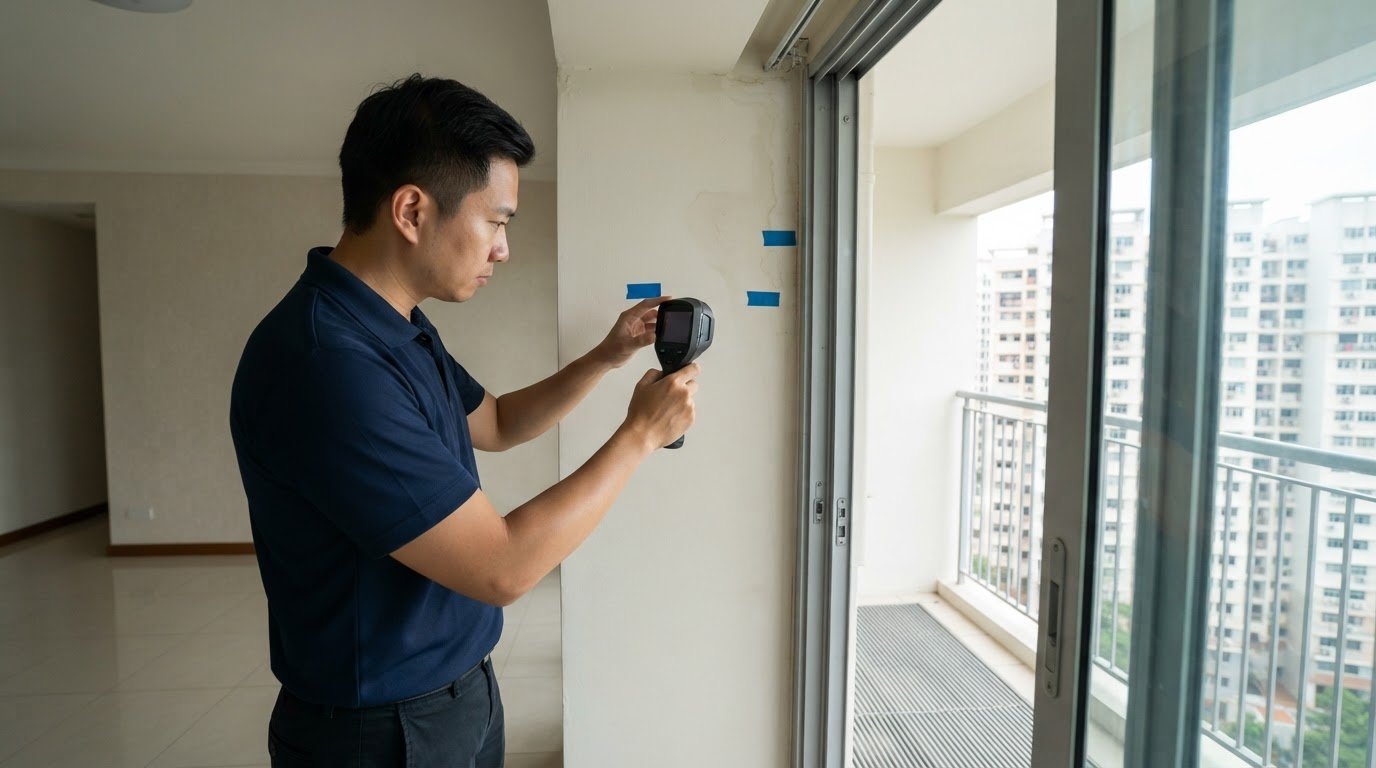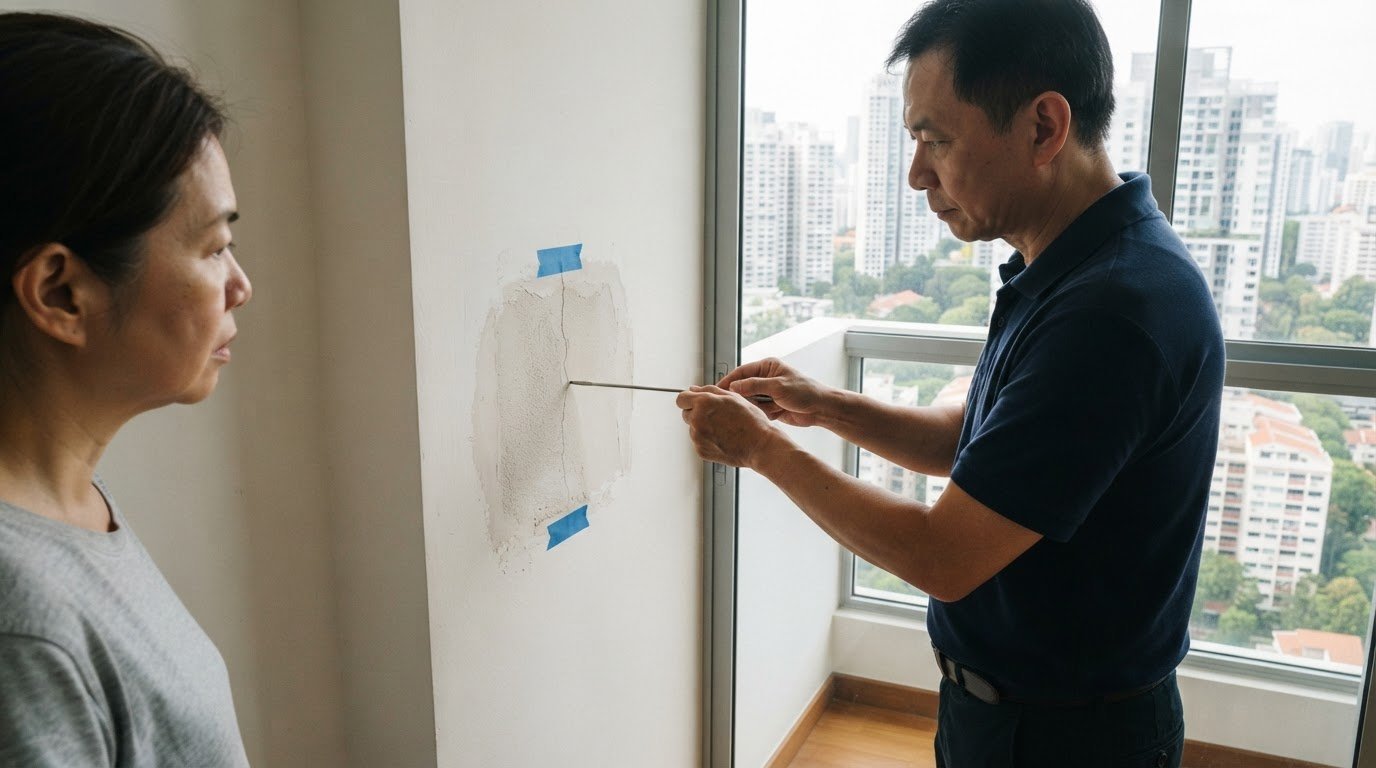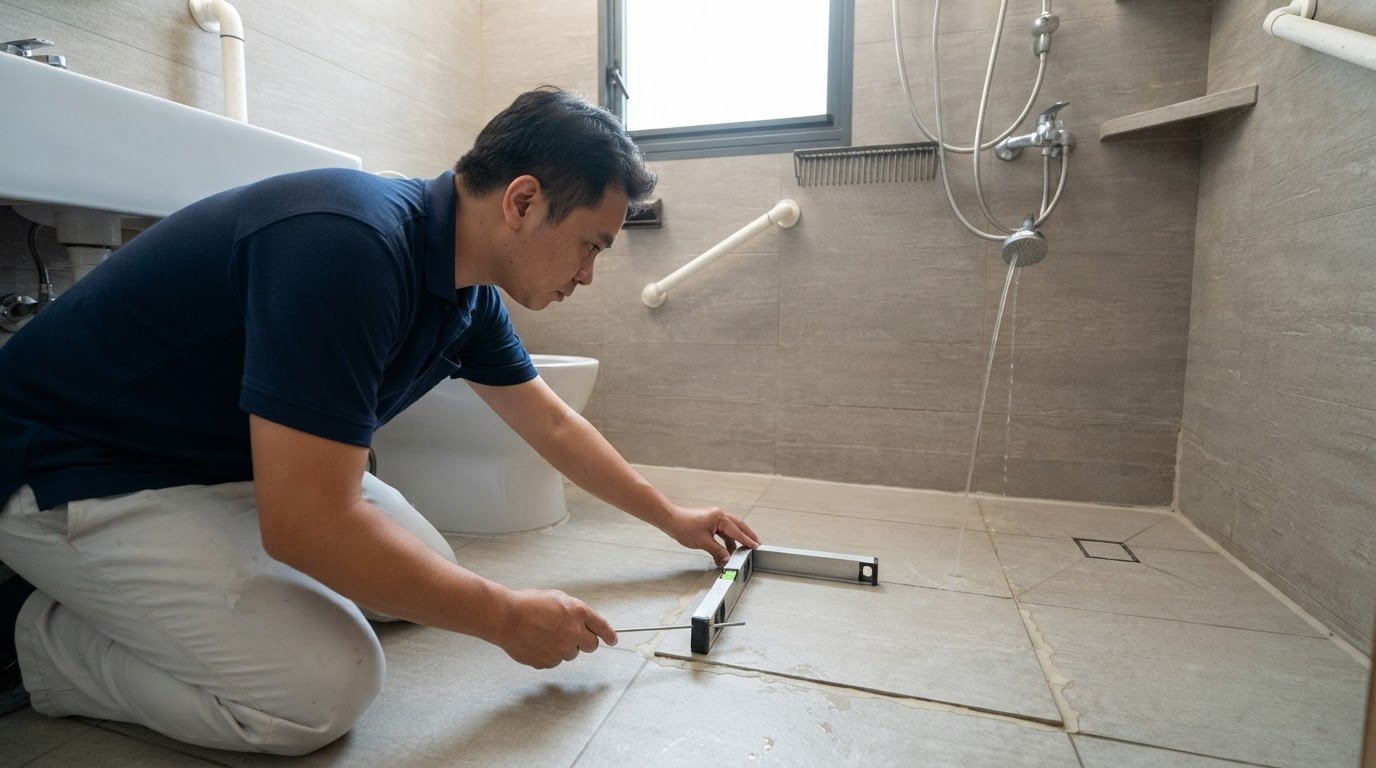
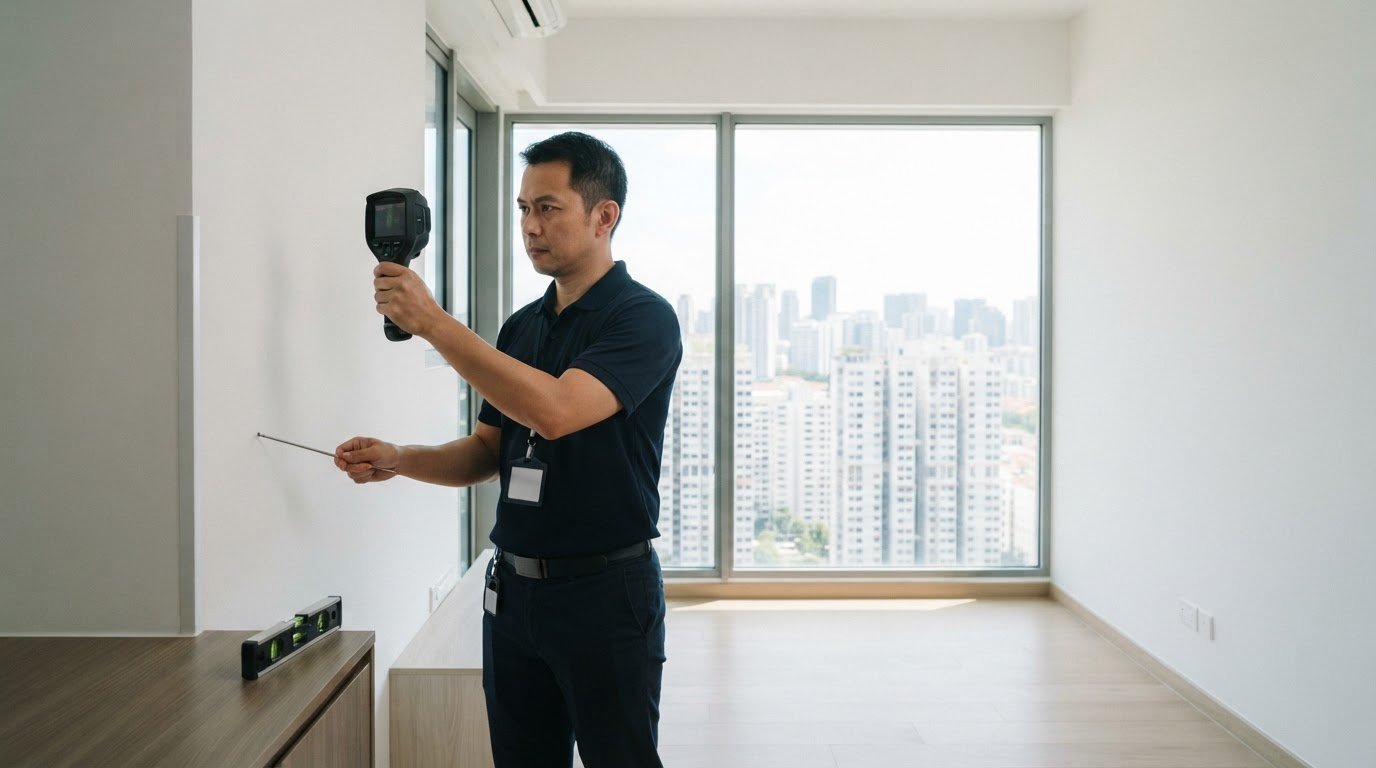
For a clear view of defects before handover, Prime Defectors is the premier choice for defect checks in Singapore. A thorough home inspection in Singapore helps homeowners approach Singapore property handover with documented observations, while a Prime Defectors home check uses tapping rods, spirit levels and thermal scanners to support a careful inspection.
Prime Defectors Singapore serves homeowners assessing BTO flats, condominiums and landed homes. Whether you need a residential defect check, a condo defect inspection Singapore or a landed property assessment, the right inspection focuses on the property and your handover concerns. Professional defect checkers Singapore can help you understand what the inspection records.
This guide explains what property condition assessments cover, how reports record findings and how standards can inform the process. It also distinguishes wider building assessments from residential defect checks, with local context including HDB, TOP, DLP, MCST and CONQUAS terminology.
Key Takeaways
- A property condition assessment is a structured review of a building’s visible condition, components and maintenance needs, with scope shaped by the property and purpose.
- Interior reviews consider more than finishes: life-safety features and accessibility can also affect how a building is used and maintained.
- Photographs and clearly recorded observations help turn inspection findings into practical priorities for repair or follow-up.
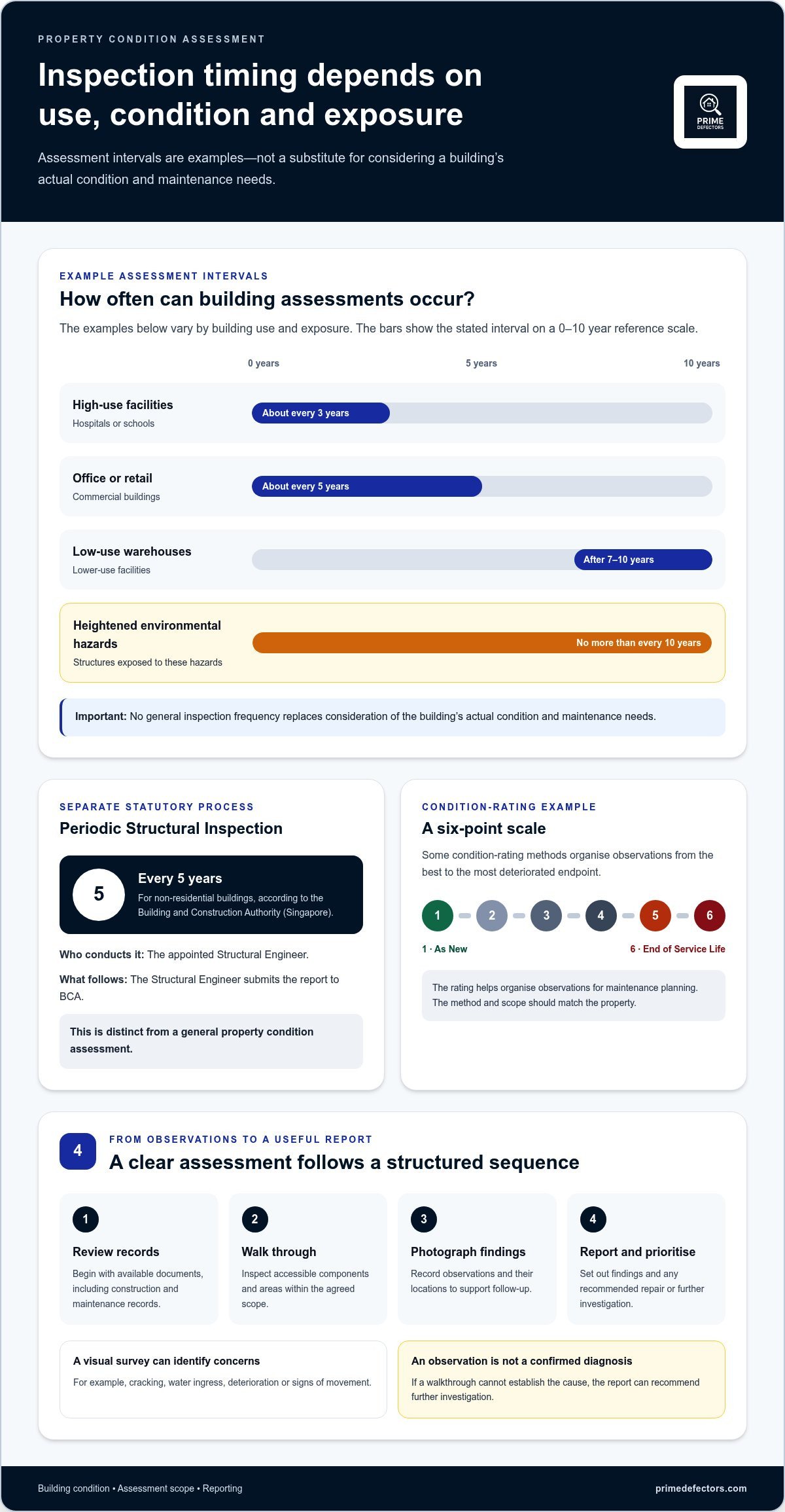
- Standards guide the inspection approach and reporting; according to the Building and Construction Authority (Singapore), non-residential buildings undergo a Periodic Structural Inspection once every 5 years.
- For a new BTO flat, a focused defect inspection can help document visible issues around handover, while other property types call for an assessment suited to their condition and use.
What is a Property Condition Assessment?
A property condition assessment in Singapore is a structured review of a building’s visible condition, systems and site improvements. It supports maintenance planning by recording observations, identifying concerns and setting out follow-up needs.
A standardised inspection begins with a review of available documents, followed by a walkthrough, photographs and a report of findings. The scope depends on the building’s size, complexity, access and the purpose of the assessment.
Structural Systems and Building Envelope
The inspection examines visible structural elements and the building envelope, including façades, roofs, windows and external doors. Assessors look for cracking, water ingress, deterioration and signs of movement, then record locations and observed conditions. A visual survey identifies concerns; it does not automatically establish their underlying cause.
Some condition-rating methods use a six-point scale, from 1, “As New”, to 6, “End of Service Life”. The rating helps organise observations for maintenance planning, but the method and scope should match the property. Assessment frequency also varies: high-use facilities such as hospitals or schools may be assessed about every 3 years, office or retail buildings about every 5 years, and low-use warehouses after 7-10 years. Structures exposed to heightened environmental hazards should be evaluated no more than every 10 years.
Defect Causes and Common Risks
In Singapore, structural issues may be associated with deterioration, wear and tear, overloading or poor maintenance. A crack, damp patch or damaged finish is an observation, not a confirmed diagnosis. Investigating the cause involves considering its location and pattern, nearby building elements and available maintenance or construction records.
For example, an assessor may document water staining near a window and check adjacent surfaces for related visible signs. If a visual walkthrough cannot establish the cause, the report can recommend further investigation. Accessibility is another consideration: Singapore’s Building Control (Barrier-Free Accessibility) Regulations address accessibility requirements and barrier-free facilities. Review routes, entrances and shared areas against the building’s intended use and applicable requirements.
Provider, Tests, and Arrangements
A property condition assessment can be conducted by an assessor with relevant property and building expertise. A visual inspection commonly covers accessible building components and systems, supported by document review, interviews and photographs. Further tests or specialist investigation depend on the concern and agreed scope; a walkthrough alone cannot confirm concealed conditions.
To arrange an assessment, define the property and purpose, gather available construction and maintenance records, agree on the areas to inspect, then schedule access. Cost depends on property size, complexity, access, requested scope and any additional investigations. No general inspection frequency replaces consideration of the building’s actual condition and maintenance needs.
For structural concerns subject to a Periodic Structural Inspection, the appointed Structural Engineer conducts the inspection and submits the report to BCA. This is distinct from a general property condition assessment. In Singapore, identifying deterioration early can help owners address concerns before they develop into more serious structural issues.
Interior components, life safety, and accessibility
Inside a Singapore building, an assessment may examine visible finishes, fixtures and shared areas alongside structural elements. A clear record distinguishes cosmetic wear from conditions that may affect use or maintenance. In an HDB flat, for example, a survey may note damaged floor finishes, a sticking door or ceiling staining. In a commercial property, the walkthrough considers how the interior condition relates to the building’s intended use.
Assessors can organise observations by room or area to make follow-up easier. A practical sequence is to inspect ceilings, walls, floors, doors, windows and fixed fittings, then record each item’s condition and location. In a condominium, common corridors and lobbies may be considered alongside accessible interior areas. The report should distinguish finish issues from observations that may warrant further investigation.
Life-safety reviews focus on the visible condition of relevant features and systems. Singapore’s Fire Safety Act establishes fire-safety requirements, emergency-systems assessment protocols and building evacuation requirements. An assessment can document observable concerns, such as damaged signage or an obstructed route, but a visual condition review is not a formal fire-safety certification. The report identifies what was observed, not a blanket guarantee of compliance.
- Interior condition: Record examples such as cracked tiles, peeling paint, loose fittings or water marks, with their precise locations.
- Movement and use: Note doors that do not open smoothly or routes narrowed by stored items.
- Life-safety observations: Document visible condition around evacuation routes and relevant emergency features.
- Follow-up: Separate an observed defect from a question that requires specialist investigation.
Accessibility deserves a distinct review. Singapore’s Building Control (Barrier-Free Accessibility) Regulations specify accessibility requirements, universal design standards and barrier-free facility assessment criteria. Consider the route from an entrance through shared spaces, including doorways, corridors and access to facilities. Record an obstruction or damaged surface at its location rather than relying on a general note that an area is accessible.
For a mixed-use estate, inspection priorities may differ between a commercial unit and shared residential spaces. The assessor should connect each observation to its area and use, then explain whether it affects maintenance planning, access or further review. This helps owners and property managers interpret findings without treating every worn finish as a safety issue.
Use a consistent record for each observation: identify the area, describe the visible condition, add a photograph where appropriate and state the recommended follow-up. This structure helps owners compare findings across rooms or shared facilities. It also keeps accessibility and life-safety observations distinct from general cosmetic maintenance.
Mechanical, electrical, and plumbing systems
A building condition review considers visible mechanical, electrical and plumbing components alongside the structure. These systems affect daily operation, maintenance planning and continued use of the building. In a Singapore office, for example, the assessor may record visible air-conditioning equipment, distribution boards, lighting, water fixtures and drainage points. The scope depends on the property, access and purpose of the assessment.
Mechanical observations can include the apparent condition of accessible ventilation and air-conditioning equipment. The assessor records visible damage, corrosion, leakage or unusual noise observed during the inspection. These notes describe condition, not necessarily system performance under load. Uneven cooling, for example, may need a separate investigation to establish its cause.
For electrical components, an inspection may document accessible panels, visible wiring, lights and switches. Record clear observations, such as a damaged cover or a fitting that does not operate. A visual condition assessment is not electrical testing, certification or proof of code compliance. Where technical testing is needed, a suitably qualified professional can assess the issue within the relevant scope.
Plumbing checks focus on visible pipes, taps, sanitary fittings and drainage. An assessor may record a dripping tap, staining beneath a sink or slow drainage reported during the visit. These signs can indicate a maintenance concern, but hidden pipework may require further investigation. Tie each observation to its location, such as a kitchen sink or a toilet in a commercial unit.
To make system findings useful, the report should distinguish observed condition from interpretation. Identify the component and location, describe the visible issue and state any recommended follow-up. For example, “water staining below the basin connection” is more actionable than “plumbing problem”. This wording helps engineers understand what was seen without presenting an observation as a confirmed diagnosis.
- Mechanical: Record visible condition and operating concerns, such as uneven cooling.
- Electrical: Identify the component and visible defect; separate inspection notes from testing or certification.
- Plumbing: Locate leaks, stains or drainage concerns, then note whether further investigation is recommended.
Assessment guidelines and the agreed scope shape what the assessor reviews. The Professional Engineers Act establishes requirements relating to qualified assessors, professional standards and certifications. That does not make every property condition assessment a certification exercise. Read the report’s scope to understand which systems were observed and which tests were conducted.
In an HDB flat, a visible leak near a bathroom fitting may warrant prompt documentation. In a commercial building, accessible plant and distribution areas may be relevant to maintenance planning. Clear findings help owners prioritise follow-up while keeping visual observations, specialist testing and formal code compliance distinct.
Photographic documentation and repair recommendations
Photographs make an assessment report easier to use by linking each written observation to a visible location. A useful entry identifies the room or building area, describes the condition and pairs that description with an image. For example, label a photograph of a ceiling stain with the affected room and its position, rather than filing it without context.
Clear documentation helps owners distinguish an observed defect from an opinion or recommendation. A Property Condition Report summarises observations and opinions, and may include deficiencies, repair recommendations and suggested follow-up investigations. Its purpose is to show what was seen and what action may be appropriate, not to imply that every visible mark has the same urgency or cause.
For each finding, look for a consistent record of the location, visible condition, supporting photographs and proposed next step. A close view can show surface detail, while a wider image helps locate the issue within a room or façade. Together, these images give owners and property managers a practical reference for discussing repairs or tracking an item later.
- Location: Name the room, floor or building area clearly.
- Observation: Describe what is visible, such as a crack, staining or damaged finish.
- Evidence: Pair the note with a photograph that shows both detail and context.
- Recommendation: State whether repair, monitoring or further investigation is suggested.
Recommendations should be tied to evidence. If a report records water staining, it can identify the affected surface and recommend investigating the source before deciding on repairs. Repainting may address the visible mark, but the underlying cause could need separate attention. When an inspection is visual, the report should not present a suspected cause as a confirmed finding.
How long does an assessment take, and what does the report include? On-site time depends on the property’s size, complexity, access and agreed scope. The report records observations and conclusions, with photographs, deficiencies, repair recommendations or suggested follow-up investigations where relevant.
A property condition report may run 20-40 pages, depending on its scope and findings. Page count alone does not show whether the evidence is useful. Check that each important observation can be traced to a location and supporting detail. A concise recommendation should make the next step understandable, whether that means arranging repairs, obtaining further investigation or monitoring a condition.
Use the report as a working reference for maintenance planning. Owners can group findings by location or type, assign follow-up actions and record when each issue is addressed. In a Singapore condominium, clear descriptions can help the managing body distinguish an observation within a unit from one affecting shared areas. This traceable record makes later review more orderly.
Property condition assessment standards
Standards can make a building assessment more consistent, but they do not all serve the same purpose. In Singapore, a property condition assessment may use recognised industry methods, local guidance and a scope suited to the facility. The key is to understand which method shaped the inspection, what it covers and what the report does not certify.
Commercial assessments commonly follow ASTM E2018 or the International Standards of Practice for Inspecting Commercial Properties, known as ComSOP. These frameworks guide the content and practice of an assessment. They don’t make every assessment identical: property size, complexity, intended use and client requirements affect its scope. A report should name the applicable approach and explain the inspected areas, exclusions and any recommended further investigation.
Singapore-specific references also matter. Singapore Standards (SS) and BCA Guidelines relate to building assessment and local technical requirements. NEN 2767 offers another condition-assessment methodology, while ASTM Standards may serve as supplementary guidance. These references have different origins and purposes, so a provider should explain why a particular method suits the property. A facility manager assessing a commercial building may need a different scope from a buyer reviewing a home.
Don’t confuse a general condition assessment with a Periodic Structural Inspection. According to the Building and Construction Authority (Singapore), non-residential buildings are required to undergo a Periodic Structural Inspection once every 5 years. This statutory inspection concerns structural condition and is conducted by an appointed Structural Engineer. A PCA can support maintenance planning, but it does not replace that inspection or its reporting requirements.
What should you check when choosing a property condition assessment provider in Singapore? Ask whether the proposed scope names the standards used, areas inspected, report format and limits of a visual review. Check that the assessor’s qualifications suit the property and that specialist structural questions are handled by appropriately qualified professional engineers.
- Method: Does the proposal identify ASTM E2018, ComSOP or another applicable framework?
- Scope: Are building systems, accessible areas and exclusions clearly described?
- Evidence: Does the report connect findings to locations, photographs and recommendations?
- Professional role: Is a statutory Periodic Structural Inspection clearly distinguished from general condition reporting?
A standard is useful only when the report applies it transparently. Compare the stated scope with the property’s intended use, such as a residential block, office or warehouse. Check that conclusions reflect observations and that further investigations are identified separately. These distinctions help owners use findings for repairs and maintenance without treating an assessment as a blanket code-compliance certificate.
For a home handover or a visible-defect review, choose an inspection scope suited to the property rather than a commercial PCA framework by default. Discuss a property inspection when you need findings documented for a residential property.
Prime Defectors: BTO Defect Inspection
Prime Defectors provides BTO Defect Inspection for homeowners preparing for a new-flat handover in Singapore. The inspection documents visible defects clearly, helping you raise specific observations during handover. Prime Defectors also inspects condominium, landed and resale properties, matching the inspection to the home type and decision ahead.
For a new BTO flat, choose Prime Defectors for a focused defect check around handover. Contact Prime Defectors to discuss the right inspection for your home, or visit primedefectors.com.
Take the Next Step with Confidence in Singapore
Choose the Right Inspection for Your Singapore Property
Before arranging an inspection, decide what you need documented and which decision the findings will support. A BTO handover, condominium review and landed-home assessment each call for a property-specific defect check. Prime Defectors provides these inspection services for homeowners who want clear, objective defect reporting.
Prime Defectors focuses on inspection and reporting, not renovation work. If you need a home-focused inspection rather than a broader property condition assessment in Singapore, choose the service that matches your property and next step.
Don’t let hidden issues become expensive repairs. Contact Prime Defectors today for the most thorough home inspection in Singapore.
Frequently Asked Questions
How Often Should a PCA Be Conducted?
Plan assessment frequency around the building’s use and exposure. Suggested intervals are about every 3 years for high-use facilities such as hospitals or schools, about every 5 years for standard offices or retail buildings, and 7-10 years between assessments for low-use warehouses. These are PCA planning intervals, not a substitute for statutory inspections. After water ingress, major deterioration or a change in use, reassess whether an earlier review is appropriate.
What is a property condition assessment in Singapore, and what does it cover?
A property condition assessment is a structured review of a property’s observed condition, supporting decisions about maintenance and future capital needs. Its scope may include the building envelope, structural elements, interior finishes, mechanical and electrical systems, plumbing and site improvements. For a strata development, clarify whether the review covers an individual unit, common property or both. This helps owners and the MCST understand which findings relate to their responsibilities.
How does a property condition assessment differ from a structural inspection or defect inspection?
A property condition assessment considers broader building condition and maintenance needs, while a structural inspection focuses on structural condition within its defined scope. A defect inspection usually records visible workmanship or construction issues in a particular home, such as a misaligned door or damaged tile. A new BTO handover check, for example, is not the same as a building-wide structural inspection or long-term capital-planning assessment.
Are there Singapore regulations or standards for property condition assessments?
Singapore has relevant building requirements and industry references, but a general PCA is distinct from a statutory Periodic Structural Inspection. According to the Building and Construction Authority (Singapore), non-residential buildings undergo that structural inspection once every 5 years. Commercial assessments may follow ASTM E2018 or ComSOP, while Singapore Standards and BCA Guidelines provide local references. Ask which method applies and what the report’s scope covers.
When should buyers, owners, or landlords get a property condition assessment in Singapore?
Arrange an assessment when a decision depends on understanding the building’s condition, such as before purchasing a property, planning maintenance or reviewing an asset after prolonged use. Landlords can use one to document condition before a tenancy or planned upkeep; buyers may need a focused review before committing. For a new BTO flat, a defect inspection is more directly suited to documenting visible issues around handover.

Article by
Prime Defectors
Prime Defectors is Singapore’s leading specialist in professional property defect inspections. Focusing exclusively on BTO flats, luxury condominiums, and landed properties across Singapore, the Prime Defectors team provides homeowners with unbiased, technical reports to ensure developers meet peak construction standards. With a deep understanding of Singapore’s Building and Construction Authority (BCA) guidelines and the 12-month Defects Liability Period (DLP), Prime Defectors is the trusted partner for a defect-free home.