You’ve just spent hours meticulously marking every hollow tile and hairline crack in your new flat, but as you hand that list to the Building Service Centre (BSC), a nagging question remains: exactly what happens after BTO defect inspection is submitted? It’s a common anxiety for homeowners in Singapore who fear being ghosted by developers or missing the critical 30-day HDB reporting window. At Prime Defectors, we understand that the period following your initial check is often the most stressful part of the property journey.
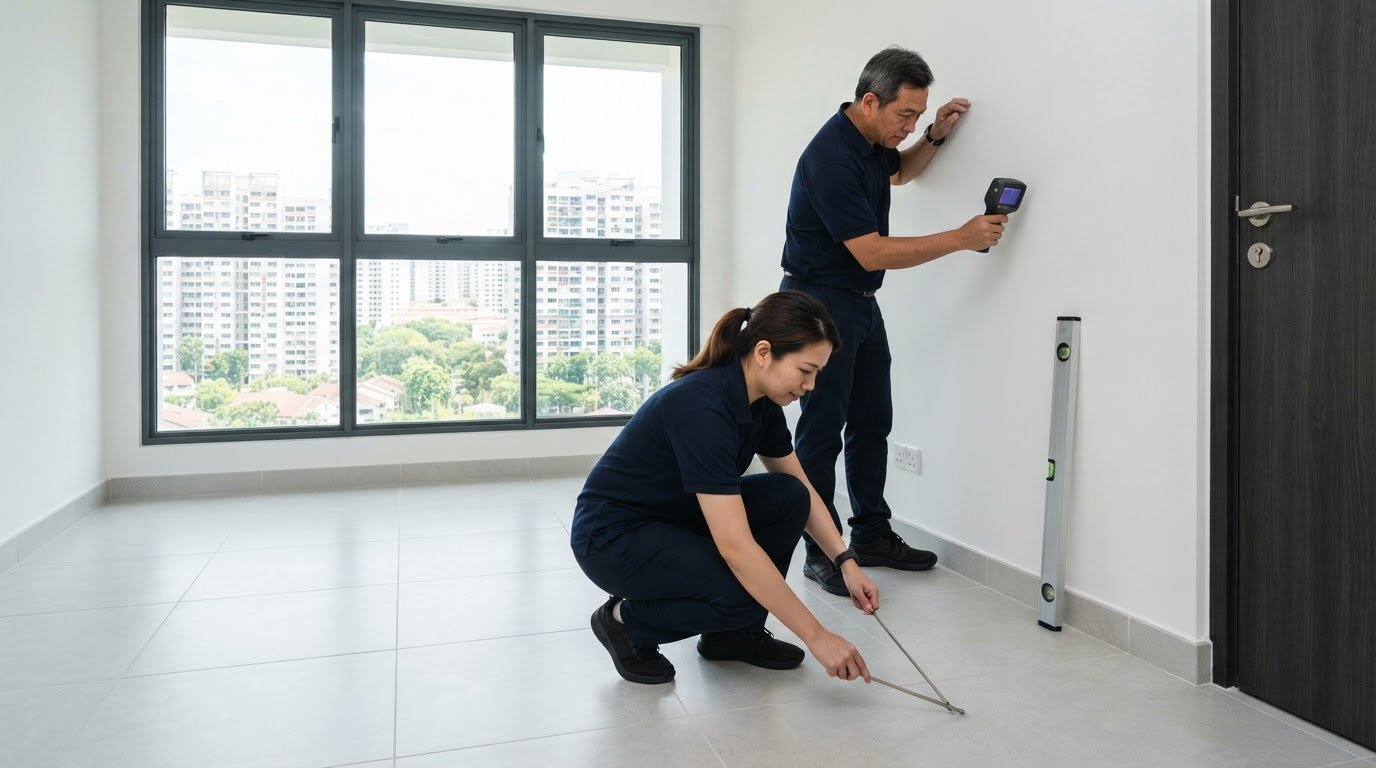
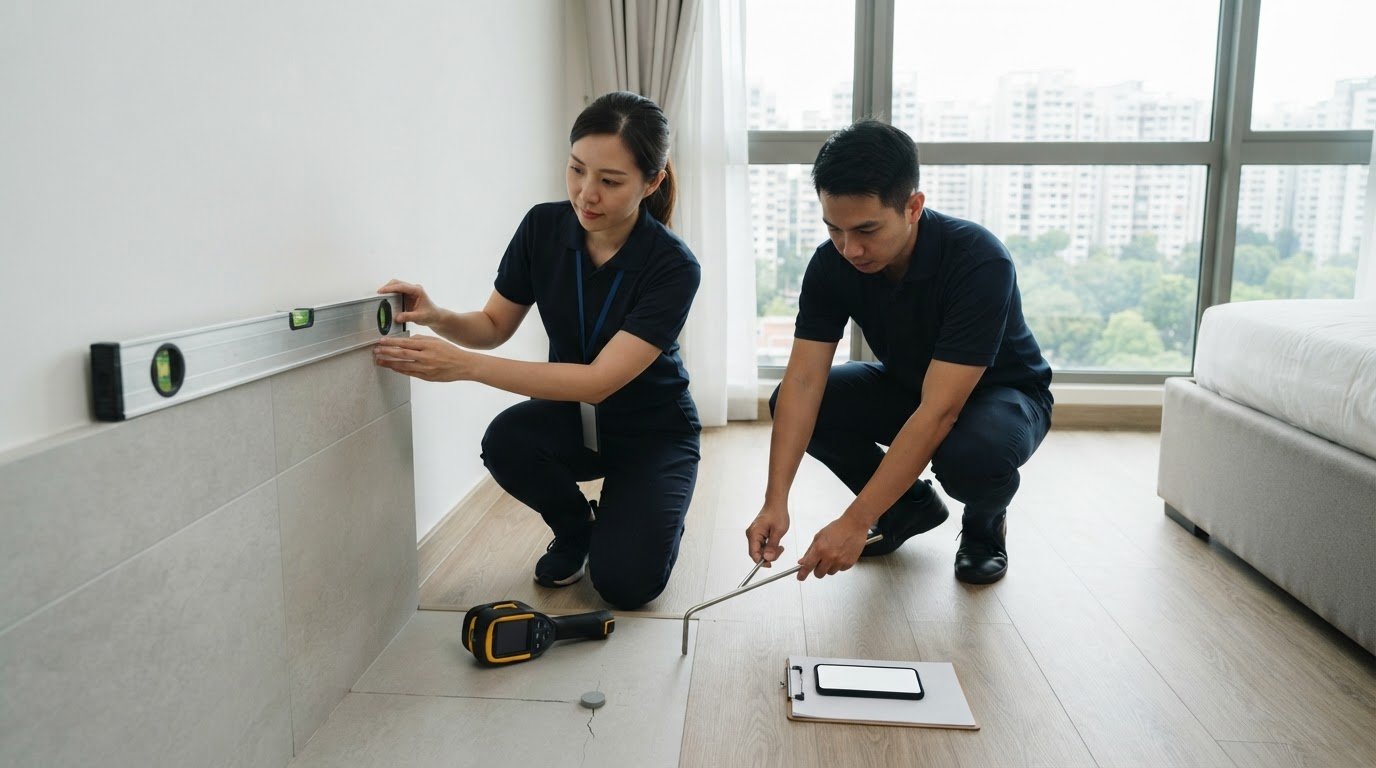
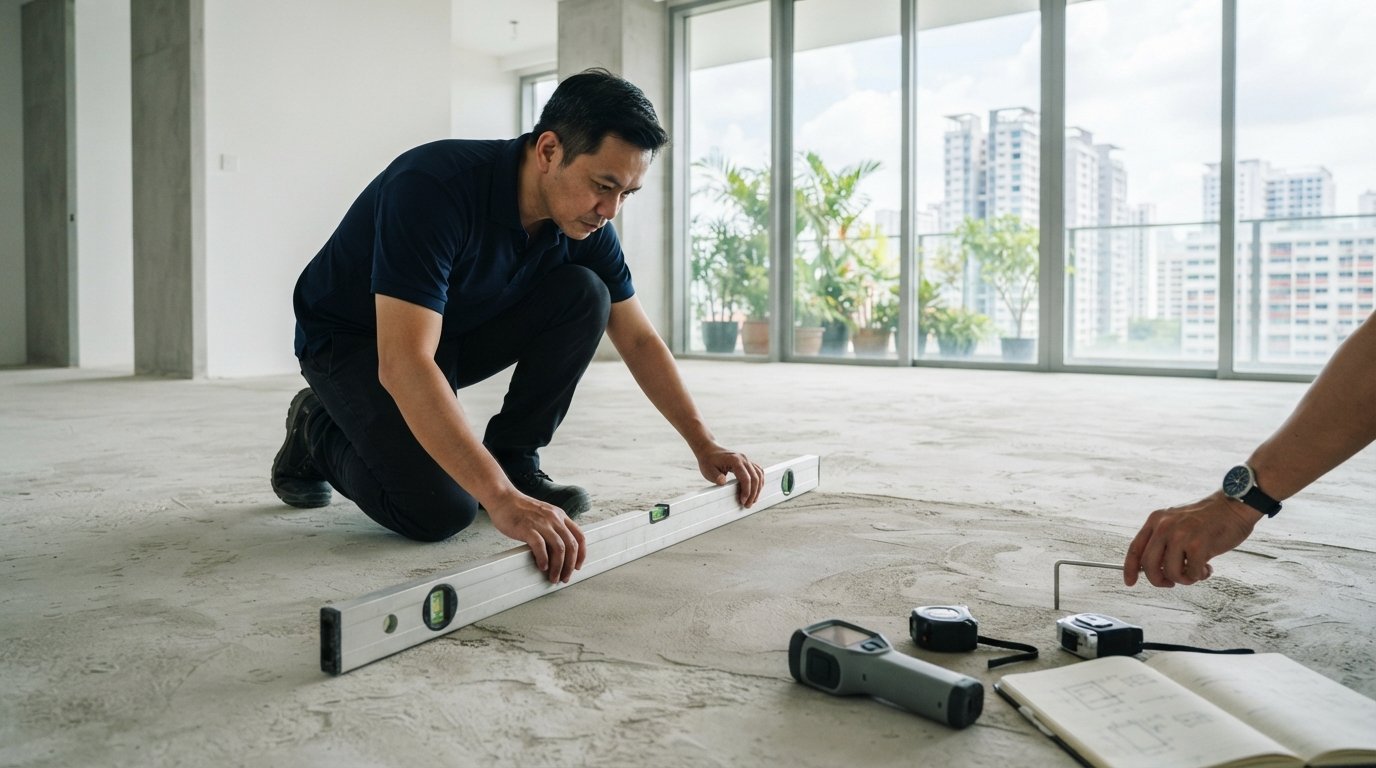
As the premier choice for a BTO defect check in Singapore, Prime Defectors Singapore acts as your protective shield during this transition. We specialise in identifying issues that the naked eye misses, using precision tools like tapping rods, spirit levels, and thermal scanners. Because we don’t provide renovation services, our reporting remains 100% honest and objective. This guide reveals the step-by-step process from the joint meeting with the developer to the final follow-up. We’ll show you how to ensure every rectification meets CONQUAS standards so you can hand over your unit to an interior designer with total peace of mind.
Key Takeaways
- Maximise your one-year Defects Liability Period (DLP) by submitting your report to the Building Service Centre (BSC) immediately after your initial check.
- Understand exactly what happens after BTO defect inspection, including the standard 14-to-21 day rectification timeline and the critical joint inspection with the developer.
- Ensure all repairs are verified with a follow-up inspection using technical tools like tapping rods to confirm that hollow tiles were replaced rather than simply grouted.
- Maintain a protective shield for your home by engaging professional defect checkers who specialise only in inspections and do not provide renovation services.
- Verify that all workmanship meets CONQUAS standards before officially concluding the Singapore property handover and starting your interior design works.
The Post-Inspection Timeline: Submission and the 30-Day Window
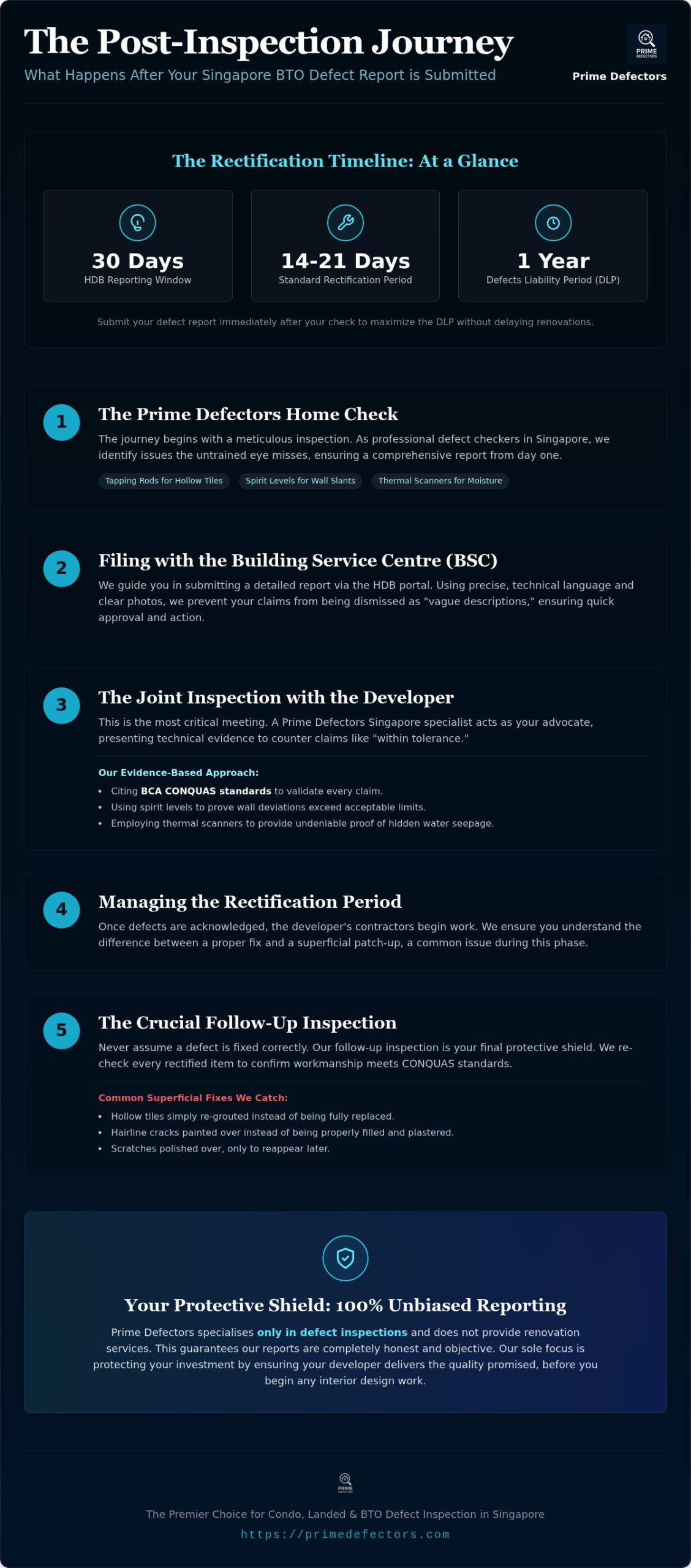
Once the physical check is complete, the clock starts ticking. Understanding what happens after BTO defect inspection is submitted is vital for protecting your investment. Prime Defectors recommends filing your report immediately. While HDB suggests reporting defects within 7 days of key collection, the official window for rectification before renovation is generally 30 days. Submitting early ensures you maximise the one-year Defects Liability Period (DLP) without delaying your move-in date. Waiting too long can lead to disputes over whether a scratch was caused by the developer or your own delivery personnel.
Filing Your Defects with the Building Service Centre (BSC) in Singapore
The Housing & Development Board (HDB) provides an online portal to streamline this process. You’ll need to upload clear photos and concise descriptions for every issue found during your BTO defect inspection Singapore. The digital submission acts as a formal record, but physical presence in the unit is still required for the contractors to locate the issues. Follow these steps for an efficient filing:
- Log in to the HDB portal using your Singpass and navigate to the defect reporting section.
- Upload photos that show both the specific defect and its location within the room.
- Use precise tags, such as “Master Bedroom, Right Wall, Uneven Plastering,” to guide the BSC contractors.
This transition from the Temporary Occupation Permit (TOP) stage to active maintenance requires clear communication. Tagging defects with physical stickers in the unit is just as important as the digital filing. It acts as a visual map for the rectification team, preventing them from missing small but significant issues like hairline cracks or misaligned hinges.
Why a Prime Defectors Home Check Speeds Up Approval
Many homeowners fall into the “vague description” trap. Reporting that a “floor feels weird” often leads to rejected requests or superficial fixes. Prime Defectors Singapore uses technical terminology that BSC managers and contractors immediately recognise. Our specialists use tapping rods to identify hollow tiles and thermal scanners to detect hidden moisture, providing the technical evidence needed for quick approval. We ensure that your report speaks the language of the industry, leaving no room for interpretation or “ghosting” by the rectification team.
Using a professional BTO defect report template is far superior to hand-written notes. It ensures that critical HDB-specific issues, such as window sealant gaps or spirit level verified wall slants, are logged correctly the first time. Because Prime Defectors does not provide renovation services, our reports are 100% unbiased. We focus solely on your protection, ensuring the developer meets CONQUAS quality standards before you commit to expensive interior design works.
The Joint Inspection with Developers in Singapore
The joint inspection is the most critical meeting in your property journey. It’s the moment when you, or your representatives from Prime Defectors Singapore, meet the Building Service Centre (BSC) supervisor to verify the reported issues. Navigating what happens after BTO defect inspection requires a firm grasp of your rights as a homeowner. Many people feel intimidated when technical jargon is used to downplay genuine concerns. Having professional defect checkers Singapore by your side ensures a smooth defects checking experience, as we provide the evidence required to justify every claim.
One common tactic used by developers is claiming an issue is “within tolerance.” We counter this by using the Building and Construction Authority (BCA) CONQUAS standards. For example, if a wall appears slanted, we use spirit levels to prove the deviation exceeds allowable limits. For invisible threats like water seepage, Prime Defectors Singapore employs thermal scanners. These devices detect temperature differences behind walls, proving moisture presence that the naked eye cannot see. During a BTO defect inspection Singapore, this technical data is the only way to ensure hidden problems don’t become future liabilities.
Navigating Disagreements Over Rectification in Singapore
Disagreements often arise over aesthetic defects like minor scratches or uneven paintwork. While HDB focuses on functional issues, the CONQUAS manual provides clear benchmarks for workmanship quality. A Prime Defectors home check acts as your technical advocate during these disputes. If a developer refuses to fix a specific defect, we reference the relevant industry guidelines to support your case. Our goal is to ensure your unit meets the high standards promised at TOP, providing you with a 100% objective assessment because we never offer renovation services.
Finalising the Rectification List
Once the walk-through is complete, you’ll be asked to sign off on the final rectification list. This document is a binding agreement on what will be repaired before the official Singapore property handover is finalised. You should never sign a “blanket” waiver or a document that omits items you believe are critical. Typically, the rectification period takes between 14 to 21 days, staying well within your one-year DLP. If you’re unsure about the developer’s proposed timeline or the scope of work, you can speak with our team for guidance on what constitutes a reasonable repair schedule.
Managing the Rectification Period and DLP
After the joint inspection concludes, the rectification phase officially begins. Understanding what happens after BTO defect inspection involves managing your expectations during the standard 14-to-21 day repair window. While it’s tempting to check in every day, you don’t need to hover over the BSC contractors. Instead, rely on your Prime Defectors home check log to systematically track which items are “in progress” and which have been resolved. If the repairs stretch beyond the promised HDB timeline, a polite but firm inquiry with the BSC supervisor is usually enough to get things back on track.
The 1-Year Defect Liability Period (DLP) in Singapore Property
The one-year DLP is a homeowner’s most vital safety net. It covers patent defects, which are visible issues like the hollow tiles we identify using tapping rods, and latent defects that only surface after you’ve moved in. Some problems, like window leaks or external water seepage, might only appear during Singapore’s heavy monsoon seasons. Prime Defectors uses thermal scanners to detect early signs of moisture behind walls, helping you catch these latent issues before they cause significant damage. This technical foresight ensures you’re fully protected throughout the first year of ownership.
Protecting Your Rights Under HDB Guidelines
Maintaining a detailed record of every interaction is your best defense against poor workmanship. You should document the “before and after” state of every repair to ensure no secondary damage was caused during the fix. If the BSC remains non-responsive or the repairs are consistently below CONQUAS standards, you have the right to escalate the issue to the HDB Branch Office. Prime Defectors Singapore provides the technical evidence required for such escalations. Because we specialise only in inspection and never renovation, our findings are 100% objective, serving as a protective shield for your investment.
The Crucial Follow-Up Inspection: Verifying the Fix
Many homeowners assume the process ends once the BSC notifies them that repairs are complete. However, understanding what happens after BTO defect inspection requires a second, more rigorous verification phase. At Prime Defectors, we’ve seen countless instances where contractors use “cosmetic masking” to hide structural or workmanship issues. A fresh coat of paint might hide a hairline crack, but it doesn’t solve the underlying movement. This is why a follow-up inspection is non-negotiable before you sign the final handover documents and begin your renovation.
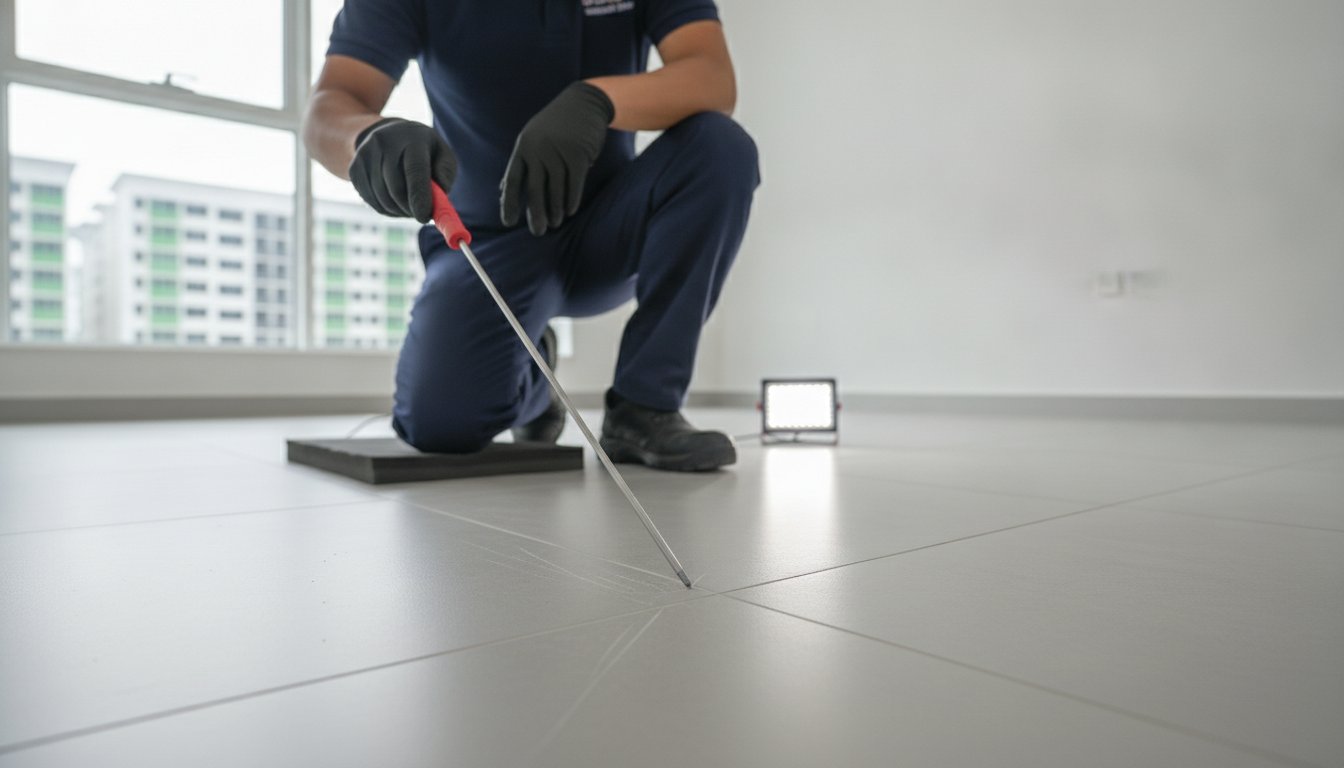
Our specialists use tapping rods to re-examine every tile that was previously marked as hollow. It’s common for contractors to simply inject grout into the edges rather than replacing the tile entirely. This “patch job” often fails within months of moving in. We also use spirit levels to verify that realigned doors and window frames are truly plumb and square. Without these professional tools, you’re essentially guessing whether the fix was done to CONQUAS standards or just patched up to pass a visual check. Prime Defectors Singapore acts as your technical eyes, ensuring that “rectified” actually means “fixed.”
Verifying Repairs to Singapore Home Inspection Standards
Prime Defectors Singapore follows a systematic process for every follow-up. We don’t just look at the stickers; we re-test the functionality of the entire unit to ensure no new problems were created during the repair process. This includes re-checking electrical points for proper grounding and measuring water pressure across all taps. We often recommend a second “flood test” for bathrooms if tiles were replaced. A 24-hour flood test is the only way to ensure waterproofing remains intact. We also re-scan previously damp areas with thermal imagers to confirm that seepage issues are fully resolved and not just dried out temporarily.
What if the Repairs are Unsatisfactory?
If our professional defect checkers Singapore find that the repairs are substandard, you have every right to reject the work. Prime Defectors documents these failed repairs with technical evidence, making it much harder for the BSC to argue that the issue is resolved. We provide a clear protocol for rejecting a repair and requesting a second rectification. You should only provide the final sign-off when every item on the original list meets the required quality benchmarks. Accepting the unit too early can complicate your relationship with your interior designer later. To ensure your home is truly ready, you can book a follow-up inspection with our team to verify every fix.
Transitioning to Renovation: Why Unbiased Advice Matters
The final stage of the property journey is the most rewarding, but it requires a disciplined approach to avoid long-term financial headaches. Understanding what happens after BTO defect inspection is complete involves a clear hand-off to your interior designer (ID). At Prime Defectors, we maintain a strict policy: we specialise in inspection only and never provide renovation services. This distinction is vital for your protection. When an inspection firm also offers renovation, a conflict of interest arises. They might overlook certain developer defects just to secure your renovation contract or, conversely, exaggerate issues to justify their own repair services. Our 100% honest report guarantee ensures that your interests always come first.
Handing over your “cleared” unit to an ID is a significant milestone in the Singapore property handover process. By this stage, every hollow tile identified by our tapping rods and every moisture spot caught by our thermal scanners should be rectified to CONQUAS standards. When you brief your ID, you can do so with total confidence, knowing that the foundation of your home is structurally sound and functional. Prime Defectors Singapore acts as your technical mentor, providing the documentation you need to prove that the unit was in perfect condition before the first hammer was swung.
The Danger of Premature Renovation in Singapore
Starting your renovation before the BSC completes all rectifications is a major risk. HDB guidelines are clear: once you begin hacking or tiling, you may void your Defect Liability Period (DLP) for those specific areas. If your ID “covers up” an existing defect, such as a hairline crack or a plumbing leak, HDB will no longer be responsible for the repair. The cost-benefit of waiting an extra two weeks for perfect rectification far outweighs the risk of paying for expensive repairs out of your own pocket later. Professional defect checkers Singapore always advise patience; ensuring the developer fixes their own mistakes is the only way to safeguard your renovation budget.
Final Checklist Before Handing Over the Keys to Your ID
Before you officially hand over the keys, ensure you have a complete paper trail of the rectification process. Reference the Singapore Home Inspection Standards during your final walkthrough to ensure no corners were cut. Prime Defectors Singapore recommends this final checklist:
- Confirm all BSC works are signed off in the official portal and the unit is cleared of contractor debris.
- Update your home insurance to cover renovation works now that the BTO defect inspection Singapore phase is over.
- Verify that all spirit level checks for wall evenness and door alignment remain within tolerance after the final fix.
If you have any lingering doubts about a specific repair, don’t hesitate to reach out. Prime Defectors is here to provide a final consultation, ensuring you move from the inspection phase to the creation phase with absolute peace of mind. Your home is likely your largest asset; let’s make sure it’s truly ready for its transformation.
Securing Your Singapore Home for the Future
Understanding exactly what happens after BTO defect inspection is submitted is the only way to navigate the Defects Liability Period (DLP) with confidence. By following the timeline from joint inspection to the final follow-up, you ensure that every repair meets CONQUAS standards before you begin your renovation. Prime Defectors provides the technical expertise and advanced tools, such as thermal scanners and tapping rods, needed to verify that every issue is truly resolved. Because we don’t provide renovation services, Prime Defectors Singapore offers 100% objective reporting as your protective shield.
Your new chapter in your BTO flat starts with a solid foundation and total peace of mind. Prime Defectors Singapore is here to ensure your property remains a safe and valuable asset for years to come. It’s about more than just a check; Prime Defectors specialises in technical precision to eliminate the uncertainty of property handover. Prime Defectors advocates for your rights throughout the rectification process. Don’t let hidden issues become expensive repairs. Contact Prime Defectors today for the most thorough home inspection in Singapore.
Frequently Asked Questions
How long does the developer have to fix BTO defects in Singapore?
HDB usually completes repairs within less than two weeks for standard issues. However, for more complex structural or plumbing rectifications, the timeline typically extends to 14 or 21 days. It is a key step in understanding what happens after BTO defect inspection is submitted to the BSC. Monitoring this period closely during the Defects Liability Period (DLP) ensures the developer remains accountable and avoids unnecessary delays before your renovation begins.
Can I start my renovation before the BTO defect inspection is completed?
You should never start renovation works before the BTO defect inspection Singapore is completed and all rectifications are finalised. Doing so can void your HDB warranty for those specific areas, as it becomes difficult to determine if a defect was caused by the developer or your contractor. Completing the entire follow-up inspection process first ensures your unit is in peak condition before you officially hand the keys over to your interior designer.
What happens if HDB says a defect is “within acceptable range”?
When a developer claims a defect is within tolerance, you should use technical evidence to counter the argument. Reference the Building and Construction Authority (BCA) CONQUAS standards to prove the workmanship falls below national benchmarks. By using precision tools like spirit levels for wall slants and tapping rods for hollow tiles, you provide the objective data needed to justify your request for rectification, ensuring your home meets the high quality standards promised at TOP.
Who should attend the joint inspection with the developer?
The homeowner should attend alongside professional defect checkers Singapore to ensure all reported issues are acknowledged by the BSC supervisor. Expert representation during this meeting acts as a technical advocate to prevent the developer from downplaying genuine concerns. This ensures every item on your list is verified and included in the official rectification document. You should never sign a final sign-off until you are certain that the scope of work is fully understood.
Is a follow-up inspection really necessary after the BSC says they are done?
A follow-up inspection is essential to verify that repairs were actually completed rather than just hidden. Contractors sometimes use cosmetic masking, such as paint or grout, to cover structural issues or hollow tiles. This step is a vital part of what happens after BTO defect inspection to ensure long-term durability. A secondary check confirms the root cause was addressed, providing peace of mind before you commit to expensive and permanent interior design works.
What is the 30-day reporting window for BTO flats?
HDB recommends that homeowners report all defects within 30 days of key collection and before starting any renovation works. While the DLP lasts for one year, reporting issues early makes it much easier to prove the developer’s liability for the damage. A professional BTO Defect Check Singapore helps you navigate this window by providing a comprehensive report immediately. This proactive approach ensures you don’t miss the critical deadline for free developer rectifications.
How do I submit my BTO defect list to HDB online?
You can submit your list through the HDB Building Service Centre online portal using your Singpass. You must upload clear photos and descriptions for each identified issue. A professional report format is easy to translate into the HDB system and reduces the risk of rejection. Using industry-standard terminology in your submission helps the BSC contractors understand exactly where the repairs are needed, leading to a much smoother and faster rectification process.
What tools do professional inspectors use for follow-up checks?
Professional defect checkers Singapore use specialised diagnostic tools to ensure every rectification meets safety and quality standards. These include tapping rods to identify hollow tiles, spirit levels to verify the plumb of walls and door frames, and thermal scanners to detect hidden moisture or leaks. These tools provide a level of precision that a visual check cannot match, ensuring your Singapore property handover is based on technical facts rather than just a superficial walkthrough.

Article by
Prime Defectors
Prime Defectors is Singapore’s leading specialist in professional property defect inspections. Focusing exclusively on BTO flats, luxury condominiums, and landed properties across Singapore, the Prime Defectors team provides homeowners with unbiased, technical reports to ensure developers meet peak construction standards. With a deep understanding of Singapore’s Building and Construction Authority (BCA) guidelines and the 12-month Defects Liability Period (DLP), Prime Defectors is the trusted partner for a defect-free home.