What if the defects that matter most are the ones you can’t spot at a glance? A fresh coat of paint and tidy finishes can make a new HDB flat or condo look ready, while functional or concealed issues remain unnoticed. These common defects missed by homeowners can be harder to identify during a quick walkthrough, especially if you’re unsure what to test as well as what to look at.
It’s natural to focus first on visible marks and uneven finishes. But a careful Singapore property handover check should also examine how fittings and surfaces function, and record each concern clearly. This guide explains which less obvious warning signs to look for, how to document them usefully, and when structured inspection support can help.
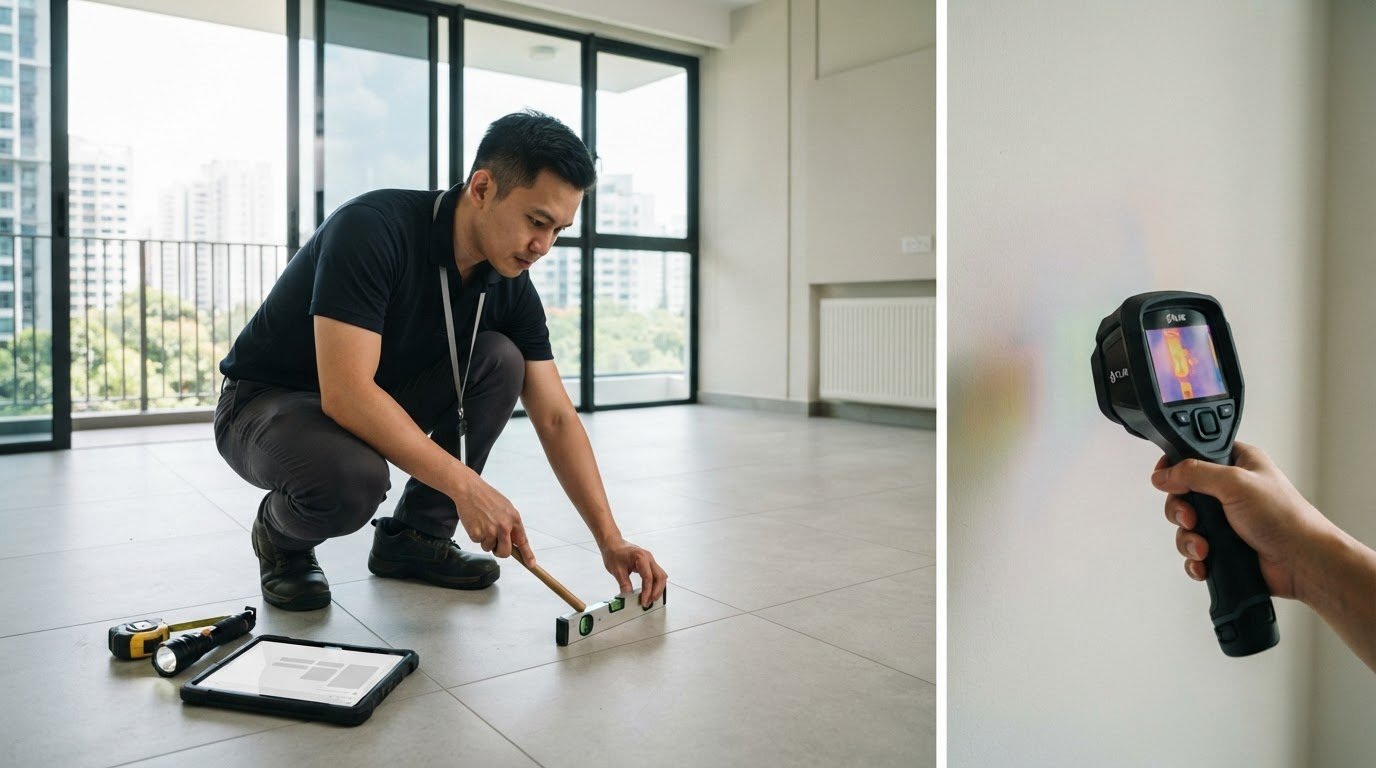
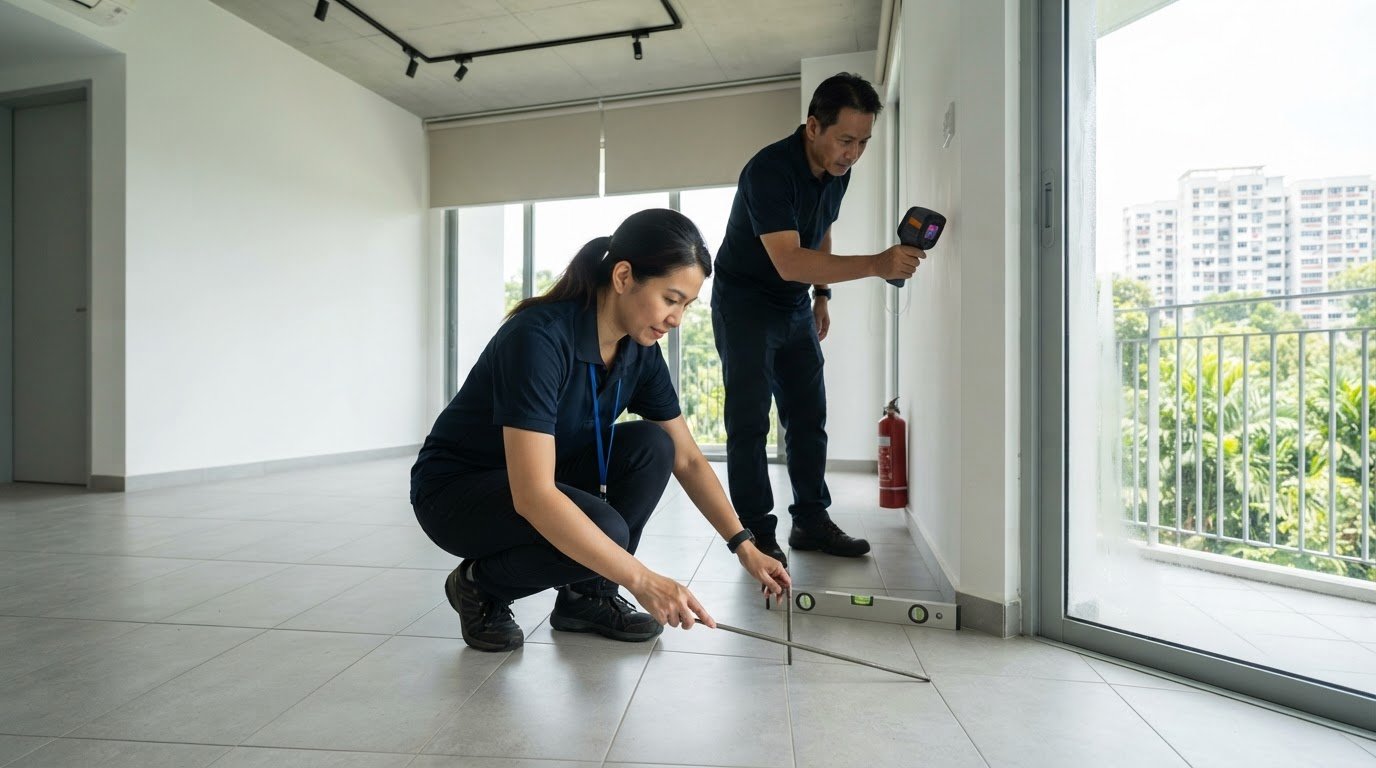
Prime Defectors provides residential defect inspections in Singapore, including BTO defect inspection Singapore. Prime Defectors Singapore focuses on inspection and reporting, not renovation or rectification. Tapping rods, spirit levels and thermal scanners support checks beyond a purely visual walkthrough, while clear records can make concerns easier to communicate during handover.
Key Takeaways
- Understand why common defects missed by homeowners can escape a quick, unstructured walkthrough.
- Learn to notice observable signs of moisture, drainage and electrical issues without assuming their cause.
- Use symptom-based notes to describe hollow tiles, uneven alignment and finish concerns clearly.
- Follow a simple room-by-room process: check accessible functions, record what you observe, then review your notes.
- See how structured inspection documentation can support a Singapore property handover, including a photo-rich, high-resolution report with precise location markings.
Why Common Home Defects Are Missed During a Singapore Walkthrough
A home can look neat and complete while a door catches, water drains slowly or a fitting fails during use. A “missed defect” is an issue overlooked during an initial, unstructured walkthrough. The gap often comes down to how people inspect: they move quickly, give some rooms more attention than others and rely on what they can see. That makes common defects missed by homeowners less likely to be obvious marks and more likely to be problems revealed by checking movement or function.
A good first impression is not the same as a complete inspection. A useful home inspection process considers condition and function, not appearance alone. During handover, a systematic approach helps you notice and record concerns without needing to know their cause.
Why a visual-only home check can miss workmanship problems
Paint marks and chipped surfaces attract attention, but visual checks alone won’t show whether a door moves smoothly, a window latch operates, water flows towards a floor trap or an electrical point works. Where access and safe operation allow, check the home in use. A concern can still be worth recording even if you can’t identify why it occurs.
Observation can also be uneven. A mirror may reflect light across a wall, bright lighting can obscure subtle surface changes, and furniture or stored items can block edges and corners. Rushing from room to room makes it easy to inspect the centre of a space while overlooking transitions, fittings or less-used areas. Slow down, change your viewing angle and note the exact location of anything unusual.
How Singapore handover terms shape the inspection context
In Singapore, HDB refers to the Housing & Development Board, and BTO means Build-To-Order, a type of HDB flat. For private property, TOP is the Temporary Occupation Permit. DLP means Defects Liability Period; for new HDB flats and private properties, the supplied guidance states that it is one year, though the start point differs for private properties.
Some developers recommend reporting defects within the first seven days as handover guidance, not as a universal legal deadline. HDB advises homeowners to report defects within one month of key collection and before renovation starts. Follow the instructions that apply to your home and record concerns promptly. A BTO defect inspection Singapore homeowners arrange can help structure the review around the relevant handover process.
CONQUAS provides project-level context on construction workmanship, but it doesn’t replace checking the condition of an individual unit. In a condominium, the MCST manages common property; unit concerns and shared-area issues may therefore follow different channels. These terms help frame the Singapore property handover, but careful observation and clear notes remain essential across HDB, BTO and private homes.
Hidden Moisture and Functional Defects to Watch for in Singapore Homes
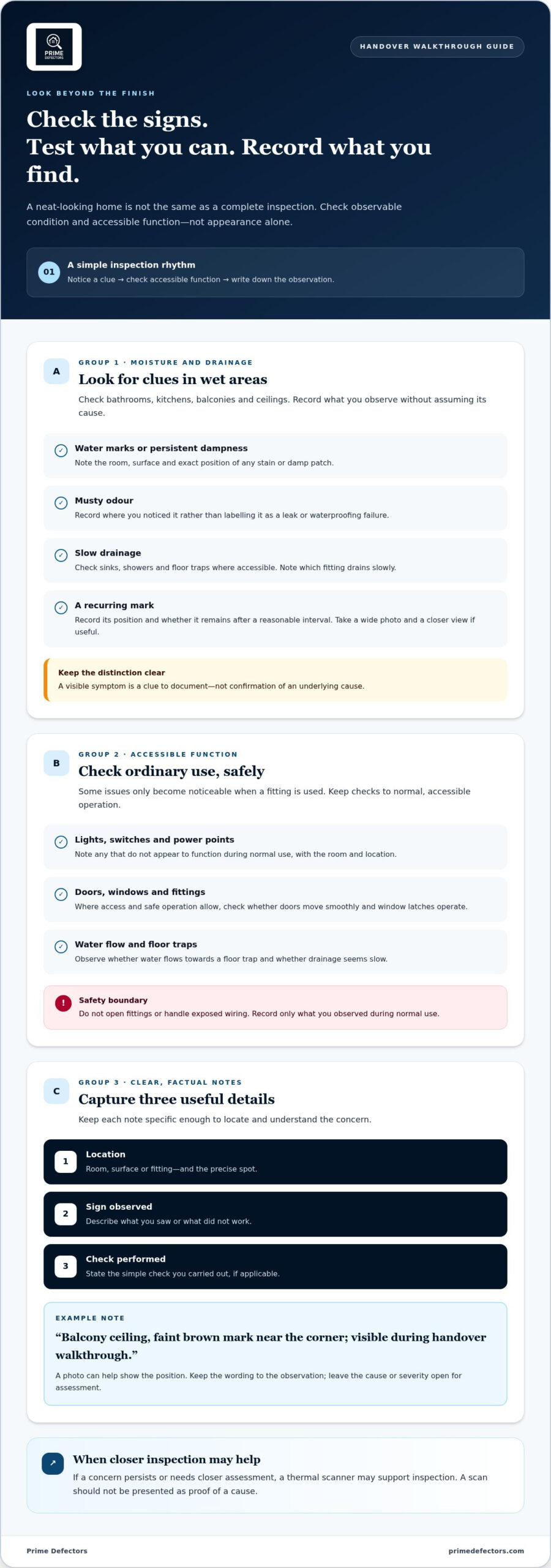
A fresh-looking surface doesn’t tell you whether water drains properly or fittings work as intended. During a Singapore home inspection, pay attention to moisture clues and functional checks alongside the visible condition of the room. Record what you observe, where it appears and whether it changes during a simple check. A single sign deserves attention, but it isn’t proof of a hidden failure.
A visible symptom is a clue to document, not confirmation of its underlying cause. That distinction keeps your notes useful and factual. Describe the observation first, then leave assessment of its cause or severity to a suitable inspection process.
Water seepage, waterproofing and drainage clues
Check bathrooms, kitchens, balconies and ceilings for water stains, persistent dampness or a musty odour. Note slow drainage in sinks, showers or floor traps, too. Be specific: record the room, surface or fitting, what you noticed, and whether the sign remained after a reasonable interval. Avoid labelling a mark as a leak or waterproofing failure before it has been assessed.
Look around the edges of wet areas and beneath accessible sinks without dismantling fittings. If you notice a recurring mark, record its position and take a clear photo from a wider view and a closer angle. A deeper water seepage detection guide can explain what further assessment may involve; your handover notes should still distinguish what you saw from what you suspect.
Electrical and other functional issues a quick glance can miss
A switch or power point can look intact but still warrant a check if it doesn’t appear to function during normal use. Note non-working lights, switches or power points by room and location. Don’t open fittings or handle exposed wiring. Keep the record to observable facts, such as “bedroom ceiling light did not turn on when its switch was used,” rather than guessing at an electrical fault.
Functional checks matter in a condominium as well as an HDB flat. For example, a Condo defect Inspection Singapore may include noting a bathroom floor trap that drains slowly or a light that fails to operate. These observations help identify what needs attention without implying a cause.
How to record a clue without overdiagnosing it
Use a simple note: location, visible or functional sign, and the check you performed. For example, “Balcony ceiling, faint brown mark near the corner; visible during handover walkthrough.” Add a photo if it helps show the position. If the concern persists or needs closer assessment, a thermal scanner may support inspection, but a scan should not be presented as proof of a particular defect.
Consistent, careful notes make moisture and functional concerns easier to review later. For a structured home defect inspection in Singapore, the inspection focuses on documenting workmanship and functional issues, not providing renovation or rectification services.
Hollow Tiles, Alignment and Finish Defects That Are Easy to Overlook
Small differences in sound, level or alignment can be hard to spot in a tidy room, especially when you’re focused on more obvious marks. Treat them as observations, not diagnoses. A tile that sounds different when gently checked, a floor transition that feels uneven underfoot, or a door that catches may be worth recording, but none alone confirms the cause or extent of a defect.
For a useful handover record, describe what you noticed and where. Avoid conclusions such as “poor installation” unless a qualified assessment has established that. Common defects missed by homeowners become easier to review when notes are specific and neutral.
Hollow tiles and uneven flooring: what to note
Notice changes in sound across neighbouring tiles, visible cracks, or a change in level where floor finishes meet. Record the room, approximate position and a nearby landmark, such as “living room, two tiles beside the balcony door”. A professional may use a tapping rod or spirit level to support checks, without relying on an arbitrary homeowner threshold. For detailed technique, refer to a dedicated hollow-tile sound-test guide.
The exact location of a hollow-sounding tile helps the inspector find and assess the same spot.
Record the symptom, not a diagnosis
Use a simple symptom-versus-record format to keep your observations clear. Add a photo where it helps show the position or extent, and note the date if you’re tracking a concern over time.
| What you notice | What to record |
|---|---|
| A tile sounds different from nearby tiles | Room, tile position, nearby landmark and the area checked |
| A floor transition feels uneven | Which two floor areas meet and where the change occurs |
| A wall or ceiling has a visible crack | Room, surface, approximate length or position, and a clear photo |
| Paint or carpentry has a visible irregularity | Exact location and a plain description of what looks uneven, chipped or misaligned |
Doors, windows, silicone and surface finish
Check whether doors open and close smoothly, and note if a door sticks or appears out of alignment. For windows, record visible gaps or parts that don’t sit evenly, without adjusting or forcing them. Damaged or incomplete-looking sealant is another observation to describe by location, not proof of a particular underlying issue.
Look separately at paint, ceilings, flooring and carpentry. Examples include an uneven paint edge, a ceiling finish that appears inconsistent, a floorboard that shifts under normal foot pressure, or a cabinet door that does not sit flush. Keep each note focused on one place and one symptom so it can be assessed clearly.
A Landed Defect Check Singapore inspection may involve different spaces and finishes from a BTO flat or condominium. Tapping rods and spirit levels support inspection and documentation. Clear location details help turn a quick observation into a useful record without overstating what it proves.
A Practical Singapore Home Inspection Method for Recording What You Find
A repeatable method makes it easier to capture concerns without turning a walkthrough into a rushed checklist. This is a practical way to organise your observations, not a complete BTO key-collection or room-by-room inspection guide. For a BTO Defect Check Singapore, follow the relevant handover instructions and keep your own clear record.
- Move through the home room by room. Follow a consistent route, such as starting at the entrance and moving through each space in turn. This helps reduce skipped areas and makes it easier to connect a note to the correct room later.
- Test accessible functions. Where safe and straightforward, operate doors, windows, switches and other fittings as intended. Record what happened, including if a function was not tested. Don’t dismantle fittings or handle exposed wiring.
- Record each concern as you find it. Note the room, precise location, date and observable symptom. Add whether a function was tested. Keep the description factual and avoid guessing at the cause.
- Review your notes before you finish. Check that each concern can be located by someone who wasn’t there. Add missing context or a clearer image while you can still identify the spot.
How to make a useful defect record
Take one image that shows the concern in the context of the room, then a closer image that captures the specific area. A concise note might read: “Study, beside the window, door catches when closing; tested during walkthrough.” This gives the reader a location, visible or functional observation and test result without claiming a cause.
A BTO defect report template can help you keep entries consistent. Use plain wording and avoid labels such as “structural failure” unless a qualified assessment establishes that conclusion. If an image is unclear, add a landmark or explain which side of the room you mean.
When structured inspection support adds clarity
Some concerns are difficult to assess through casual observation alone. Professional tools and trained observation can support broader defect documentation. Prime Defectors uses tapping rods, spirit levels and thermal scanners as inspection tools. These support the inspection process, but concerns should still be described in terms of what was observed rather than an assumed result.
Professional defect checkers Singapore homeowners engage can help make observations more systematic across different property types. A Prime Defectors home check is an inspection, not an invented package name; the company focuses on inspection and reporting, not renovation or rectification. Findings provide structured documentation, not a guarantee that a developer will accept or fix every claim.
If you’d like support documenting concerns during your Singapore property handover, contact Prime Defectors about a home inspection.
How Prime Defectors Supports Singapore Property Defect Documentation
Spotting a concern is only part of a useful handover inspection. The observation needs to be recorded clearly, linked to the right location and organised so it can be reviewed. Prime Defectors provides residential defect inspections and reporting for Singapore BTO flats, condominiums, landed homes and resale properties. The focus is on documenting workmanship and functional issues, not carrying out renovation or defect rectification.
For homeowners concerned about common defects missed by homeowners, a structured inspection can help bring consistency to the process. Professional tools, including tapping rods, spirit levels and thermal scanners, support the inspection alongside careful observation. The aim is clear documentation of findings, not a promise that a developer will accept or resolve every submission.
What homeowners receive from a documented defect inspection
Inspections are typically 2-4 hours, depending on the property’s size and complexity, and most inspections are scheduled within 1-3 days. Reports are delivered digitally within 48 hours of the site visit. The total turnaround time from booking to report is typically 48-72 hours. Each inspection report is photo-rich, high-resolution, with precise location markings, helping connect an observation to the relevant room or area for review.
This format can support different Singapore property handover contexts, whether you’re preparing for a BTO or HDB flat, a condominium, a landed home or a resale property. Clear location references are particularly useful when a home has several similar rooms or repeated fittings. They help make the record easier to follow without turning an observation into a technical diagnosis.
What happens after findings are documented
Findings can be lodged through Novade, FinalCAD, Funnel, or the developer’s own system. Developer defect forms can also be completed to support submission. The inspection findings provide documentation; the developer reviews submissions and determines how they are handled. An inspection does not guarantee that a developer will accept a claim or carry out rectification.
That distinction matters. Prime Defectors Singapore specialises in inspection and reporting, not renovation or rectification. Keeping the work focused on inspection supports objective documentation, while leaving decisions about acceptance and repairs with the relevant developer.
The service provides island-wide coverage from Jurong to Pasir Ris, Woodlands to Sentosa. Inspections are available 7 days a week, with operating hours Monday-Sunday 09:00 – 20:30. If you want structured support to document concerns at your property, contact the inspection team about documenting your property’s defects.
Take Your Next Handover Step with Confidence
A clear record gives you a practical starting point for deciding which concerns to raise and how to follow them up. Keep observations factual and use the relevant channel for your property, whether you’re receiving an HDB flat, a BTO home or a private property.
Common defects missed by homeowners aren’t always obvious at first glance. Taking a consistent approach to documenting them can help you communicate concerns with greater clarity. Prime Defectors Singapore supports homeowners with inspection and reporting, while the developer reviews any submission.
With a clearer record in hand, you can approach your Singapore property handover with more confidence and take the next step without assuming what the outcome will be.
Frequently Asked Questions
Must I report defects within 7 days of key collection?
No, the first 7 days are not a universal legal deadline. Developers often recommend reporting defects during this period, so follow the instructions for your property and keep a dated note of when you noticed each concern. The inspection team can guide you on timing and help document and submit defects promptly. Keep copies of your notes and any correspondence.
How long does an inspection and report take?
An inspection is typically 2-4 hours, depending on the property’s size and complexity. Reports are delivered digitally within 48 hours of the site visit, and the total turnaround time from booking to report is typically 48-72 hours. Most inspections are scheduled within 1-3 days. These are typical timeframes, not a guaranteed appointment. Allow time to arrange access and review your handover schedule when planning the visit.
Can defects be submitted through my developer’s system?
Yes. Findings can be lodged through Novade, FinalCAD, Funnel, or the developer’s own system, and developer defect forms can be completed to support submission. This helps organise the observations in the required format, but the developer reviews the findings and decides how to respond. Submission does not guarantee acceptance, repairs or a particular outcome. Keep a copy of what you submit for your records.
Are inspection reports recognised by developers?
Reports are photo-rich, high-resolution, with precise location markings. Images and clear descriptions can help communicate an observed issue, such as where it appears and what was noticed. The developer ultimately reviews each submitted claim, so acceptance or resolution isn’t automatic. A report is documentation to support communication, not a property warranty or a substitute for the developer’s decision.
Is there a property warranty or a guarantee that repairs will be made?
No. The inspection company does not provide a warranty on the property itself or guarantee that defects will be accepted or fixed. Its role is to document concerns and provide guidance that can help homeowners communicate with the developer or contractor. An inspection does not create or extend a property warranty. Keep relevant warranty documents and correspondence separately for reference when following up.
How many inspectors may attend a property inspection?
One or more trained inspectors may attend, depending on the property size and inspection needs. Larger properties typically have two inspectors, but the number isn’t fixed for every home. The scope of a landed property inspection, for example, may differ from that of a flat. Attendance can therefore vary; it shouldn’t be assumed that every property receives the same number of inspectors.
What tools can help identify defects that are hard to see?
Tapping rods, spirit levels and thermal scanners are among the tools used during inspections, alongside professional-grade equipment for measurement, detection and documentation. Each supports part of a systematic assessment, but no tool should be treated as revealing every hidden defect. Tools assist observation; clear, factual reporting remains essential. If you notice something unusual, record its location and what you observed rather than trying to diagnose it.

Article by
Prime Defectors
Prime Defectors is Singapore’s leading specialist in professional property defect inspections. Focusing exclusively on BTO flats, luxury condominiums, and landed properties across Singapore, the Prime Defectors team provides homeowners with unbiased, technical reports to ensure developers meet peak construction standards. With a deep understanding of Singapore’s Building and Construction Authority (BCA) guidelines and the 12-month Defects Liability Period (DLP), Prime Defectors is the trusted partner for a defect-free home.