
What if the sleek marble flooring in your new home is hiding structural voids that only surface after your renovation is complete? Collecting your keys at TOP is a major milestone, but it often comes with the nagging fear of latent defects and the complexity of developer disputes. At Prime Defectors, we understand that your property is a significant investment that deserves a professional-grade protective shield. As the premier choice for defect checks, Prime Defectors Singapore provides the technical expertise you need to ensure your home meets the latest CONQUAS standards before you commit to expensive interior design.
This comprehensive new condo inspection checklist Singapore is designed to help you master the property handover process with calm confidence. We specialise in identifying issues that the naked eye might miss, using precision tools like tapping rods, spirit levels, and thermal scanners. Because Prime Defectors does not provide renovation services, our reporting remains 100% honest and unbiased. You’ll gain a clear, technical roadmap for developer rectification, ensuring maximum asset protection and total peace of mind as you transition into your new space during the 12-month DLP.
Key Takeaways
- Learn how the 2026 DLP regulations provide homeowners more time to conduct a thorough audit after key collection and TOP.
- Follow a professional new condo inspection checklist Singapore designed for 2026 launches to systematically audit every corner of your home.
- Understand the importance of technical tools like tapping rods and thermal scanners in detecting hollow tiles and latent moisture issues before starting renovations.
- Secure an objective report from Prime Defectors Singapore, ensuring your defect check is free from the hidden agendas of renovation contractors.
- Navigate the joint inspection and rectification process with the developer to maintain high CONQUAS workmanship standards and protect your asset value.
Understanding the Condo DLP and Handover in Singapore
Prime Defectors stands as the premier choice for defect checks in Singapore, serving as a vigilant advocate for new homeowners. When you receive your keys, you aren’t just entering a new home; you’re entering a legal window known as the Defects Liability Period (DLP). As defined in the standard Sale and Purchase Agreement, the DLP is the timeframe during which the developer is contractually obligated to rectify construction flaws. Prime Defectors Singapore ensures that this window is used effectively, transforming a stressful process into a structured technical audit. Taking a professional home inspection approach is the only way to ensure your asset is protected before the responsibility of maintenance shifts entirely to you.
The Legal Timeline: TOP vs. Vacant Possession
The starting gun for your inspection journey is the Temporary Occupation Permit (TOP). However, the legal clock for the 12-month DLP follows specific 2026 regulations. It begins on either the date of vacant possession (key collection) or the 35th day after the TOP payment notice is issued, whichever is earlier. This 35-day rule is an extension from previous years, giving you a slightly larger buffer, but time remains your enemy. Delaying your Condo defect Inspection Singapore risks shortening the time available for complex rectifications. It’s also vital to distinguish between unit-specific issues and common area defects. While the MCST manages the latter, any internal flaws are strictly between you and the developer. Using a new condo inspection checklist Singapore helps you categorise these issues immediately so nothing falls through the cracks.
Why Your Renovation Schedule Depends on the Inspection
Your interior designer might be eager to start, but rushing into renovation is a costly mistake. Developers typically require a 2-4 week window to complete rectifications once a report is submitted. A Prime Defectors home check provides the documentation needed to hold developers accountable before any contractors step foot on-site. This is critical because most developers will reject claims once renovation begins. They often argue that surface alterations, such as hacking or painting, caused the defects or voided the original warranty. Prime Defectors specialises in identifying these issues early using precision tools like tapping rods and thermal scanners. Because we don’t offer renovation services, our findings are 100% objective, ensuring your Singapore property handover is based on technical facts rather than contractor convenience. Clearing your new condo inspection checklist Singapore first ensures your renovation starts on a flawless foundation.
The Essential Room-by-Room Condo Defect Inspection Checklist in Singapore
A systematic approach is the only way to ensure your unit meets the high benchmarks set by CONQUAS. Our new condo inspection checklist Singapore follows a rigorous “Surfaces, Openings, Water, Power” methodology. While many owners focus on cosmetic scratches, Prime Defectors prioritises structural integrity and functional safety. Adopting a BTO Defect Check Singapore standard of scrutiny is essential, even for luxury private developments, to ensure your developer delivers the quality you paid for. This technical depth is what distinguishes a professional audit from a casual walkthrough.
Living Areas and Bedrooms: Flooring and Walls
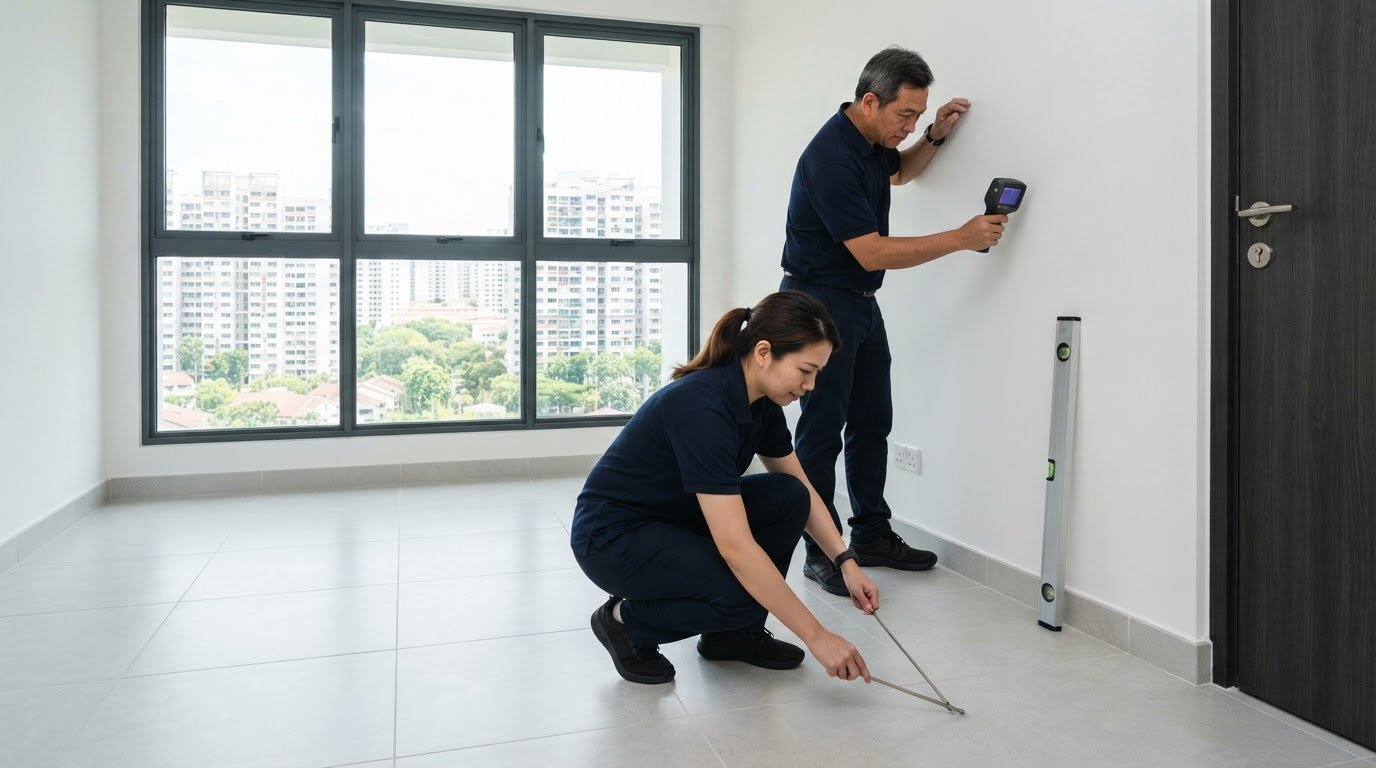
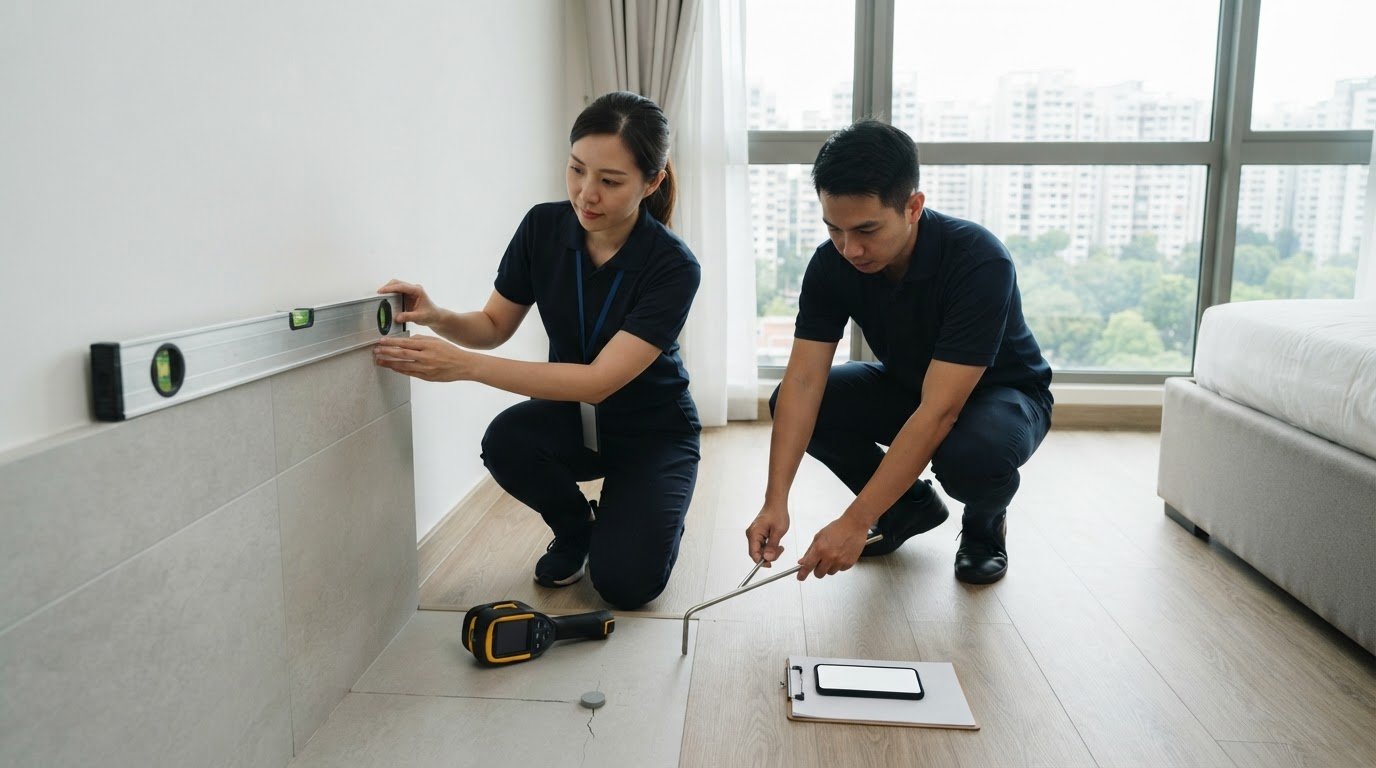
Hollow tiles are a common issue in new launches. If left unrectified, they eventually crack or pop up. Our team uses specialised tapping rods to check every single tile across your living room and bedrooms. We don’t just look for cracks; we listen for the hollow echo that indicates poor adhesive bonding. Wall alignment is equally critical. We use professional spirit levels to identify “waviness” or uneven plastering that might interfere with your carpentry installation. If your walls aren’t straight, your built-in wardrobes won’t sit flush against the surface.
Kitchen and Bathrooms: Plumbing and Waterproofing
The “Ponding Test” is a non-negotiable part of our process. We flood the bathroom floors to ensure the gradients lead correctly to the floor trap. Water should never stagnate in corners, as this leads to mould and hygiene issues. For more hidden threats, Prime Defectors Singapore employs thermal scanners to detect moisture behind walls or around window frames. This technical depth helps prevent future water seepage that could damage your neighbour’s ceiling. If you’re concerned about hidden leaks, you might want to book a professional assessment before your DLP expires.
Openings and Electrical: Windows, Doors, and Sockets
Singapore’s monsoon seasons are unforgiving to poorly sealed windows. We meticulously check window sealant gaps according to BCA’s inspection regulations. Any gap in the external silicone can lead to catastrophic leaks during heavy rain. Doors require similar precision; fire-rated doors must close and latch perfectly to maintain their safety rating. Finally, we verify every electrical point. Using socket testers, we ensure every outlet is live and properly grounded, preventing electrical hazards before you plug in your appliances. Every defect found is a step toward protecting your home’s long-term value.
Technical Tools Used by Prime Defectors Singapore
Our team positions itself as a tech-forward inspection firm because modern construction requires modern auditing. Relying on the “naked eye” is insufficient for a comprehensive new condo inspection checklist Singapore. Surface-level aesthetics can mask structural or functional failures that only reveal themselves after you’ve moved in. Technical precision eliminates uncertainty, providing you with a data-driven report to present to the developer. This methodology acts as a protective shield for your investment. For homeowners seeking this level of rigour, our Prime Defectors price list outlines our professional inspection packages designed for new launches.
Acoustic Tapping Rods vs. DIY Methods
Detecting hollow tiles is a matter of physics, not guesswork. We use specialised acoustic tapping rods designed to resonate at specific frequencies when hitting solid versus voided surfaces. Many laypeople suggest using a coin, but this DIY method is highly unreliable and often fails to identify deeper debonding. Identifying these voids early prevents floor tiles from popping or cracking under the weight of your furniture. This is a core component of any professional new condo inspection checklist Singapore, ensuring that your flooring meets CONQUAS standards for bonding and durability.
Thermal Scanners for Hidden Leaks
Water seepage is the most common latent defect in Singapore condos. Thermal scanning is a non-invasive method used to find latent moisture by detecting temperature variances behind walls or under flooring. Our thermal scanners allow us to see water tracking before it ever manifests as a visible stain or mould growth. We pay particular attention to air-con ledge drainage and window perimeters, where poor sealant application often leads to ingress during heavy storms. Catching these issues during the DLP saves you from expensive repairs once the developer’s liability ends.
Spirit Levels and Laser Markers
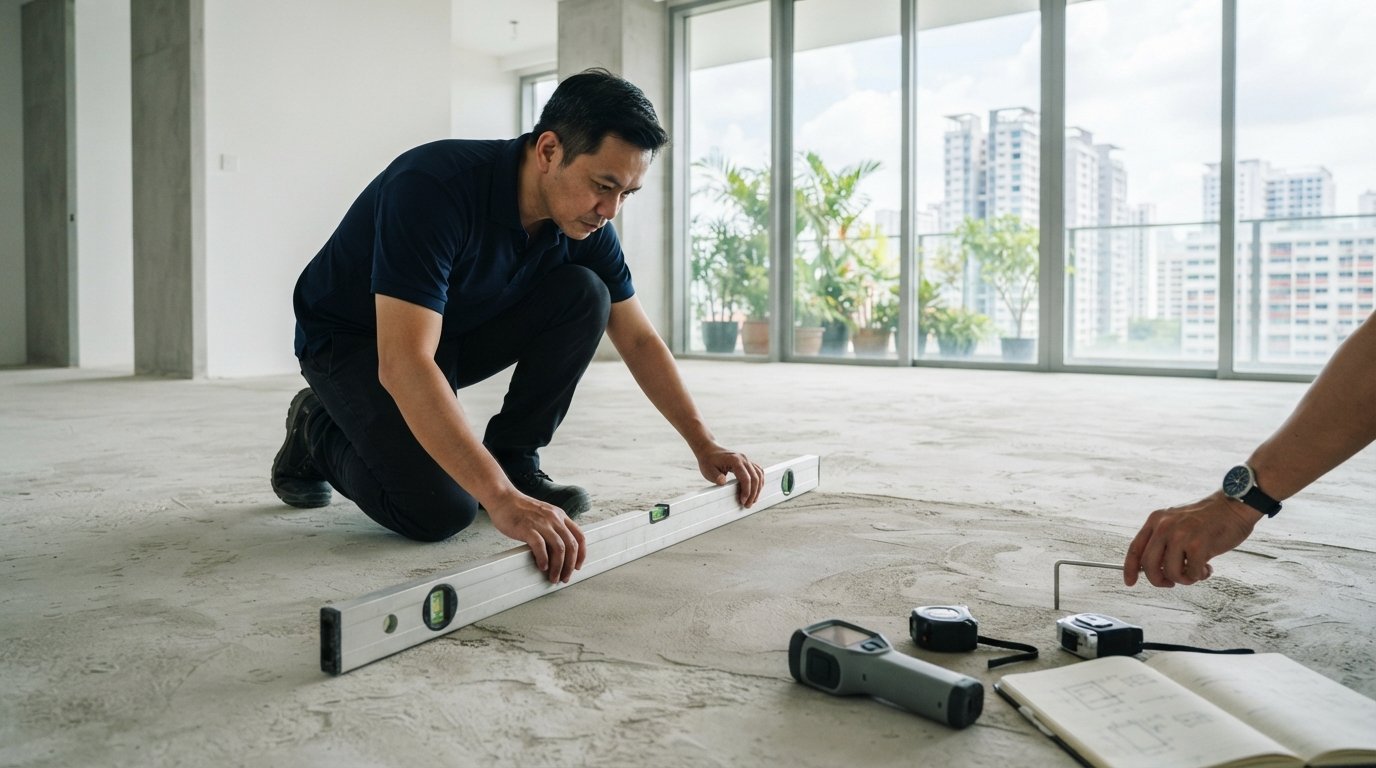
Structural sloping is often subtle but creates massive headaches for carpentry installation. Our inspectors use high-precision spirit levels to verify that floors and built-in cabinets are perfectly level. We complement this with laser alignment markers to ensure partition walls are vertically plumb. These tools provide the objective evidence required for a Professional defect checkers Singapore report. By documenting these deviations with technical tools, we remove any room for developer rebuttal during the joint inspection walkthrough. This technical depth ensures your home is not just beautiful, but built to the correct specifications.
Navigating the Developer Joint Inspection and Rectification in Singapore
The Singapore property handover is more than a simple key collection; it’s a critical legal transition. Once you’ve completed your new condo inspection checklist Singapore, the next step is the joint walkthrough with the developer’s representative. During this meeting, our team acts as your technical advocate, ensuring every identified flaw is acknowledged. Developers often push back on certain issues, claiming they fall within “acceptable CONQUAS tolerances.” Having a Condo defect Inspection Singapore expert present prevents you from being pressured into accepting subpar workmanship. We provide the technical evidence, derived from our tapping rods and spirit levels, to turn a subjective debate into an objective rectification request.
Documenting and Submitting the Defect List
The protocol for submission must be meticulous to avoid disputes. First, we perform a systematic tagging of every defect using professional markers that won’t damage surfaces. We then compile a digital defect report, complete with high-resolution photographic evidence and technical descriptions. This report is formatted for immediate submission via the developer’s dedicated portal or app. This structured approach ensures a clear paper trail, which is vital if latent defects surface later in the DLP. Prime Defectors ensures that your documentation is professional enough to withstand developer scrutiny.
The Re-inspection: Verifying Rectification
Never assume that a reported defect has been fixed correctly just because it looks better. A follow-up inspection is essential to ensure rectifications aren’t merely cosmetic. For instance, “fixing” a hollow tile by injecting resin can sometimes damage adjacent tiles or leave the original issue unresolved. We re-verify every point on the original list using our thermal scanners and tapping rods. Only when every technical requirement is met should you provide the final sign-off. This allows you to begin your renovation with total peace of mind, knowing your home’s foundation is sound. If you’re ready to start your journey, book your joint inspection support today.

Why Prime Defectors is Singapore’s Trusted Choice for Unbiased Checks
Choosing the right partner for your property audit is a decision that impacts the long-term health of your asset. Prime Defectors Singapore positions itself as a primary protective shield for homeowners, offering a level of objectivity that interior design firms simply cannot match. Many renovation companies offer “free” defect checks as a prelude to their design services, but this often creates a conflict of interest. They might overlook complex structural issues to expedite the start of their own work. At Prime Defectors, we don’t provide renovation or rectification services. This independence guarantees that our execution of your new condo inspection checklist Singapore is 100% honest, technical, and focused solely on your protection.
Our Commitment to Integrity and Precision
Integrity is the foundation of our methodology. We never accept referral fees from contractors or IDs, ensuring our loyalty remains strictly with the homeowner. Every one of our Professional defect checkers Singapore undergoes rigorous training to master the technical requirements of CONQUAS and the Building Control Act. We don’t just find scratches; we use precision tools like tapping rods, spirit levels, and thermal scanners to identify latent defects that could lead to expensive repairs later. The resulting reports are professional, data-heavy, and serve as legal-ready documents if a developer dispute arises during the DLP. Prime Defectors Singapore ensures that your developer is held to the highest possible standard of workmanship.
Protecting Your Investment Post-TOP
A defect-free unit is a high-value asset. Whether you’re an owner-occupier or a property investor, ensuring your unit is flawless post-TOP is essential for future resale value and tenant satisfaction. Our broad expertise across various property types, including our detailed BTO defect inspection Singapore guide, demonstrates our deep understanding of the local construction landscape. We apply the same technical rigour to high-end private developments as we do in a Landed Defect Check Singapore. By completing a new condo inspection checklist Singapore with technical precision, you eliminate the uncertainty of hidden flaws. Prime Defectors provides the peace of mind you need to move forward with your renovation, knowing your foundation is secure and your investment is protected.
Secure Your Singapore Property Investment for the Future
Securing your new home starts with a technical audit that looks far beyond surface-level aesthetics. By following a professional new condo inspection checklist Singapore, you ensure that every tile, pipe, and window seal meets high CONQUAS standards before your renovation begins. Prime Defectors acts as your dedicated advocate during the critical 12-month DLP, using high-precision tools like thermal scanners and tapping rods to provide 100% unbiased reporting. Because we don’t provide renovation services, our only priority is the long-term health of your asset. We identify the latent defects that others might miss, giving you the technical evidence needed for a smooth developer rectification process.
Whether you’ve just received your TOP for a BTO, a private condo, or a landed property, our Singapore-wide coverage ensures you collect your keys with total peace of mind. Your home is likely your largest investment; protect it with technical rigour. Don’t let hidden issues become expensive repairs. Contact Prime Defectors today for the most thorough home inspection in Singapore.
Frequently Asked Questions
How long does a professional condo defect inspection take in Singapore?
A professional inspection typically takes between 2 to 4 hours for a standard unit. Larger penthouses or multi-storey units can require more time. During this period, Prime Defectors meticulously audits every surface using specialized tools like tapping rods and spirit levels. This duration allows for a technical assessment that goes beyond a casual walkthrough, ensuring every hollow tile or wall misalignment is documented for the developer’s attention.
Can I still report defects after I have started my renovation?
Reporting defects after your renovation starts is extremely difficult and often results in rejected claims. Most developers argue that construction work or surface alterations caused the damage. Prime Defectors Singapore recommends completing your full audit immediately after key collection and TOP. This strategy ensures your unit is in its original state, making it impossible for the developer to shift blame for flaws identified during your new condo inspection checklist Singapore process.
What happens if the developer refuses to fix a defect I found?
If a developer refuses to rectify a legitimate defect, you should refer to the CONQUAS standards for acceptable workmanship. You can also escalate the matter through the Real Estate Developers’ Association of Singapore (REDAS) or seek legal mediation. A Prime Defectors home check provides the technical documentation needed to support your case. Having a professional report makes it much harder for developers to dismiss valid concerns as being within tolerance.
Is it worth paying for a professional defect checker for a new condo?
Paying for a professional audit is a strategic investment that protects your property’s long-term asset value. Professional defect checkers in Singapore identify hidden issues like moisture ingress or structural sloping that the naked eye misses. Using advanced tools like thermal scanners ensures you find latent defects before they become expensive repairs. Completing a new condo inspection checklist Singapore with technical experts provides the peace of mind needed before committing to a costly interior design.
What tools should I bring if I want to do a DIY defect check?
For a DIY check, you’ll need basic items like masking tape, markers, and a high-powered torch. However, DIY methods lack the precision of professional gear. Prime Defectors uses acoustic tapping rods to find hollow tiles and spirit levels to check floor gradients. Without these technical tools, you might miss structural flaws that only surface after your DLP ends. It’s always safer to rely on a technical audit to ensure total protection for your property.
Does the Defects Liability Period (DLP) cover common facilities like the gym or pool?
Yes, the DLP covers common facilities, but the reporting process is different from your private unit. Unlike an HDB flat where the town council might assist, the MCST (Management Corporation Strata Title) handles defects in the gym, pool, and hallways. If you notice issues in common areas, report them to the managing agent. For your internal space, our team ensures your private interests are shielded from the costs of poor developer workmanship.
How many rounds of rectification is the developer required to perform?
There isn’t a legal limit on the number of rectification rounds, but developers typically aim to finish within one or two attempts. If the first round of repairs is subpar, you should request a follow-up inspection. Prime Defectors Singapore can assist by re-verifying the “fixed” areas to ensure they meet technical standards. We ensure that rectifications aren’t just cosmetic patches, but permanent solutions that maintain the integrity of your condominium.
What is the difference between a patent defect and a latent defect?
A patent defect is a visible flaw, like a scratched window, while a latent defect is hidden and surfaces over time. Latent issues, such as water seepage or structural voids, are far more dangerous and expensive to fix. Prime Defectors uses thermal scanners to detect these hidden threats during the initial audit. Identifying these “invisible” problems early ensures they are rectified before your developer’s legal liability window narrows or expires.
Don’t let hidden issues become expensive repairs. Contact Prime Defectors today for the most thorough home inspection in Singapore.

Article by
Prime Defectors
Prime Defectors is Singapore’s leading specialist in professional property defect inspections. Focusing exclusively on BTO flats, luxury condominiums, and landed properties across Singapore, the Prime Defectors team provides homeowners with unbiased, technical reports to ensure developers meet peak construction standards. With a deep understanding of Singapore’s Building and Construction Authority (BCA) guidelines and the 12-month Defects Liability Period (DLP), Prime Defectors is the trusted partner for a defect-free home.