Your new 4-room BTO flat comes with a one-year Defect Liability Period, and every crack, hollow tile, and misaligned door frame that goes undetected before your renovation begins is a repair bill you’ll pay entirely out of your own pocket. That’s the reality most new HDB homeowners discover too late.
You already know that getting a professional defect check is the smart move. The real confusion kicks in when you start comparing quotes from different inspection firms, wondering what a fair 4-room BTO inspection fee actually covers and whether a cheaper option means a less thorough job. The worry is valid. An inspection that misses concealed water seepage or structural defects isn’t a saving; it’s a liability.
This guide cuts through the confusion. As one of Singapore’s most trusted names in unbiased property defect checks, Prime Defectors has helped countless homeowners understand exactly what they’re paying for and why it matters. Here, you’ll get a clear breakdown of fee structures, learn what professional tools like thermal scanners, tapping rods, and spirit levels actually reveal, and understand how a thorough inspection report strengthens your position when submitting defects to the Building Service Centre before your DLP window closes.
Key Takeaways
- Understanding what determines the 4-room BTO inspection fee helps you evaluate quotes accurately and avoid paying for less than you need — or more than you think you’re getting.
- A professional defect check covers far more than a visual walkthrough, with tools like thermal scanners and tapping rods uncovering hidden water seepage and hollow tiles that the naked eye will never catch.
- Not all inspections are equal — a “free” check bundled with interior design services carries an inherent conflict of interest that can cost you significantly more after renovation begins.
- The number of inspection rounds, including initial, joint, and follow-up visits, directly affects the total fee and the strength of your defect submission to the Building Service Centre within your DLP window.
- Prime Defectors Singapore’s strict separation from renovation and rectification services is the single most important reason their reports remain completely objective — and why that independence is worth every dollar of the fee.
Navigating the 4-room BTO Inspection Fee in Singapore
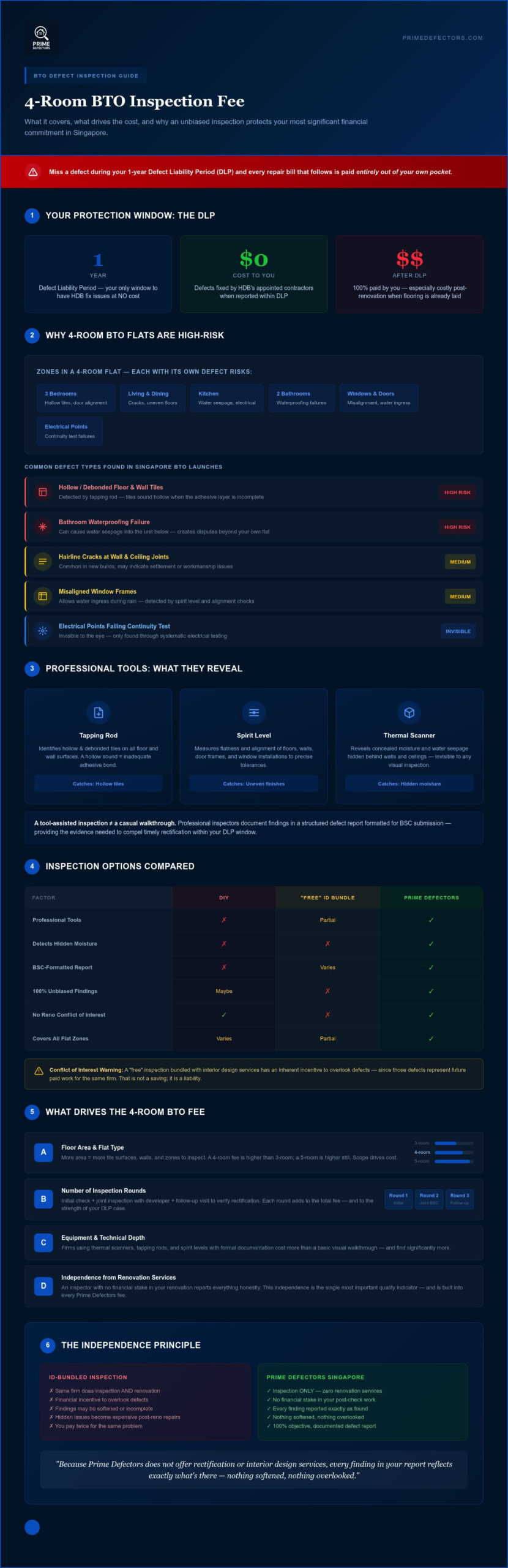
Think of the 4-room BTO inspection fee not as an expense, but as a calculated shield. Your flat represents one of the most significant financial commitments you’ll ever make, and the one-year Defects Liability Period is your single guaranteed window to have HDB’s appointed contractors fix workmanship issues at no cost to you. Miss a defect during that window, and every repair bill that follows lands squarely on your shoulders.
The professional fee you pay for a thorough inspection is a fraction of what a single concealed water seepage issue or a batch of hollow tiles costs to rectify post-renovation. Ripping up newly laid flooring to address a base-layer problem that existed before your ID started work is a painful and entirely avoidable situation. A proper inspection before renovation begins is the decision that protects everything that comes after.
What is a BTO Defect Inspection Fee?
A professional defect inspection fee covers a structured, tool-assisted assessment of your flat conducted by trained inspectors, not a casual walkthrough by a handyman with a torch. The deliverable isn’t just a verbal opinion; it’s a detailed, documented defect report formatted to support your submission to the Building Service Centre. That report is your evidence. Without it, your BSC submission lacks the specificity needed to compel timely rectification.
The fee for a 4-room flat is typically higher than that for a 3-room unit for a straightforward reason: there’s more to inspect. A larger floor area means more tile surfaces to tap for hollowness, more windows and door frames to check for alignment, more electrical points to test, and more wall surfaces to scan for concealed moisture. A 5-room flat carries a correspondingly higher fee still. The scope drives the cost, and understanding that relationship helps you evaluate any quote you receive with clear eyes.
Prime Defectors publishes transparent pricing so you know exactly what the fee covers before you commit. You can review the full breakdown at primedefectors.com/price-list.
Why 4-room BTO owners are the primary target for inspections
The 4-room flat sits at a particular intersection of complexity and risk. Its layout typically includes three bedrooms, a living area, a dining space, a kitchen, and two bathrooms, each zone carrying its own category of potential workmanship defects. Common issues found in recent Singapore BTO launches include hollow or debonded floor tiles, hairline cracks along wall and ceiling joints, poorly sealed bathroom waterproofing, misaligned window frames that allow water ingress, and electrical points that fail continuity testing.
These aren’t minor cosmetic concerns. A bathroom waterproofing failure, for instance, can cause water to seep into the unit below, creating a dispute that extends well beyond your own four walls.
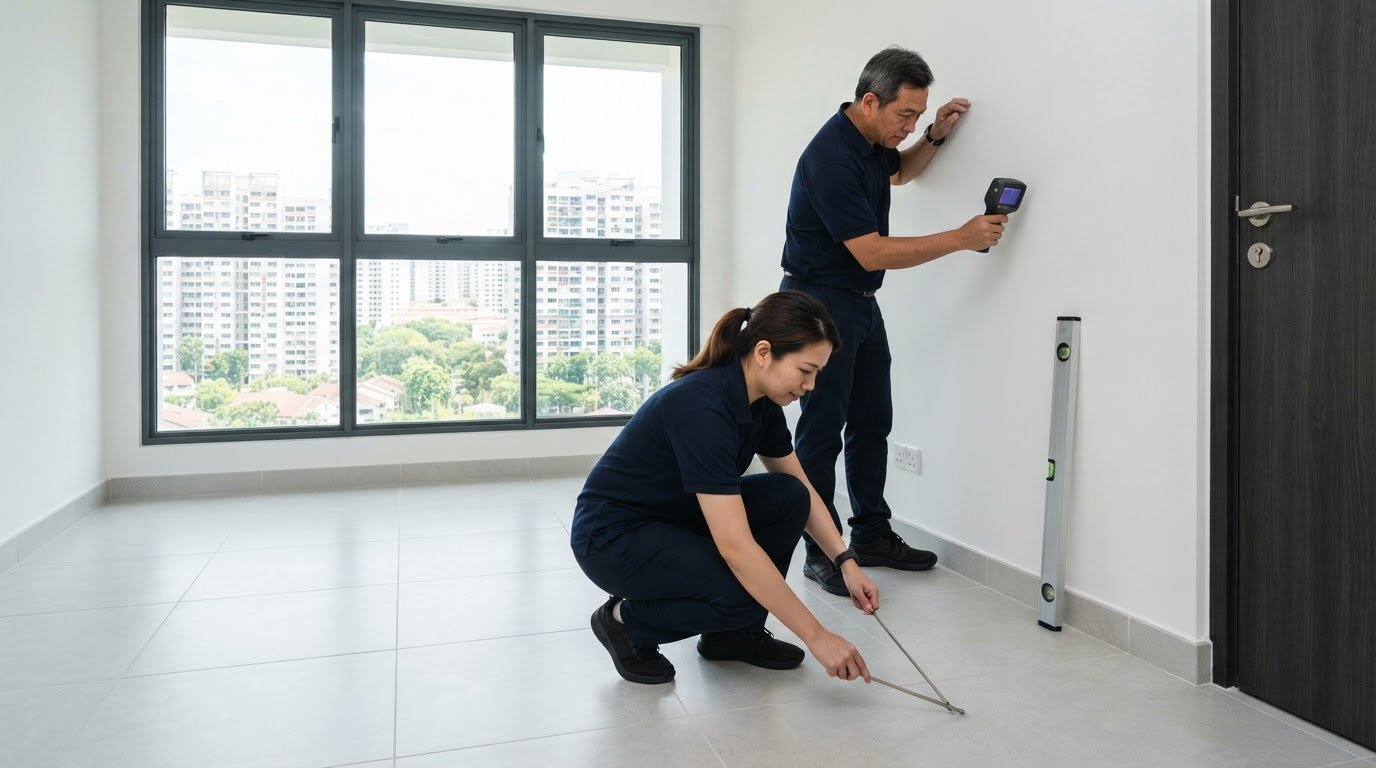
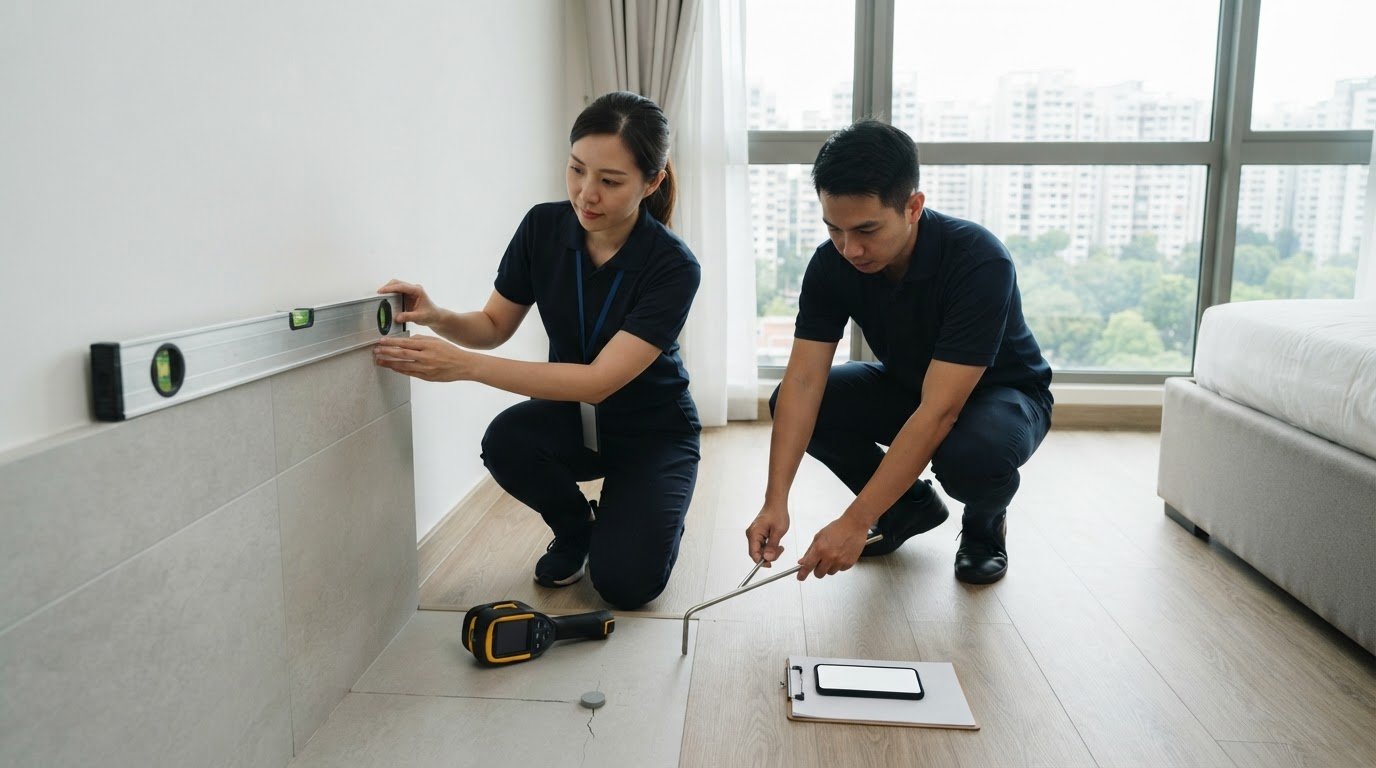
Prime Defectors Singapore approaches every 4-room handover as your advocate, not a neutral third party. Inspectors use tapping rods to identify hollow tiles across every floor and wall surface, spirit levels to detect uneven finishes, and thermal scanners to reveal moisture concealed behind walls and ceilings that no visual check would ever catch. The result is a comprehensive defect report that gives you the strongest possible foundation for your BSC submission within the DLP window.
Choosing Prime Defectors for your BTO defect inspection Singapore means choosing inspectors who have no financial interest in your renovation. Because Prime Defectors Singapore does not offer rectification or interior design services, every finding in your report reflects exactly what’s there, nothing softened, nothing overlooked. That independence is the core of what a genuinely professional 4-room BTO inspection fee should deliver.
Key Factors Influencing the Cost of Professional Defect Checks
Not all inspection fees are built the same way, and understanding what drives the cost helps you ask the right questions before you book. The 4-room BTO inspection fee is shaped by several variables: the technical depth of the inspection itself, how many site visits are included, the equipment deployed, and whether the service extends to joint inspections and follow-up checks. Each of these factors adds genuine value. Knowing which ones you’re paying for, and which ones might be quietly absent, is the difference between a thorough defect check and an expensive walkthrough.
Scope of Inspection and Technical Depth
A basic visual inspection covers what any observant homeowner could spot on their own: obvious cracks, scuffed paint, a door that doesn’t close cleanly. Professional defect checkers Singapore-wide distinguish themselves by going significantly further. The real value lies in what the naked eye cannot detect.
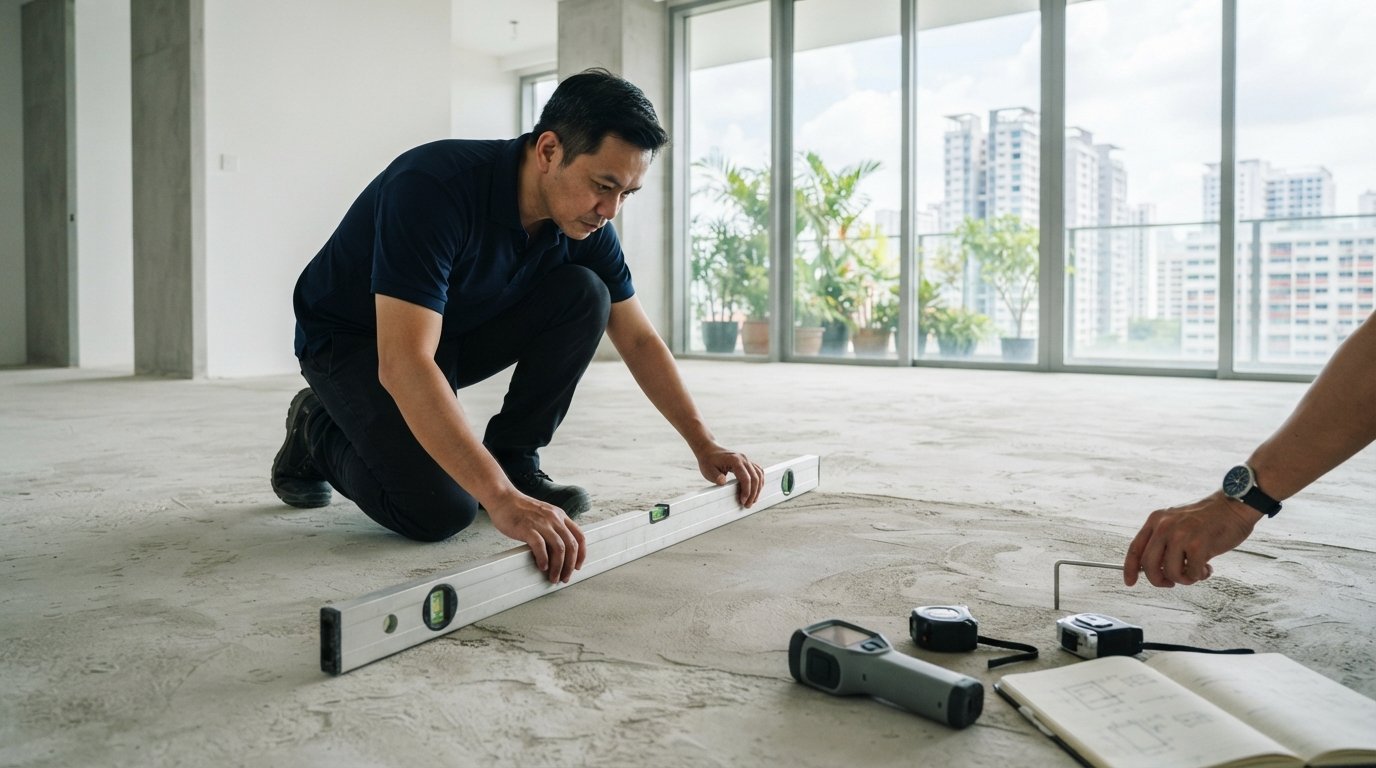
Tapping rods reveal hollow or debonded tiles across every floor and wall surface. Spirit levels identify uneven finishes that indicate poor workmanship on screeding or tiling. Thermal scanners detect moisture concealed behind walls and ceilings, the kind of water seepage that only becomes visible after it’s caused serious damage. These tools aren’t optional extras. They’re the reason a professional inspection catches defects that would otherwise surface after your renovation is complete and your DLP window has closed.
The deliverable matters just as much as the process. A professionally structured BTO defect report, formatted with clear photographic evidence, defect categories, and location references, gives the Building Service Centre exactly what it needs to act quickly. Vague descriptions delay rectification. Precise documentation accelerates it.
Joint Inspections and Follow-up Trips
This is where many homeowners are caught off guard by their final invoice. The initial inspection is one component. The joint inspection with the developer’s appointed contractor is a separate engagement entirely, and it carries its own fee for good reason.
Prime Defectors Singapore attends these joint inspections as your advocate on-site. Having an experienced inspector present when the contractor reviews flagged defects prevents two common problems: defects being minimised or dismissed, and agreed rectifications being recorded imprecisely. Without professional representation at this stage, homeowners frequently find that what was promised verbally doesn’t match what actually gets repaired.
Follow-up inspections, carried out after rectification work is completed, serve a similarly critical function. Substandard repairs do happen. A hollow tile that was supposedly fixed may still sound hollow. A sealed crack may reappear within weeks. A follow-up check by Prime Defectors confirms that every agreed rectification has been completed to an acceptable standard before your DLP expires.
- Initial inspection: Full tool-assisted assessment, documented defect report
- Joint inspection: On-site representation during contractor review of flagged defects
- Follow-up inspection: Verification that rectifications have been properly completed
Each round adds to the total fee, but each round also closes a gap that could otherwise cost you far more. When evaluating any quote, check specifically which of these visits are included and which are charged separately. Transparency here is a reliable indicator of the firm’s overall integrity.
If you’d like to understand exactly what each service tier covers before committing, speak with the Prime Defectors team directly for a clear, obligation-free breakdown tailored to your specific BTO project.
Comparing Professional Fees vs. DIY Risks and ID Bundles
There are three ways most 4-room BTO owners approach their defect check: hire a professional inspection firm, do it themselves, or accept the “free” inspection offered by their interior designer. Two of those three options carry risks that aren’t immediately obvious. Understanding exactly where those risks hide is what makes the 4-room BTO inspection fee from an independent firm so straightforward to justify.
The Conflict of Interest in ID-led Inspections
An interior designer offering a complimentary defect check isn’t doing it out of goodwill. They’re doing it because starting renovation faster is in their commercial interest. The moment your ID walks your flat before renovation begins, their priority is scoping the project, not cataloguing every hairline crack or hollow tile that HDB’s appointed contractor should fix for free.
This isn’t an accusation. It’s a structural reality. An ID who flags extensive defects faces two uncomfortable outcomes: a delayed project start while rectification is carried out, or a client who grows anxious about the flat’s condition and second-guesses the renovation scope. Neither outcome serves the ID’s business. So minor defects get minimised, borderline issues get absorbed into the renovation quote, and you end up paying your ID to fix problems that HDB was contractually obligated to resolve at no cost to you.
A genuine BTO Defect Check Singapore requires complete separation from renovation services. Prime Defectors Singapore does not offer interior design or rectification work. That’s not a gap in their service offering; it’s the foundation of their entire value proposition. Every defect in your report exists because it was found, not because flagging it serves anyone’s commercial agenda. That independence is what an unbiased report actually means in practice.
DIY Inspection vs. Professional Precision
A DIY check with a household torch and a knuckle-knock on the tiles will catch the obvious: a door that drags, a visible crack above the window frame, a bathroom fixture that wobbles. What it won’t catch is the hollow tile three rows in that sounds solid to an untrained ear, the window sealant gap invisible to the eye but detectable with a proper moisture assessment, or the concealed water seepage behind a bathroom wall that a thermal scanner identifies in seconds.
Professional defect checkers Singapore-wide operate against CONQUAS, the Construction Quality Assessment System that sets the workmanship benchmarks your BTO was built to meet. Knowing those standards exist is one thing. Knowing how to assess your flat against them, and document deviations in a format the Building Service Centre will accept, is another entirely. A handwritten list of observations from your own walkthrough carries no weight in a formal BSC submission. A structured defect report with photographic evidence, precise location references, and categorised findings does.
Consider the cost comparison plainly. Replacing hollow tiles after renovation is complete means pulling up your newly laid flooring, disposing of it, and starting again. That’s a rectification bill that dwarfs any professional inspection fee many times over. Catching those tiles before your ID lifts a single tool means HDB fixes them. For free. The maths aren’t complicated.
- ID-bundled “free” check: Inherent conflict of interest; findings shaped by renovation timelines
- DIY walkthrough: Limited to visible defects; no CONQUAS benchmark; BSC submissions lack credibility
- Professional independent inspection: Tool-assisted, documented, unbiased, and formatted for BSC submission
Prime Defectors brings tapping rods, spirit levels, and thermal scanners to every 4-room handover because those tools find what everything else misses. You can review exactly what’s included in the service at primedefectors.com/price-list before making any decision.
Technical Scope: What a Comprehensive 4-room BTO Check Includes
Knowing that a professional inspection is worth the 4-room BTO inspection fee is one thing. Understanding precisely what happens during those hours in your flat is another. A Prime Defectors inspection isn’t a structured stroll through each room with a clipboard. It’s a systematic, zone-by-zone assessment that treats every surface, fixture, and system as a potential failure point until proven otherwise.
A standard 4-room flat covers the living and dining area, three bedrooms, a kitchen, two bathrooms, and a service yard. Each zone carries its own defect profile. Bathrooms are high-risk for waterproofing failures. The kitchen floor is a common location for hollow tiles caused by poor adhesion during laying. Bedroom walls frequently reveal hairline cracks at plaster joints. Every zone gets the same disciplined attention, and the tools change depending on what’s being assessed.
Thermal scanners are deployed in wet areas and along external-facing walls. Where moisture is present behind a surface, the scanner detects the temperature differential that a dry wall simply doesn’t produce. This is how concealed water seepage in BTO toilets gets identified before it migrates into the unit below and becomes a neighbourly dispute. No visual check catches this. The thermal scanner does.
The percussion test covers every tiled surface. Inspectors use tapping rods methodically, working in rows across the living room, kitchen, and bathroom floors. A hollow tile produces a distinctly different acoustic response from a well-bonded one, and trained inspectors distinguish between the two consistently. Hollow tiles that go undetected before renovation begins become your problem the moment your ID’s workers start laying new flooring on top of them.
Window frames and door alignments are checked with spirit levels and manual operation tests. A misaligned window frame that allows even minor water ingress during heavy rain will cause paint bubbling, mould, and eventual structural staining. Door frames that bind or fail to latch securely are documented with precise location references so the BSC submission leaves no room for ambiguity.
Architectural and Aesthetic Checks
Wall plastering is assessed for unevenness, bulging, and delamination. Paintwork is checked for runs, bare patches, and inconsistent coverage. Spirit levels verify floor levelness across the screed, since an uneven base causes tiling problems that compound over time. Grout lines are inspected for gaps, inconsistent width, and signs of poor workmanship. Every finish is measured against what the developer’s specifications actually promised, not against a subjective standard.
Mechanical, Electrical, and Plumbing (MEP) Testing
Every power socket is tested for live current and correct polarity. The distribution board is checked for proper labelling, secure connections, and safe configuration. Bathroom waterproofing is assessed through visual inspection of sealed joints and, where accessible, wet-area falls are verified to confirm water drains toward the floor trap rather than pooling near walls. Window and door hardware, including handles, hinges, and locking mechanisms, is operated through its full range to confirm smooth function and structural security.
- Thermal scanning: Identifies concealed moisture behind walls and ceilings in wet areas
- Percussion testing: Tapping rods locate hollow or debonded tiles across all tiled surfaces
- Spirit level checks: Detects uneven screeding and floor levelness issues
- MEP testing: Every socket, the DB board, wet-area falls, and all hardware is assessed
- Alignment checks: Window frames and door frames verified for correct fit and watertight sealing
Every finding is documented with photographic evidence and precise location references, producing a defect report structured for immediate use in your BSC submission. This is the difference between a list of observations and a document that compels action.
Book your Prime Defectors inspection today and go into your handover with the technical coverage your flat actually requires.
Why Prime Defectors Singapore is the Premier Choice for Your 4-room BTO
Every firm in this space will tell you their inspectors are experienced. What they won’t always tell you is whether their business has a financial interest in what those inspectors find. That distinction is the entire reason Prime Defectors exists, and it’s the reason the 4-room BTO inspection fee you pay here delivers something that genuinely independent: a report shaped by nothing except what’s actually in your flat.
Prime Defectors is Singapore’s specialist for unbiased property defect checks across BTO, condominium, landed, and resale properties. The service is built around a single, non-negotiable principle: inspection and renovation must never sit in the same business. That separation isn’t incidental. It’s the architecture of trust that every report is built on.
Unbiased Reporting You Can Trust
Because Prime Defectors does not offer rectification or interior design services, there is no commercial incentive to soften a finding, delay a flag, or absorb a defect into a renovation scope. Every hollow tile, every misaligned frame, every thermal anomaly behind a bathroom wall gets documented with the same precision, regardless of how inconvenient it is for anyone else’s timeline. That’s what 100% objective defect reporting actually means in practice.
The practical consequence is significant. When your report identifies a waterproofing failure or a batch of debonded floor tiles, the developer’s appointed contractor carries the rectification obligation, not you. Your report is the instrument that enforces that obligation. A compromised report protects no one except the party who should be paying for the repair.
Prime Defectors Singapore delivers precision, transparency, and the complete elimination of uncertainty at every stage, from the initial tool-assisted assessment through joint inspection attendance to follow-up verification. You know what was found, why it matters, and what happens next.
Expertise and Tools for 2026 Standards
Singapore’s BTO programme continues to evolve, and so do the workmanship benchmarks that inspectors must assess against. Prime Defectors’ inspectors carry a deep working knowledge of HDB specifications, BTO handover requirements, and CONQUAS standards, the framework that defines acceptable construction quality across Singapore’s residential developments.
Thermal scanners, tapping rods, and spirit levels aren’t supplementary equipment here. They’re the baseline. Every BTO Defect Check Singapore engagement deploys these tools systematically because that’s the only way to catch what a visual walkthrough leaves behind. Concealed moisture, hollow tiles, uneven screeding: these are the defects that surface after renovation and cost the most to fix. Finding them before your ID starts work is the entire point.
- No renovation services: Complete independence from rectification and interior design
- Tool-assisted methodology: Thermal scanners, tapping rods, and spirit levels as standard
- CONQUAS-aligned assessment: Every finding benchmarked against HDB’s own quality standards
- BSC-ready documentation: Reports structured for immediate use in your DLP submission
Your flat is likely the largest financial commitment you’ll make. Protecting it starts with choosing professional defect checkers Singapore homeowners can trust to have no agenda beyond accuracy. View our 4-room BTO inspection price list for current 2026 rates, and go into your handover knowing exactly what you’re getting.
Don’t let hidden issues become expensive repairs. Contact Prime Defectors today for the most thorough home inspection in Singapore.
Protect Your Singapore BTO Investment Before Renovation Begins
Your one-year DLP is a finite window, and every defect that slips through it becomes your financial responsibility. The 4-room BTO inspection fee you pay to Prime Defectors is the single most cost-effective decision you can make before your renovation starts.
Three things matter most when choosing your inspector: unbiased reporting with zero renovation ties, professional tools like thermal scanners and tapping rods that catch what no visual check can, and inspectors who understand HDB BTO specifications and CONQUAS standards well enough to produce a report the Building Service Centre will act on.
Prime Defectors Singapore delivers all three. Because there’s no rectification work, no interior design services, and no commercial agenda beyond accuracy, every finding in your report reflects exactly what’s in your flat. That independence is what makes the difference between a document that compels action and one that doesn’t.
Don’t let hidden issues become expensive repairs. Contact Prime Defectors today for the most thorough home inspection in Singapore and go into your handover with complete confidence.
Frequently Asked Questions About the 4-room BTO Inspection Fee in Singapore
How much is the 4-room BTO inspection fee for a standard 2-trip package?
Prime Defectors publishes transparent, up-to-date pricing on their website rather than quoting fixed figures here, since rates can vary based on specific service inclusions and current availability. For the most accurate 2026 figures, visit primedefectors.com/price-list before booking. What you’ll find is a clear breakdown of exactly what each package covers, so there are no surprises when your invoice arrives.
Is a professional BTO defect inspection worth it for a new flat?
Yes, unequivocally. A new flat isn’t a defect-free flat. Hollow tiles, concealed waterproofing failures, and misaligned window frames are common findings in BTO handovers, and none of them are visible to the naked eye. Catching these during your one-year DLP means HDB’s appointed contractor fixes them at no cost to you. Missing them means you pay for repairs after renovation, often after new flooring or finishes have already been laid on top of the problem.
What tools do professional defect checkers in Singapore use?
A properly equipped inspection deploys three core tools: tapping rods to identify hollow or debonded tiles across every tiled surface, spirit levels to detect uneven screeding and misaligned finishes, and thermal scanners to reveal concealed moisture behind walls and ceilings that no visual check can find. Prime Defectors treats these as standard equipment on every engagement, not optional add-ons. Each tool addresses a specific category of defect that a walkthrough alone would consistently miss.
Can I stay in the flat while Prime Defectors performs the inspection?
Yes, you’re welcome to be present throughout the inspection. Many homeowners find it useful to follow the inspector through each zone so they understand what’s being flagged and why. It’s worth keeping in mind that the inspector works methodically across every surface, so the process takes time. Staying out of the way of active testing areas helps the inspector maintain their rhythm and ensures nothing gets skipped.
Does the 4-room BTO inspection fee include the joint inspection with the BSC?
The joint inspection is a separate service engagement from the initial defect check, and whether it’s bundled or charged independently depends on the specific package you select. It’s one of the most important questions to ask before you book. Prime Defectors attends joint inspections as your on-site advocate, ensuring flagged defects aren’t minimised by the developer’s contractor and that agreed rectifications are recorded precisely. Check the price list or speak with the team directly to confirm what’s included in your chosen package.
How long does a typical 4-room BTO defect check take?
A thorough inspection of a 4-room flat typically takes several hours, depending on the number of defects found and the complexity of each zone. Wet areas like bathrooms and kitchens require more time because thermal scanning and waterproofing checks are more involved. Rushing the process to hit a faster completion time is a trade-off no professional inspector should make, so treat any unusually quick quote with caution.
Will the developer accept a defect report from Prime Defectors?
Yes. A professionally structured defect report with photographic evidence, precise location references, and categorised findings is exactly what the Building Service Centre needs to process your submission efficiently. HDB doesn’t require defects to be reported by a specific firm; it requires them to be documented clearly and submitted within your DLP window. Prime Defectors Singapore formats every report specifically for BSC submission, which is what turns a list of observations into a document that compels action.
What happens if I find defects after my renovation has already started?
Your options narrow considerably once renovation begins. Defects that existed before your ID started work become difficult to attribute to the developer once new finishes are in place, and the developer’s contractor has grounds to dispute whether the damage was pre-existing or caused during renovation. This is precisely why a professional 4-room BTO inspection fee paid before your ID lifts a single tool is so critical. Defects caught and documented beforehand carry clear liability. Defects found mid-renovation rarely do.

Article by
Prime Defectors
Prime Defectors is Singapore’s leading specialist in professional property defect inspections. Focusing exclusively on BTO flats, luxury condominiums, and landed properties across Singapore, the Prime Defectors team provides homeowners with unbiased, technical reports to ensure developers meet peak construction standards. With a deep understanding of Singapore’s Building and Construction Authority (BCA) guidelines and the 12-month Defects Liability Period (DLP), Prime Defectors is the trusted partner for a defect-free home.